Public Family Trees
Real families, shared by their owners and reviewed by our team - browse the stories and connections behind them.
Belgian Royal Family Tree - The House of Belgium from Leopold I to Princess Elisabeth
The Belgian royal family, formally the House of Belgium and dynastically a branch of the House of Saxe-Coburg and Gotha, is the reigning family of Belgium, founded when the German prince Leopold of Saxe-Coburg-Saalfeld accepted the throne of the newly independent kingdom in 1831 and continuing today through King Philippe and his heir, Princess Elisabeth, Duchess of Brabant. Belgium became independent from the Netherlands in 1830 and chose a constitutional monarchy. Its National Congress looked abroad for a sovereign who could balance French and British interests, and settled on Leopold, a widowed, well-connected and famously cautious prince who had already turned down the crown of Greece. He took the constitutional oath on 21 July 1831, still the Belgian national day. Seven monarchs have reigned since: Leopold I, Leopold II, Albert I, Leopold III, Baudouin, Albert II and Philippe. ## Origins The dynasty's roots are in the small Thuringian duchy of Saxe-Coburg, whose princes married into half the thrones of nineteenth-century Europe. Leopold I was the uncle of both Queen Victoria and her husband Prince Albert, and his second marriage, to Louise-Marie of Orleans, daughter of the French king Louis Philippe I, tied the new kingdom to Paris as well as London. The crown did not pass in a straight line: Leopold II's only son died at the age of nine, so the succession moved to Leopold II's brother Philippe, Count of Flanders, and then to Philippe's son, Albert I. Every Belgian monarch since 1909 descends from that collateral branch. ## Notable members Leopold II is the most studied and most criticised figure in the family, remembered for the industrial boom and monumental building of his reign and, above all, for his personal rule over the Congo Free State. Albert I and Queen Elisabeth of Bavaria became wartime symbols of Belgian resistance behind the Yser in 1914. Leopold III's surrender in 1940 and his conduct under occupation triggered the political crisis known as the Royal Question and ended in his abdication. Baudouin reigned for 42 years and presided over Congolese independence and Belgium's transformation into a federal state. Daughters of the house carried its blood outward: Charlotte became Empress Carlota of Mexico, Marie-Jose was the last Queen of Italy, and Josephine-Charlotte was Grand Duchess of Luxembourg. ## Significance In a country divided by language, the monarchy has been the one institution claimed by both Flemish and Walloon Belgians, and the king's role in brokering coalition governments remains politically real rather than ceremonial. The family has also changed with the country: equal succession was introduced in 1991, making Princess Elisabeth the first female Duchess of Brabant and the future first queen regnant of the Belgians, and in 2020 a court recognised Delphine of Saxe-Coburg as a daughter of Albert II. | Fact | Details | | --- | --- | | Dynasty | House of Belgium (Saxe-Coburg and Gotha) | | Country | Kingdom of Belgium | | Founder | Leopold I, King of the Belgians (1790-1865) | | Reigning since | 21 July 1831 | | Monarchs to date | Seven, from Leopold I to Philippe | | Current head | King Philippe (born 1960), reigning since 2013 | | Heir apparent | Princess Elisabeth, Duchess of Brabant (born 2001) | | Principal residences | Royal Palace of Brussels, Castle of Laeken | | Motto | L'union fait la force / Eendracht maakt macht |
Bernadotte Family Tree - The Swedish Royal House from Charles XIV John to Princess Estelle
The House of Bernadotte is the royal family of Sweden, founded by the French marshal Jean-Baptiste Bernadotte, who was elected Swedish crown prince in 1810 and reigned from 1818 as King Charles XIV John, and it has held the throne in an unbroken line ever since, down to King Carl XVI Gustaf, Crown Princess Victoria and Princess Estelle. ## Origins The dynasty began far from Sweden, in the Gascon town of Pau, where Jean-Baptiste Bernadotte was born in 1763 as the son of a provincial lawyer. He rose through the revolutionary French army to become a Marshal of the Empire and Prince of Pontecorvo. In 1810 the Swedish Riksdag, left without an heir after the deposition of Gustav IV Adolf and the accession of the childless Charles XIII, unexpectedly offered the succession to the French marshal. He accepted, converted to Lutheranism, took the name Charles John and in 1818 became king of both Sweden and Norway. His marriage to Desiree Clary, a Marseille merchant's daughter once engaged to Napoleon, produced the dynasty's second king, Oscar I. ## Notable members Oscar I's marriage to Josephine of Leuchtenberg, a granddaughter of the Empress Josephine, brought a descent from Sweden's older royal houses into the line, and Gustaf V's marriage to Victoria of Baden, a great granddaughter of the deposed Gustav IV Adolf, reinforced it. Later generations produced an unusual number of figures known for work outside the court: Prince Eugen, one of Sweden's foremost landscape painters; Gustaf VI Adolf, a working archaeologist and botanist; and Sigvard Bernadotte, an industrial designer. The family's daughters carried the name into the other Scandinavian monarchies and into Belgium: Ingrid became queen of Denmark, Astrid queen of the Belgians and Martha crown princess of Norway, which makes this tree a close relative of the Glucksburg line. ## Significance Under the Bernadottes the Swedish monarchy moved from real political power to a purely ceremonial role, settled by the constitution of 1974. In 1980 Sweden became the first monarchy to adopt full absolute primogeniture, making the infant Crown Princess Victoria heir ahead of her younger brother. Carl XVI Gustaf, who became heir at nine months old and king in 1973, is the longest reigning monarch in Swedish history. Several princes of the house lost their royal titles by marrying commoners and were created Counts of Wisborg by the Grand Duke of Luxembourg, a kinsman through Queen Sophia of Nassau, which is why the Bernadotte name is borne today both by a reigning royal house and by a line of counts. | Fact | Details | | --- | --- | | Family name | House of Bernadotte | | Country | Sweden, and Norway until 1905 | | Founder | Charles XIV John, born Jean-Baptiste Bernadotte (1763 to 1844) | | Reigning since | 1818 | | Monarchs | Charles XIV John, Oscar I, Charles XV, Oscar II, Gustaf V, Gustaf VI Adolf, Carl XVI Gustaf | | Current head | King Carl XVI Gustaf, reigning since 1973 | | Heir apparent | Crown Princess Victoria, Duchess of Vastergotland | | Principal residences | Stockholm Palace, Drottningholm Palace, Haga Palace | | Royal motto | "For Sweden, with the times" (Carl XVI Gustaf) |
Rothschild Family Tree - The European Banking Dynasty from Mayer Amschel to Today
The Rothschilds are a European banking dynasty founded in Frankfurt am Main by Mayer Amschel Rothschild (1744-1812), whose five sons established banking houses in Frankfurt, Vienna, Naples, London and Paris and together built the most powerful private financial network of the nineteenth century. ## Origins Mayer Amschel Rothschild was born in 1744 in the Judengasse, the walled Jewish street of Frankfurt am Main, where the family took its name from the red shield that had marked an ancestor's house. He began as a dealer in rare coins and medals, became court factor to Crown Prince Wilhelm of Hesse-Kassel in 1769, and turned that position into a banking business handling loans, bullion and government paper. With his wife Gutle Schnapper he had ten children who reached adulthood, five sons and five daughters. ## The five houses Mayer Amschel's decisive act was to place his sons in five cities so that the family could move money and news across borders as a single firm. Amschel Mayer stayed in Frankfurt, Salomon went to Vienna, Nathan to London, Carl to Naples and James to Paris. The brothers financed the allied campaigns against Napoleon, then the governments, railways and industries of nineteenth century Europe. The Naples house closed in 1860 with Italian unification, Frankfurt in 1901 for want of an heir, and Vienna in 1938 after the Anschluss. London and Paris survived, and their successors trade today as Rothschild and Co and the Edmond de Rothschild Group. ## Notable members Nathan Mayer Rothschild founded N M Rothschild and Sons and made London the centre of international lending. His son Lionel broke the bar on Jews sitting in Parliament, taking his Commons seat in 1858, and his grandson Nathan Mayer became the first Jewish member of the House of Lords in 1885. James Mayer de Rothschild dominated French finance under three regimes and bought Chateau Lafite, while his son Edmond funded the first Jewish agricultural settlements in Palestine. The family also produced naturalists and collectors rather than only bankers: Walter, 2nd Baron Rothschild, the zoologist to whom the Balfour Declaration was addressed in 1917; his brother Charles, the flea specialist who founded British nature conservation; Charles's daughter Dame Miriam Rothschild, a Fellow of the Royal Society; and another daughter, Nica, the patron of Thelonious Monk. Jacob, 4th Baron Rothschild, built RIT Capital Partners and chaired the trustees of the National Gallery. ## Significance The Rothschilds were the first banking family to operate as a genuinely international partnership, and for much of the nineteenth century they were the principal lenders to European states. Their name is attached to railways, mines, hospitals, museums, nature reserves, Bordeaux first growths and a long tradition of Jewish philanthropy. Repeated marriages between first cousins kept capital and control inside the family, which is why the branches of this tree cross back into one another so often. | Fact | Details | | --- | --- | | Founder | Mayer Amschel Rothschild (1744-1812) | | Matriarch | Gutle Schnapper (1753-1849) | | Origin | The Judengasse, Frankfurt am Main | | Children of the founder | Ten, five sons and five daughters | | The five houses | Frankfurt, Vienna, Naples, London, Paris | | Motto | Concordia, Integritas, Industria | | Principal firms | N M Rothschild and Sons, de Rothschild Freres, S. M. von Rothschild | | Still active today | Rothschild and Co, Edmond de Rothschild Group | | Known for | Government finance, railways, wine estates, natural history, art collections, philanthropy |
Glucksburg Family Tree - The Royal House of Denmark, Norway and Greece from Christian IX to Today
The House of Glücksburg is the reigning royal house of Denmark and Norway and the former royal house of Greece, a branch of the ancient House of Oldenburg whose modern members all descend from King Christian IX of Denmark (1818 to 1906) and his wife Louise of Hesse-Kassel. Through the marriages of their six children, a minor ducal family from the Danish-German borderland became the common ancestor of monarchs in Copenhagen, Oslo and Athens, of a British queen consort, of a Russian empress, and of Prince Philip, Duke of Edinburgh. ## Origins The house takes its name from Glücksburg, a small castle town in Schleswig, and belongs to the Schleswig-Holstein-Sonderburg-Glücksburg line of the House of Oldenburg, which had held the Danish throne since 1448. Christian IX was a prince of that cadet branch with no expectation of ruling until the childless Frederik VII made the Danish succession an open European question. Christian succeeded him in 1863, and within months his second son was elected King of the Hellenes as George I, planting the family in Greece for 110 years. In 1905 his grandson Prince Carl of Denmark accepted the Norwegian throne as Haakon VII, giving Norway its own dynasty after centuries of union with Denmark and then Sweden. ## Notable members Christian IX was nicknamed the father-in-law of Europe: his daughter Alexandra married Edward VII of the United Kingdom, and his daughter Dagmar became Empress Maria Feodorovna of Russia, mother of Nicholas II. The Danish line runs through Christian X, Frederik IX and Queen Margrethe II, a trained archaeologist and illustrator who reigned from 1972 until her abdication in 2024, to her son King Frederik X and Queen Mary. The Norwegian line runs from Haakon VII and Queen Maud through Olav V, an Olympic sailing champion, to King Harald V and Crown Prince Haakon. The Greek line produced Constantine I, Paul, Constantine II and Queen Anne-Marie, Queen Sofía of Spain, and Prince Andrew's son Philip, consort to Elizabeth II for 73 years. ## Significance No other western dynasty connects as many surviving monarchies in a single documented lineage. Two of Europe's ten reigning royal families, Denmark and Norway, are Glücksburg in the male line, and the house also sits in the ancestry of the British and Spanish royal families. Its history traces the transformation of European monarchy itself: from the dynastic matchmaking of the 1860s, through the loss of the Russian and Greek thrones, to the constitutional, publicly accountable monarchies of modern Scandinavia. | Fact | Details | | --- | --- | | House name | Schleswig-Holstein-Sonderburg-Glücksburg, a branch of the House of Oldenburg | | Founding figure of the modern house | Christian IX of Denmark (1818 to 1906) | | Ancestral seat | Glücksburg Castle, Schleswig | | Thrones held | Denmark (1863 to present), Greece (1863 to 1973), Norway (1905 to present) | | Current heads of state | Frederik X of Denmark, Harald V of Norway | | Best-known member abroad | Prince Philip, Duke of Edinburgh (1921 to 2021) | | Nickname of its founder | The father-in-law of Europe |
Orange-Nassau Family Tree - The Dutch Royal House from William I to Catharina-Amalia
The House of Orange-Nassau is the royal family of the Netherlands, the dynasty that has given the country every monarch since William I was proclaimed king in 1815 and that is headed today by King Willem-Alexander, whose eldest daughter Catharina-Amalia, Princess of Orange, is heir to the throne. ## Origins The family takes its name from the principality of Orange in southern France and the German county of Nassau, brought together in the sixteenth century in the person of William of Orange, known as William the Silent, who led the Dutch revolt against Spanish rule. For more than two centuries his descendants served the Dutch Republic as stadtholders rather than sovereigns. The republic fell to French invasion in 1795 and the family went into exile in Britain and Prussia. It was William Frederick, son of the last stadtholder William V, who returned in 1813 as sovereign prince and in 1815 became the first King of the Netherlands as William I, ruling Luxembourg as grand duke at the same time. ## Notable members Seven generations descend from William I and his wife Wilhelmina of Prussia. His son William II commanded Dutch troops at Waterloo and accepted the liberal constitution of 1848 that turned the country into a parliamentary monarchy. The long reign of William III ended in a dynastic crisis: all three of his sons died before him, and the crown passed to Wilhelmina, the ten year old daughter of his second marriage to Emma of Waldeck and Pyrmont. Wilhelmina reigned for fifty eight years and became the voice of Dutch resistance, broadcasting from exile in London during the Second World War. Her daughter Juliana, remembered as the citizen queen, saw the Netherlands through decolonisation and the North Sea flood of 1953. Juliana's eldest daughter Beatrix reigned from 1980 to 2013, when she abdicated in favour of Willem-Alexander, the first Dutch king since 1890. ## Significance Three queens regnant in succession, Wilhelmina, Juliana and Beatrix, gave the Netherlands 123 years of unbroken female rule between 1890 and 2013, an unusual record among European monarchies. Each of them handed the crown on by abdication rather than at death, a Dutch habit the family has now followed four times. The monarchy itself was stripped of real political power in 1848 and has survived by adapting to it, trading authority for a bicycling, broadly informal public style that remains one of the most popular institutions in the country. The title Prince or Princess of Orange, held today by Catharina-Amalia, still marks the heir, and the family's colour gives the Netherlands its national orange. ## Quick facts | Fact | Details | | --- | --- | | House | Orange-Nassau (Oranje-Nassau) | | Country | Netherlands, with Luxembourg in personal union until 1890 | | First king | William I, reigned 1815 to 1840 | | Monarchs since 1815 | Seven: William I, William II, William III, Wilhelmina, Juliana, Beatrix, Willem-Alexander | | Current head | King Willem-Alexander, king since 30 April 2013 | | Heir apparent | Catharina-Amalia, Princess of Orange | | Principal residences | Noordeinde and Huis ten Bosch palaces, The Hague | | Motto | Je maintiendrai (I will maintain) |
Hohenzollern Family Tree - Prussia's Royal House from Frederick the Great to Kaiser Wilhelm II
The House of Hohenzollern is the German dynasty that ruled Brandenburg from 1415, held the Prussian crown from 1701, and gave Germany its three emperors between 1871 and the fall of the monarchy in 1918. This tree follows the senior Prussian line in one unbroken descent, from Frederick William the Great Elector, through the kings of Prussia and the German Emperors, down to Georg Friedrich, Prince of Prussia, the present head of the house. ## Origins The family takes its name from Hohenzollern Castle on a hill in the Swabian Alb, where a line of counts is recorded from the eleventh century. A Swabian Zollern married into the burgraviate of Nuremberg in 1192, and the Franconian branch that grew from it spent two centuries accumulating lands and credit with the Holy Roman Emperors. The decisive moment came in 1415, when Emperor Sigismund invested Frederick VI of Nuremberg as Elector of Brandenburg in return for his political and financial support. The Duchy of Prussia, a separate inheritance lying outside the Empire, passed to the Brandenburg electors in 1618, and Frederick William, the Great Elector, welded the two into a single functioning state after the devastation of the Thirty Years' War. ## Notable members Frederick I turned the electorate into a kingdom in 1701. His son Frederick William I, the Soldier King, built the army and the treasury that his own son, **Frederick the Great**, used to seize Silesia and to make Prussia a European power, while also composing music, building Sanssouci and corresponding with Voltaire. **Queen Louise** became the emotional centre of Prussian resistance to Napoleon. **Wilhelm I**, with Otto von Bismarck as his minister president, was proclaimed German Emperor at Versailles in 1871. His son **Frederick III** and the liberal English princess he married, Victoria, daughter of Queen Victoria, reigned for only ninety nine days. **Wilhelm II**, the last Kaiser, abdicated in 1918 and died in Dutch exile in 1941. ## Significance No other German family shaped the modern state so directly. Hohenzollern rulers created the Prussian civil service, compulsory schooling and the general staff, sponsored the Berlin academies and the Humboldt university model, and then used Prussian power to unify Germany around themselves. The monarchy ended with the revolution of November 1918, but the house continues as a private family: the headship passed from Wilhelm II to his eldest son, then to Louis Ferdinand, and in 1994 to Georg Friedrich, whose own father and uncles are part of the succession story told in this tree. ## Quick facts | Fact | Details | |---|---| | Family name | Hohenzollern | | Place of origin | Hohenzollern Castle, Swabia, southern Germany | | Ruled | Brandenburg from 1415, Prussia from 1618, Germany from 1871 | | Royal title | King in Prussia from 1701, King of Prussia from 1772 | | Imperial title | German Emperor, 1871 to 1918 | | German Emperors | Wilhelm I, Frederick III, Wilhelm II | | Monarchy ended | 9 November 1918 | | Present head of the house | Georg Friedrich, Prince of Prussia, since 1994 | | Principal residences | Berlin City Palace, Sanssouci and Cecilienhof at Potsdam, Charlottenburg | | Branch shown here | The senior Prussian line only, not Hohenzollern-Sigmaringen |
Stuart Family Tree - The House of Stuart from Mary, Queen of Scots to Bonnie Prince Charlie
The House of Stuart was the royal dynasty that ruled Scotland from 1371 and both Scotland and England from 1603 until 1714, giving Britain fourteen monarchs from Robert II to Queen Anne as well as the Jacobite claimants who carried its cause into exile. Spelled Stewart in Scotland and Stuart after Mary, Queen of Scots adopted the French form, the family holds the unusual distinction of having united two crowns by inheritance rather than conquest, and of ending in a disputed succession that reshaped the British constitution. ## Origins The family took its name from its office. The Stewarts were hereditary High Stewards of Scotland, a post granted in the twelfth century to a Breton house settled in Renfrewshire. In 1315 Walter Stewart, 6th High Steward, married Marjorie Bruce, daughter of King Robert the Bruce. Their son became Robert II in 1371 when the direct Bruce line failed, and the stewardship turned into a crown. For more than two centuries afterwards the Stewarts ruled Scotland alone, through a run of reigns cut short by battle, captivity and long royal minorities that left the nobility unusually powerful. ## Notable members James IV, the most cultivated of the Scottish kings, married Margaret Tudor in 1503 and so planted the claim that would carry his descendants to the English throne. His granddaughter Mary, Queen of Scots became queen at six days old, reigned briefly and turbulently, and was deposed in 1567 and executed in England twenty years later. Her son, James VI of Scotland, inherited the English crown in 1603 as James I and became the first monarch to rule both kingdoms. His son Charles I lost the Civil Wars and his throne; Charles II returned at the Restoration in 1660; James II and VII was deposed in the Revolution of 1688, after which his daughters Mary II and Anne reigned in his place. In exile his son James Francis Edward Stuart and grandson Charles Edward Stuart, remembered as Bonnie Prince Charlie, led the Jacobite attempts to recover the throne, ending with the rising of 1745. ## Significance No other British dynasty changed the shape of the state so much. The Stuarts brought Scotland and England under one sovereign, presided over the King James Bible and the theatre of Shakespeare's late career, lost a king to Parliament, and provoked the settlements of 1689 and 1701 that made the monarchy answerable to Parliament and Protestant by statute. When Queen Anne died childless in 1714, the crown passed under the Act of Settlement to the descendants of her cousin Sophia of Hanover, granddaughter of James VI and I, so every British monarch since is still a Stuart descendant. | Fact | Details | | --- | --- | | Founder | Robert II, King of Scots from 1371 | | Ruled | Scotland 1371 to 1714; England and Ireland 1603 to 1714 | | Origin | Renfrewshire, Scotland | | Union of the Crowns | 1603, under James VI of Scotland and I of England | | Last reigning monarch | Anne, Queen of Great Britain, died 1714 | | Jacobite claimants | James Francis Edward, Charles Edward and Henry Benedict Stuart | | Succeeded by | The House of Hanover, through Sophia of Hanover |
Rockefeller Family Tree - America's Oil and Philanthropy Dynasty
The Rockefeller family is an American business and philanthropic dynasty founded on the Standard Oil fortune of John D. Rockefeller, whose descendants have shaped American banking, conservation, medicine, modern art and national politics across five generations. From a modest upstate New York farmhouse the family rose to control the largest industrial enterprise of the Gilded Age, then spent the twentieth century converting that fortune into foundations, museums, parks and public office. ## Origins The line begins with William Avery Rockefeller (1810-1906), a traveling salesman from Granger, New York, and his wife Eliza Davison (1813-1889), who married in 1837 and raised six children in Richford, Moravia and Owego before the family moved to Ohio. Their eldest son, John D. Rockefeller, began as a Cleveland bookkeeper, entered oil refining in 1863 and incorporated the Standard Oil Company in 1870 together with his younger brother William Rockefeller. By the 1880s Standard Oil refined the great majority of American petroleum, until the Supreme Court ordered its dissolution in 1911. ## Notable members John D. Rockefeller and Laura Spelman Rockefeller had four children who reached adulthood, among them the Chicago arts patron Edith Rockefeller McCormick and the family's only son, John D. Rockefeller Jr. With Abby Aldrich Rockefeller, a co-founder of the Museum of Modern Art, John Jr. had six children who defined the family's public face: Abby "Babs" Rockefeller Mauze, the philanthropist John D. Rockefeller III, Nelson Rockefeller, who served four terms as Governor of New York and then as Vice President of the United States, the conservationist and venture capitalist Laurance Rockefeller, Winthrop Rockefeller, Governor of Arkansas, and the banker David Rockefeller of Chase Manhattan. Their children, known within the family as the Cousins, include Senator Jay Rockefeller of West Virginia, the Asmat art collector Michael Rockefeller, Lieutenant Governor Winthrop Paul Rockefeller of Arkansas, the economist Neva Goodwin and the Synergos founder Peggy Dulany. ## Significance The family's lasting mark is institutional rather than dynastic. The Rockefeller Foundation, the University of Chicago, Rockefeller University, the Rockefeller Brothers Fund, Rockefeller Center, the Museum of Modern Art, Colonial Williamsburg, Lincoln Center, the Asia Society and several national parks all trace their founding or their endowment to a Rockefeller. Few American families have moved so completely from industrial fortune to organized philanthropy and elected office within three generations. | Fact | Details | | --- | --- | | Surname | Rockefeller | | Origin | Richford, New York, United States | | Founder | John D. Rockefeller (1839-1937) | | Family business | Standard Oil, later Chase Manhattan Bank | | Known for | Standard Oil, the Rockefeller Foundation, Rockefeller Center, the Museum of Modern Art | | Public offices held | Vice President of the United States, Governor of New York, Governor of Arkansas, United States Senator | | Generations covered | Five, from William Avery Rockefeller to the fourth-generation Cousins |
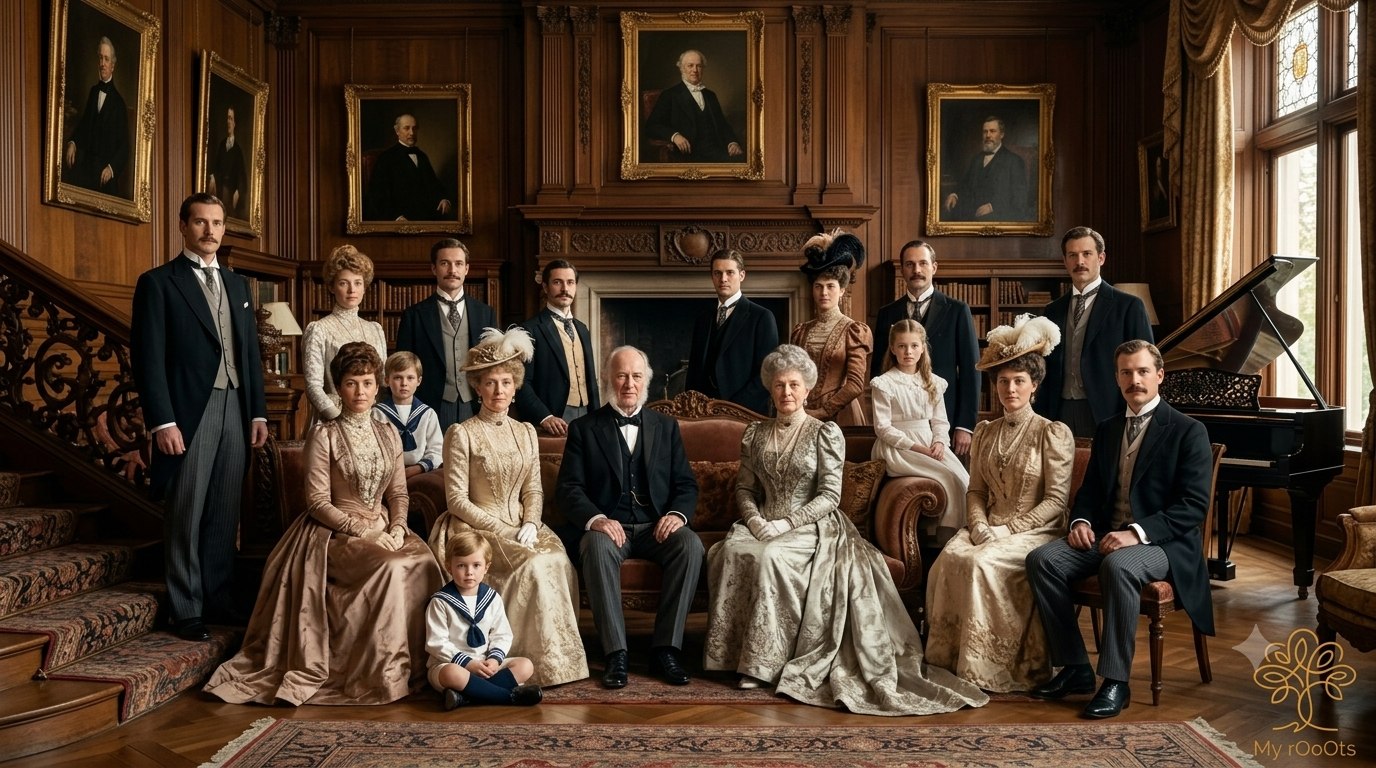
Vanderbilt Family Tree - America's Gilded Age Dynasty
The Vanderbilts are an American family who rose from Dutch farming stock on Staten Island to hold the largest private fortune in the United States, built by Cornelius Vanderbilt, known as the Commodore, out of nineteenth century shipping and railroads, and known today for the Gilded Age houses their descendants built and for figures from Consuelo, Duchess of Marlborough, to the journalist Anderson Cooper. ## Origins on Staten Island The family descends from Jan Aertsen van der Bilt, a Dutch settler who reached New Netherland in the seventeenth century and whose descendants farmed on Staten Island for generations. Cornelius Vanderbilt (1794-1877) was born there, the son of a boatman, and began work as a teenager carrying freight across New York Harbour in a single sailing barge. He married his first cousin Sophia Johnson in 1813. ## The railroad fortune Vanderbilt moved from sail to steam, dominated the Hudson River and coastal trade, and after the Civil War turned to railroads, consolidating the New York Central system and building Grand Central Depot. He left almost the whole fortune to one son, William Henry Vanderbilt, who nearly doubled it in eight years before dividing it evenly among his own eight children. They built the family's great houses: The Breakers and Marble House at Newport, Biltmore House in North Carolina, Hyde Park on the Hudson, Florham in New Jersey and Shelburne Farms in Vermont. ## Notable members The third and fourth generations produced Consuelo Vanderbilt, who married the 9th Duke of Marlborough and became a social reformer in England; the sculptor Gertrude Vanderbilt Whitney, founder of the Whitney Museum of American Art; Alfred Gwynne Vanderbilt, who died in the sinking of the Lusitania; and Harold Stirling Vanderbilt, who won the America's Cup three times and invented contract bridge. The modern line runs through Reginald Claypoole Vanderbilt to the designer Gloria Vanderbilt and her son, the CNN anchor Anderson Cooper. ## Significance No American family is more closely identified with the Gilded Age. The Vanderbilts set the pattern for how new industrial wealth was spent, and then for how quickly such a fortune disperses across many heirs. What endures is institutional: Vanderbilt University, the Whitney Museum, and the houses at Newport, Hyde Park, Shelburne and Asheville that are now museums and public estates. | Fact | Details | | --- | --- | | Founder | Cornelius Vanderbilt (1794-1877), the Commodore | | Origin | Staten Island, New York, of Dutch descent | | Source of wealth | Steamboat shipping, then the New York Central railroads | | Famous houses | The Breakers, Marble House, Biltmore House, Hyde Park | | Best known members | Consuelo Vanderbilt, Gertrude Vanderbilt Whitney, Gloria Vanderbilt, Anderson Cooper | | Generations covered | Five, from the Commodore to Anderson Cooper |
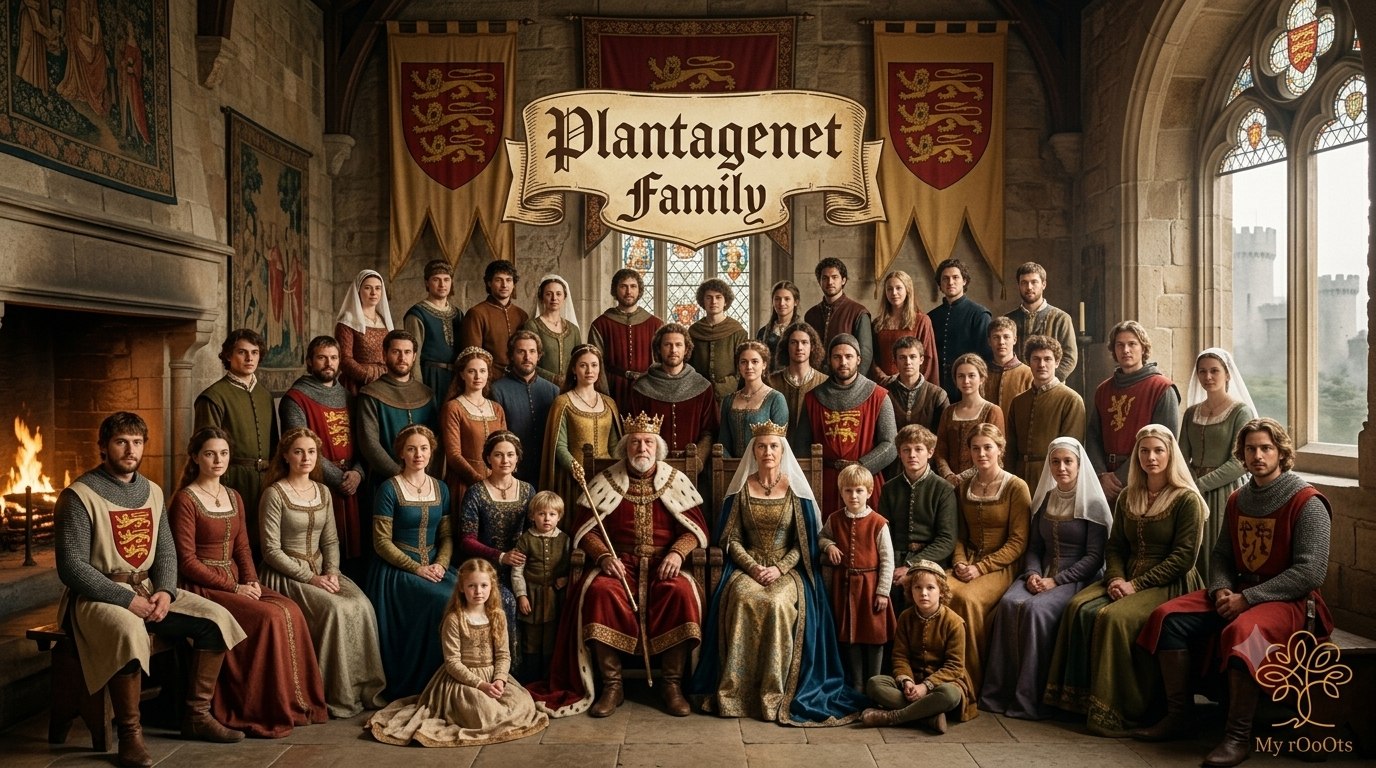
Plantagenet Family Tree - The House of Plantagenet from Henry II to Richard III
The House of Plantagenet was the royal dynasty that ruled England for 331 years, from the accession of Henry II in 1154 to the death of Richard III at the Battle of Bosworth in 1485, making it the longest-reigning royal house in English history. Fourteen Plantagenet kings held the throne in unbroken succession, and in the fifteenth century the family's two junior branches, the houses of Lancaster and York, fought each other for the crown in the civil wars later known as the Wars of the Roses. ## Origins The dynasty came from Anjou in western France. Geoffrey V, Count of Anjou, is said to have worn a sprig of broom, *planta genista*, in his cap, and from that nickname the family eventually took its name, although it was not used as an actual surname until Richard, 3rd Duke of York, adopted it in the 1440s. Geoffrey's marriage in 1128 to Empress Matilda, daughter and designated heir of Henry I of England, gave their son a claim to the English throne that he made good in 1154. With Normandy and Anjou behind him, and Aquitaine gained through his marriage to Eleanor of Aquitaine, Henry II ruled lands reaching from the Scottish border to the Pyrenees, the assemblage historians call the Angevin Empire. ## Notable members The early, or Angevin, kings are among the most familiar names in English history: Henry II, whose itinerant justices and sworn juries laid the foundations of the common law; Richard the Lionheart, a leading commander of the Third Crusade; and King John, who sealed Magna Carta at Runnymede in 1215. Henry III rebuilt Westminster Abbey, Edward I conquered Wales and summoned the Model Parliament, and Edward III opened the Hundred Years' War and founded the Order of the Garter. Later generations produced Edward the Black Prince, the victor of Poitiers, Henry V of Agincourt, and Richard III, whose lost grave was rediscovered in Leicester in 2012. ## Lancaster and York Edward III's many sons divided the dynasty. From his third surviving son, John of Gaunt, Duke of Lancaster, came Henry IV, Henry V and Henry VI, and, through Gaunt's Beaufort children, Margaret Beaufort and her son Henry VII. From his fourth son, Edmund of Langley, Duke of York, combined with the senior Mortimer descent from his second son, Lionel of Antwerp, came Richard, 3rd Duke of York, and his sons Edward IV and Richard III. The rivalry of those branches produced thirty years of intermittent civil war, ending when Henry Tudor defeated Richard III at Bosworth and married Elizabeth of York, uniting the red and white roses. ## Significance No other family has shaped English institutions so deeply. Under the Plantagenets, Magna Carta became a settled principle, parliament grew from an occasional royal council into a body whose consent was needed for taxation, the common law took its enduring form, and English displaced French as the language of the court. Their castles, abbeys and cathedrals still define the medieval landscape of England and Wales. | Fact | Details | | --- | --- | | Ruled | England, 1154 to 1485 | | Founder | Henry II, son of Geoffrey V of Anjou and Empress Matilda | | Place of origin | Anjou, France | | Kings | Fourteen, from Henry II to Richard III | | Branches | Angevin, Lancaster, York | | Emblems | The broom flower, the red rose of Lancaster, the white rose of York | | Last king | Richard III, killed at Bosworth in 1485 | | Legacy | Magna Carta, English common law, the growth of parliament |
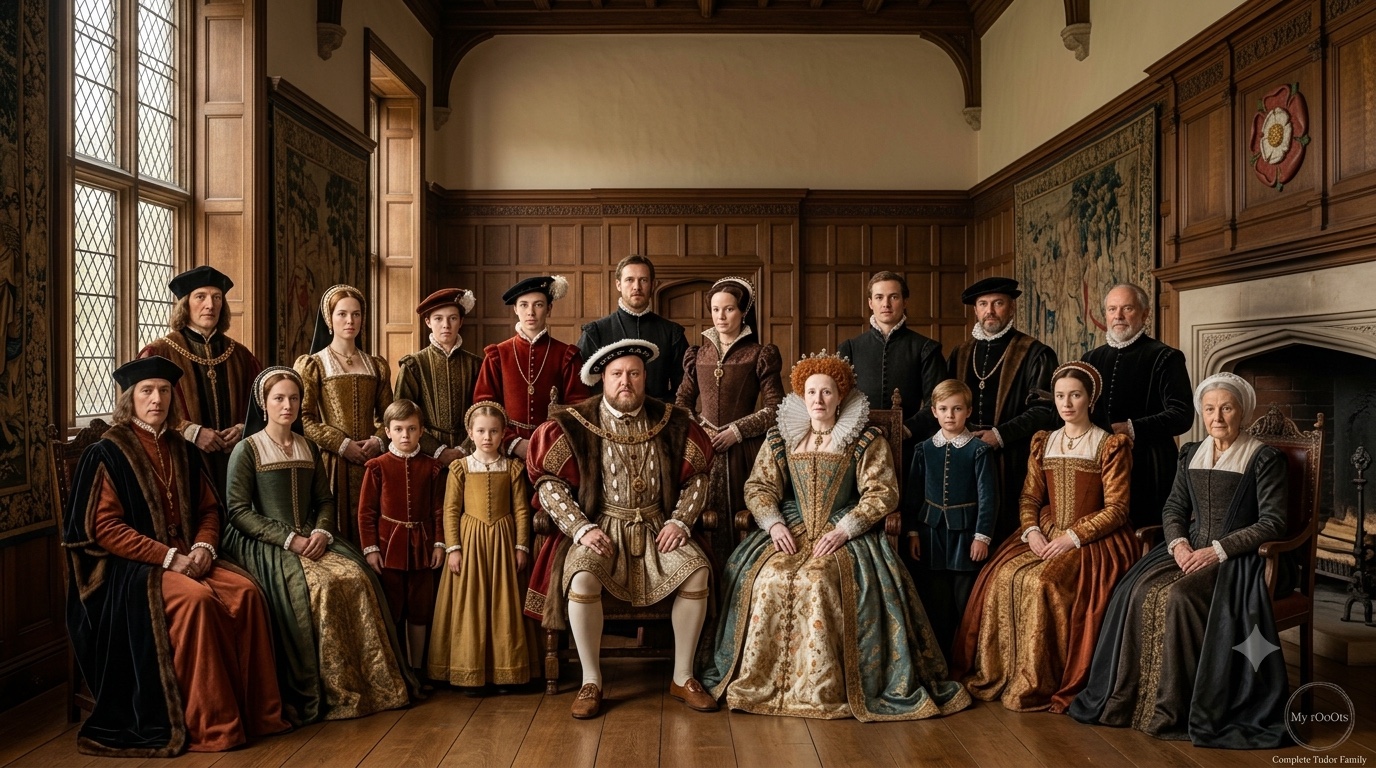
Tudor Family Tree - The House of Tudor from Henry VII to Elizabeth I
The House of Tudor was the royal family that ruled England and Wales from 1485 to 1603, founded by Henry VII after his victory at Bosworth Field and ending with the death of his granddaughter Elizabeth I. In five reigns the dynasty took England out of the Roman Catholic church, made the monarch the head of a national religion, and turned a peripheral kingdom into a naval and literary power. This tree follows the line from the Welsh courtier Owen Tudor and the dowager queen Catherine of Valois down to Elizabeth I, together with the Brandon, Grey and Clifford cousins and the Scottish line that ended in James VI and I. ## Origins The family name comes from Penmynydd in Anglesey, north Wales, where the Tudors were landed gentry in the service of the princes of Gwynedd. Owen Tudor came to the English court in the 1420s and married Catherine of Valois, the widow of Henry V. Their sons Edmund and Jasper Tudor were half-brothers of Henry VI, who raised them to earldoms in 1452. Edmund's marriage to Lady Margaret Beaufort, a great-granddaughter of John of Gaunt, added the senior Lancastrian claim to the throne, and their only child, born after his father's death, became Henry VII. His marriage to Elizabeth of York, eldest daughter of Edward IV, joined the two houses whose rivalry had driven the Wars of the Roses and gave the dynasty its red and white rose. ## Notable members Henry VII rebuilt the crown's finances and secured the new dynasty through marriage alliances with Spain and Scotland. Henry VIII married six times and broke with Rome, and his three surviving children each reigned in turn: Edward VI as a Protestant boy king, Mary I as the first queen to rule England in her own right, and Elizabeth I for forty-four years. Around them stand the cousins who carried royal blood without the crown, among them Lady Jane Grey, queen for nine days, her sisters Catherine and Mary Grey, and Margaret Pole, Countess of Salisbury, one of the last Plantagenets. ## The Scottish and Suffolk lines Henry VII's daughters carried the blood outward. Margaret Tudor married James IV of Scotland, and her line runs through James V and Mary, Queen of Scots, to James VI and I, who inherited England in 1603. Mary Tudor married Charles Brandon, 1st Duke of Suffolk, and their daughters Frances and Eleanor Brandon produced the Grey and Clifford claimants whom Henry VIII's will preferred over the Scottish descendants of his elder sister. ## Significance No English dynasty changed the country more in so few generations. The Tudors created the Church of England, absorbed the wealth of the monasteries into the crown, brought Wales formally into the English legal and parliamentary system, and built the navy that met the Spanish Armada. The Elizabethan settlement shaped English religion for centuries, and the Elizabethan decades produced Shakespeare, Spenser and the first English voyages to the Americas. When Elizabeth I died unmarried in 1603, the throne passed peacefully to her Scottish cousin, and the two crowns were joined in one person for the first time. | Fact | Details | |---|---| | Origin | Penmynydd, Anglesey, Wales | | Ruled | England, Wales and Ireland, 1485 to 1603 | | Founder | Owen Tudor, through his son Edmund Tudor | | Monarchs | Henry VII, Henry VIII, Edward VI, Mary I, Elizabeth I | | Emblem | The Tudor rose, red and white combined | | Principal seats | Richmond, Greenwich, Hampton Court and Whitehall palaces | | Ended | Death of Elizabeth I in 1603, succeeded by James VI of Scotland |
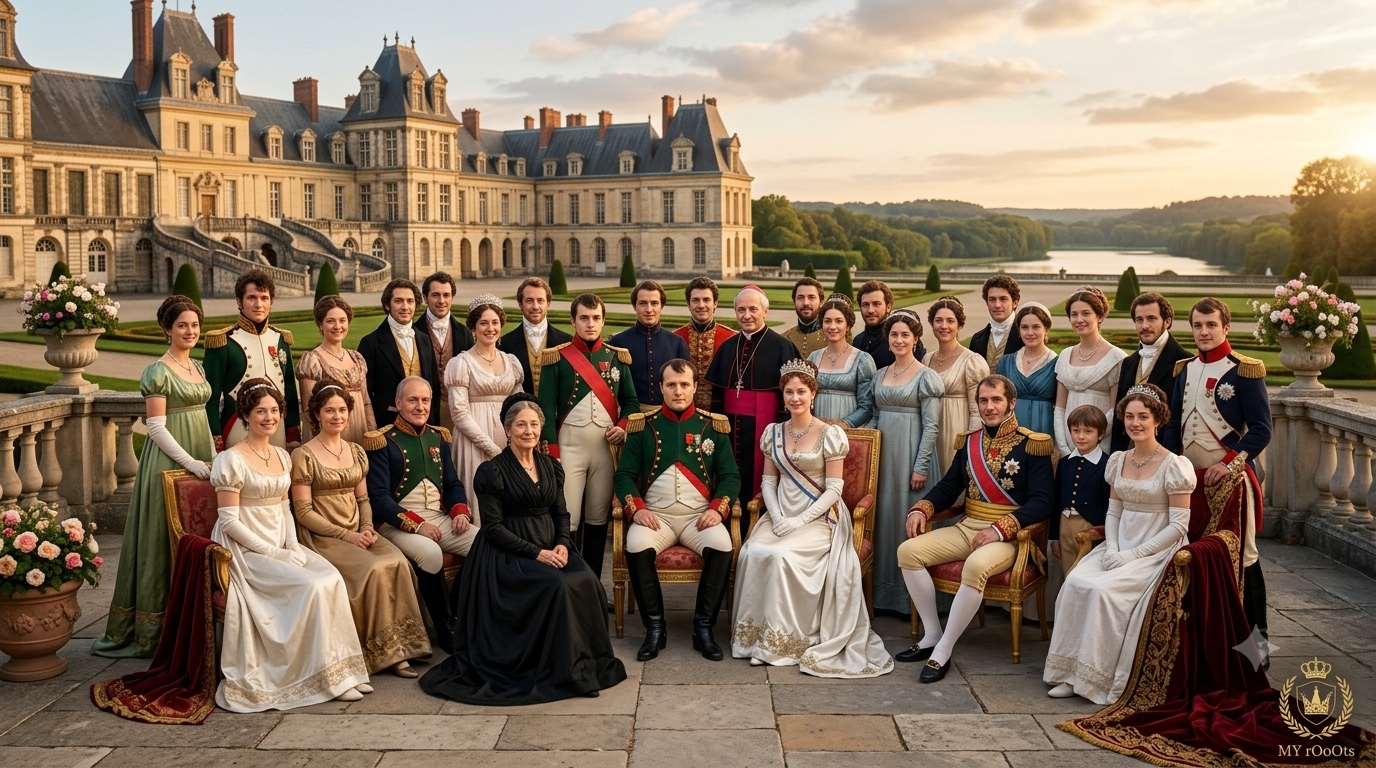
Bonaparte Family Tree - The House of Bonaparte from Napoleon I to Today
The House of Bonaparte is the French imperial dynasty founded by Napoleon I, a family of minor Corsican nobles from Ajaccio who within one generation ruled France and placed brothers and sisters on the thrones of Spain, Holland, Naples and Westphalia, and whose senior line survives today in Jean-Christophe, Prince Napoleon. The family descends from Carlo Buonaparte, an Ajaccio lawyer, and Letizia Ramolino, whose eight surviving children were born between 1768 and 1784 on an island that had only just passed from Genoese to French rule. The second son, Napoleon, became First Consul in 1799 and Emperor of the French in 1804, and the whole family rose with him. ## Origins in Corsica The Buonaparte were a patrician family of Ajaccio with roots traced to Tuscany, holding local office and a modest estate rather than great wealth. Carlo Buonaparte studied law at Pisa, served in the Corsican assembly and secured French recognition of the family's noble status, which opened the military academies of Brienne and Paris to his sons. After his death in 1785 Letizia Ramolino held the household together, later presiding over the imperial court as Madame Mere and outliving the Empire itself. ## Notable members Napoleon I is the figure the family is remembered for: general of the Italian and Egyptian campaigns, author of the Civil Code, and Emperor until his abdication in 1815 and exile on Saint Helena. His siblings became sovereigns in their own right, Joseph in Naples and Spain, Louis in Holland, Elisa in Tuscany, Caroline in Naples with her husband Joachim Murat, and Jerome in Westphalia. Napoleon's only legitimate son, Napoleon II, was titled King of Rome. The dynasty returned to power through Louis and Hortense de Beauharnais's son, who ruled as Napoleon III from 1852 to 1870 alongside Empress Eugenie. Later generations produced the ornithologist Charles Lucien Bonaparte and the celebrated Paris salon hostess Princess Mathilde. ## Significance No other modern European family moved so far so quickly, and few left as deep a mark. The Napoleonic Code still underpins the civil law of much of continental Europe and Latin America, while the Second Empire rebuilt Paris into the city of boulevards visitors see today. Two empires, two exiles and a princely line that continues in the present make the Bonapartes the most consequential of the newer European houses. | Fact | Details | | --- | --- | | Family name | Bonaparte, originally Buonaparte | | Place of origin | Ajaccio, Corsica, with earlier roots in Tuscany | | Founding couple | Carlo Buonaparte and Letizia Ramolino | | Best known member | Napoleon I, Emperor of the French | | Thrones held | France, Italy, Spain, Holland, Naples, Westphalia | | Imperial periods | First Empire 1804 to 1815, Second Empire 1852 to 1870 | | Current head of the house | Jean-Christophe, Prince Napoleon, born 1986 | | Generations in this tree | Five, from Carlo Buonaparte to Jean-Christophe |
Want your family here?
Build your family tree for free, then opt in from your family's settings page. Our team reviews every family before it's listed.