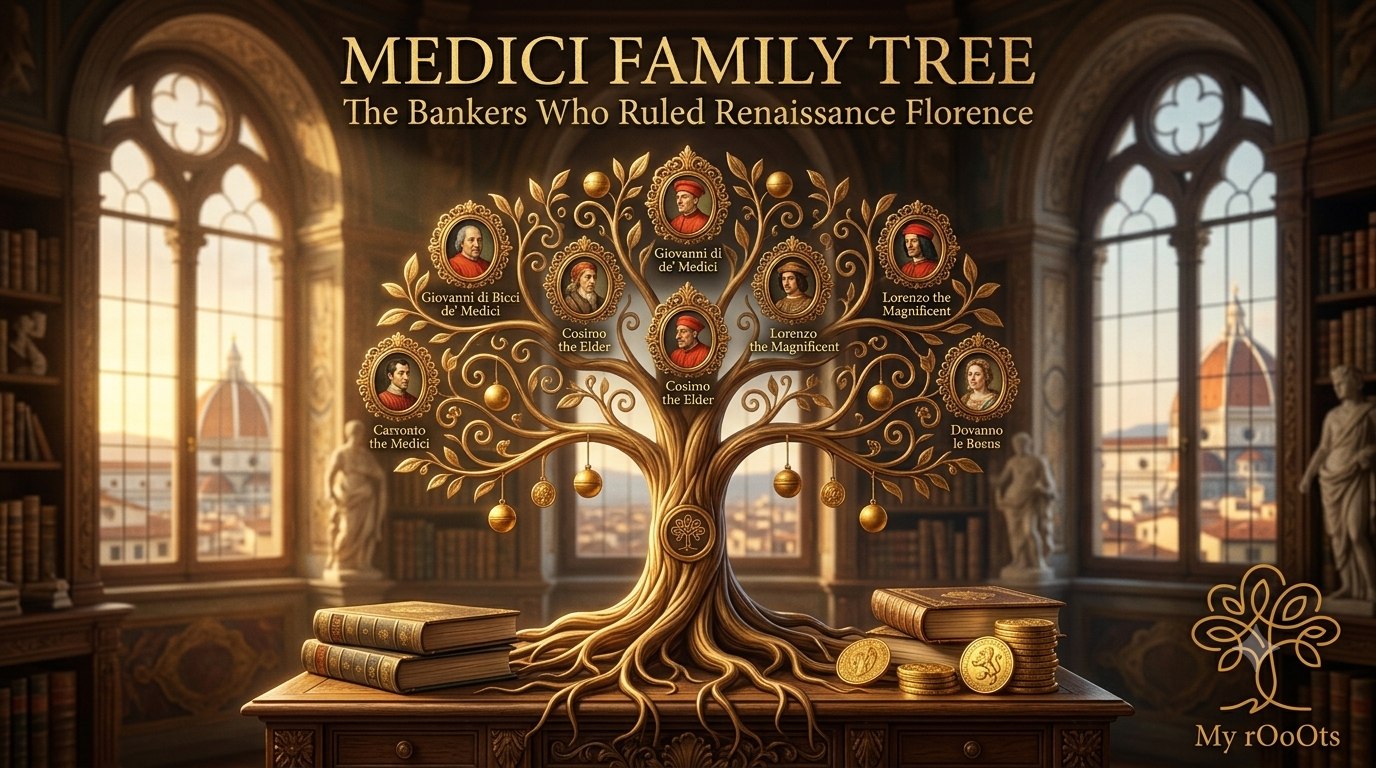
Medici Family Tree - The Bankers Who Ruled Renaissance Florence
The House of Medici was a Florentine banking family and political dynasty that rose from mercantile wealth in the late fourteenth century to dominate the Republic of Florence, produced two popes and two queens of France, and ruled as hereditary Grand Dukes of Tuscany for nearly two centuries before the direct male line died out in 1737.
## Origins
The family's fortune began with Giovanni di Bicci de' Medici, who founded the Medici Bank around 1397 and built it into one of the most trusted financial institutions in Europe through close ties to the papacy. His son Cosimo de' Medici turned that wealth into political dominance of Florence without ever holding a formal princely title, ruling through alliance, patronage, and public opinion for three decades. Cosimo's descendants, especially his grandson Lorenzo de' Medici, known as Lorenzo the Magnificent, consolidated the family's grip on the city while becoming the era's foremost patrons of Renaissance art and humanist scholarship.
## Notable Members
Lorenzo the Magnificent's sons included Giovanni, who became Pope Leo X, the first Medici pope, and whose cousin Giulio later reigned as Pope Clement VII. Lorenzo's granddaughter Catherine de' Medici became queen of France and, as regent, steered the country through the Wars of Religion; a later Medici, Marie de' Medici, likewise became queen of France as the second wife of Henry IV. When the senior line failed with the assassination of Alessandro de' Medici in 1537, the family's junior branch, descended from Cosimo the Elder's brother, provided Cosimo I de' Medici, who was crowned the first Grand Duke of Tuscany in 1569. His descendants, including the scientific patrons Cosimo II and Ferdinando II, ruled Tuscany until Gian Gastone de' Medici, the last Grand Duke, died without an heir in 1737. His sister, Anna Maria Luisa de' Medici, outlived him as the family's final member.
## Significance
Beyond their political rule, the Medici reshaped European culture through unmatched patronage: they backed Brunelleschi, Donatello, Botticelli, Michelangelo, and Galileo Galilei, and financed the buildings, art, and institutions that still define Florence today. Anna Maria Luisa's 1737 Patto di Famiglia bequeathed the family's entire art collection to the Tuscan state on the condition it never leave Florence, directly founding the holdings of the Uffizi Gallery and Pitti Palace.
| Fact | Details |
|---|---|
| Founded | c. 1397, Florence (Medici Bank) |
| Founder | Giovanni di Bicci de' Medici |
| Seat | Florence; later the Grand Duchy of Tuscany |
| Peak title | Grand Duke of Tuscany (from 1569) |
| Popes produced | Leo X (1513-1521), Clement VII (1523-1534) |
| Queens of France | Catherine de' Medici, Marie de' Medici |
| Dynasty ended | 1737 (Gian Gastone); 1743 (Anna Maria Luisa) |
| Lasting legacy | Uffizi Gallery and Pitti Palace collections |
mediciitalyflorence