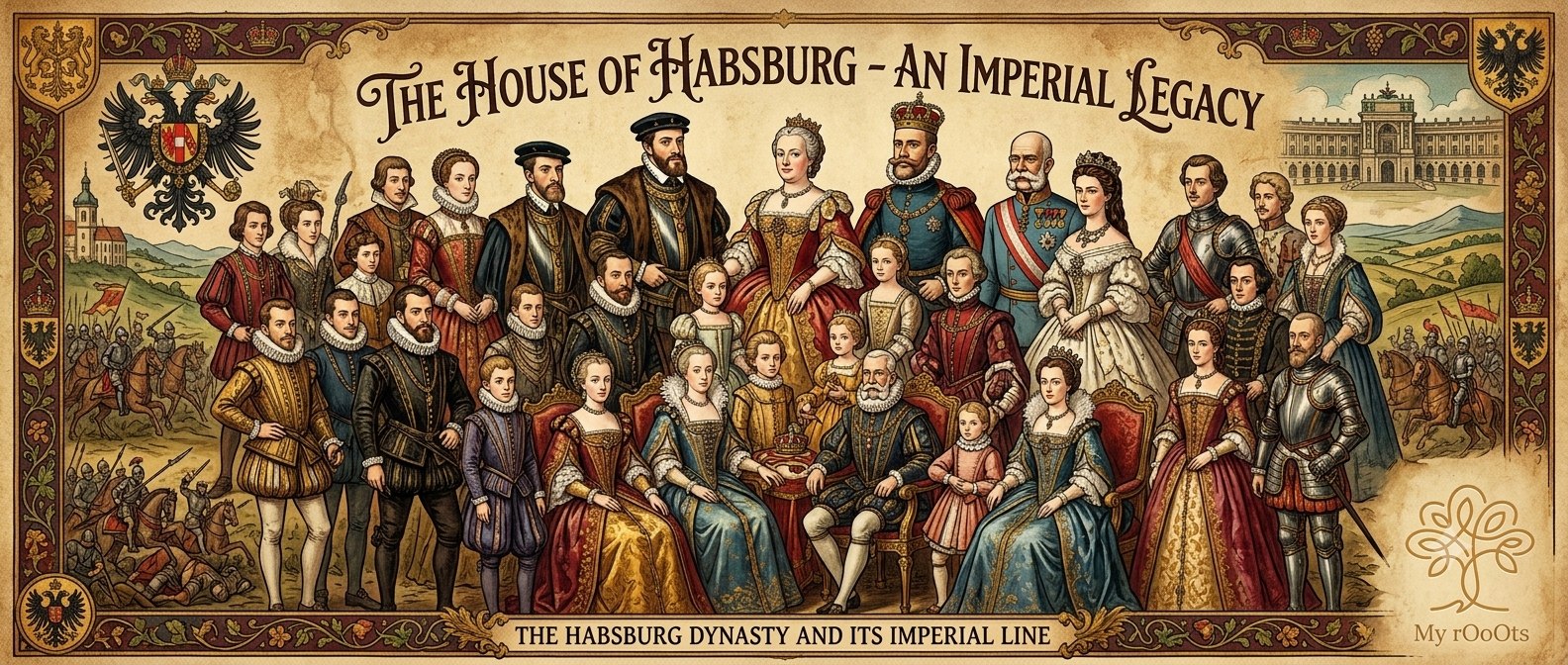
Habsburg Family Tree - The House of Habsburg
The House of Habsburg was one of the most powerful royal dynasties in European history, ruling Austria from 1282, supplying almost every Holy Roman Emperor between 1438 and the empire's dissolution in 1806, and reigning over Spain and its overseas empire from 1516 to 1700. Named for a castle in what is now Switzerland, the family rose from modest Swabian counts to sovereigns of lands stretching from the Danube to the Andes, and its senior line ended only in 1918 with the fall of Austria-Hungary.
## Origins
The dynasty takes its name from Habsburg Castle in the Aargau, in present-day Switzerland, held by a family of counts with scattered lands in Swabia and Alsace. Its fortunes changed in 1273, when the prince-electors chose Rudolf I as King of the Romans after a long interregnum. Rudolf defeated Ottokar II of Bohemia in 1278, took the duchies of Austria and Styria, and granted them to his sons, moving the family's centre of gravity permanently to Vienna. Two centuries later the marriage of Maximilian I to Mary of Burgundy, and of their son Philip the Handsome to Joanna of Castile, converted a regional Alpine power into a continental one within a single generation.
## Notable members
Charles V inherited Spain, the Netherlands, Austria, Naples and the Spanish Americas, and on his abdication in 1556 divided them: Spain and the Low Countries to his son Philip II, the Austrian lands and the imperial title to his brother Ferdinand I. The Spanish branch ran from Philip II through Philip III and Philip IV to Charles II, whose death in 1700 without an heir set off the War of the Spanish Succession. The Austrian branch ran from Ferdinand I through Ferdinand II and Ferdinand III to Charles VI, whose daughter Maria Theresa became the only woman to rule the Habsburg lands in her own right. Her marriage to Francis I Stephen of Lorraine founded the House of Habsburg-Lorraine, which produced Joseph II, Leopold II, Marie Antoinette, Francis II, and the long-reigning Franz Joseph I.
## Significance
For six centuries the Habsburgs shaped the map of Europe less by conquest than by marriage, holding together a multilingual realm of Germans, Hungarians, Czechs, Poles, Italians, Croats and others under a single crown. They led the Counter-Reformation, halted Ottoman expansion at Vienna in 1683, and gave Europe both the Thirty Years' War and the Congress system that followed Napoleon. The assassination of Archduke Franz Ferdinand in 1914 triggered the First World War, and the abdication of Charles I in 1918 ended Habsburg rule.
| Fact | Details |
| --- | --- |
| Founder of the royal line | Rudolf I of Habsburg, King of the Romans from 1273 |
| Family seat | Habsburg Castle, Aargau; later Vienna, Graz and Madrid |
| Height of power | Charles V (1500 to 1558), ruler of Spain, the Netherlands, Austria, Naples and Spanish America |
| Spanish line | Philip II to Charles II, 1556 to 1700 |
| Austrian line | Ferdinand I to Charles VI, 1521 to 1740 |
| Habsburg-Lorraine | From Maria Theresa and Francis I Stephen, 1736 onward |
| Last reigning monarch | Charles I of Austria, who left government in 1918 |
| Principal titles | Holy Roman Emperor, Emperor of Austria, King of Spain, Hungary and Bohemia |
habsburgfamily-treedynasty