Public Family Trees
Real families, shared by their owners and reviewed by our team - browse the stories and connections behind them.
Rothschild Family Tree - The European Banking Dynasty from Mayer Amschel to Today
The Rothschilds are a European banking dynasty founded in Frankfurt am Main by Mayer Amschel Rothschild (1744-1812), whose five sons established banking houses in Frankfurt, Vienna, Naples, London and Paris and together built the most powerful private financial network of the nineteenth century. ## Origins Mayer Amschel Rothschild was born in 1744 in the Judengasse, the walled Jewish street of Frankfurt am Main, where the family took its name from the red shield that had marked an ancestor's house. He began as a dealer in rare coins and medals, became court factor to Crown Prince Wilhelm of Hesse-Kassel in 1769, and turned that position into a banking business handling loans, bullion and government paper. With his wife Gutle Schnapper he had ten children who reached adulthood, five sons and five daughters. ## The five houses Mayer Amschel's decisive act was to place his sons in five cities so that the family could move money and news across borders as a single firm. Amschel Mayer stayed in Frankfurt, Salomon went to Vienna, Nathan to London, Carl to Naples and James to Paris. The brothers financed the allied campaigns against Napoleon, then the governments, railways and industries of nineteenth century Europe. The Naples house closed in 1860 with Italian unification, Frankfurt in 1901 for want of an heir, and Vienna in 1938 after the Anschluss. London and Paris survived, and their successors trade today as Rothschild and Co and the Edmond de Rothschild Group. ## Notable members Nathan Mayer Rothschild founded N M Rothschild and Sons and made London the centre of international lending. His son Lionel broke the bar on Jews sitting in Parliament, taking his Commons seat in 1858, and his grandson Nathan Mayer became the first Jewish member of the House of Lords in 1885. James Mayer de Rothschild dominated French finance under three regimes and bought Chateau Lafite, while his son Edmond funded the first Jewish agricultural settlements in Palestine. The family also produced naturalists and collectors rather than only bankers: Walter, 2nd Baron Rothschild, the zoologist to whom the Balfour Declaration was addressed in 1917; his brother Charles, the flea specialist who founded British nature conservation; Charles's daughter Dame Miriam Rothschild, a Fellow of the Royal Society; and another daughter, Nica, the patron of Thelonious Monk. Jacob, 4th Baron Rothschild, built RIT Capital Partners and chaired the trustees of the National Gallery. ## Significance The Rothschilds were the first banking family to operate as a genuinely international partnership, and for much of the nineteenth century they were the principal lenders to European states. Their name is attached to railways, mines, hospitals, museums, nature reserves, Bordeaux first growths and a long tradition of Jewish philanthropy. Repeated marriages between first cousins kept capital and control inside the family, which is why the branches of this tree cross back into one another so often. | Fact | Details | | --- | --- | | Founder | Mayer Amschel Rothschild (1744-1812) | | Matriarch | Gutle Schnapper (1753-1849) | | Origin | The Judengasse, Frankfurt am Main | | Children of the founder | Ten, five sons and five daughters | | The five houses | Frankfurt, Vienna, Naples, London, Paris | | Motto | Concordia, Integritas, Industria | | Principal firms | N M Rothschild and Sons, de Rothschild Freres, S. M. von Rothschild | | Still active today | Rothschild and Co, Edmond de Rothschild Group | | Known for | Government finance, railways, wine estates, natural history, art collections, philanthropy |
Rockefeller Family Tree - America's Oil and Philanthropy Dynasty
The Rockefeller family is an American business and philanthropic dynasty founded on the Standard Oil fortune of John D. Rockefeller, whose descendants have shaped American banking, conservation, medicine, modern art and national politics across five generations. From a modest upstate New York farmhouse the family rose to control the largest industrial enterprise of the Gilded Age, then spent the twentieth century converting that fortune into foundations, museums, parks and public office. ## Origins The line begins with William Avery Rockefeller (1810-1906), a traveling salesman from Granger, New York, and his wife Eliza Davison (1813-1889), who married in 1837 and raised six children in Richford, Moravia and Owego before the family moved to Ohio. Their eldest son, John D. Rockefeller, began as a Cleveland bookkeeper, entered oil refining in 1863 and incorporated the Standard Oil Company in 1870 together with his younger brother William Rockefeller. By the 1880s Standard Oil refined the great majority of American petroleum, until the Supreme Court ordered its dissolution in 1911. ## Notable members John D. Rockefeller and Laura Spelman Rockefeller had four children who reached adulthood, among them the Chicago arts patron Edith Rockefeller McCormick and the family's only son, John D. Rockefeller Jr. With Abby Aldrich Rockefeller, a co-founder of the Museum of Modern Art, John Jr. had six children who defined the family's public face: Abby "Babs" Rockefeller Mauze, the philanthropist John D. Rockefeller III, Nelson Rockefeller, who served four terms as Governor of New York and then as Vice President of the United States, the conservationist and venture capitalist Laurance Rockefeller, Winthrop Rockefeller, Governor of Arkansas, and the banker David Rockefeller of Chase Manhattan. Their children, known within the family as the Cousins, include Senator Jay Rockefeller of West Virginia, the Asmat art collector Michael Rockefeller, Lieutenant Governor Winthrop Paul Rockefeller of Arkansas, the economist Neva Goodwin and the Synergos founder Peggy Dulany. ## Significance The family's lasting mark is institutional rather than dynastic. The Rockefeller Foundation, the University of Chicago, Rockefeller University, the Rockefeller Brothers Fund, Rockefeller Center, the Museum of Modern Art, Colonial Williamsburg, Lincoln Center, the Asia Society and several national parks all trace their founding or their endowment to a Rockefeller. Few American families have moved so completely from industrial fortune to organized philanthropy and elected office within three generations. | Fact | Details | | --- | --- | | Surname | Rockefeller | | Origin | Richford, New York, United States | | Founder | John D. Rockefeller (1839-1937) | | Family business | Standard Oil, later Chase Manhattan Bank | | Known for | Standard Oil, the Rockefeller Foundation, Rockefeller Center, the Museum of Modern Art | | Public offices held | Vice President of the United States, Governor of New York, Governor of Arkansas, United States Senator | | Generations covered | Five, from William Avery Rockefeller to the fourth-generation Cousins |
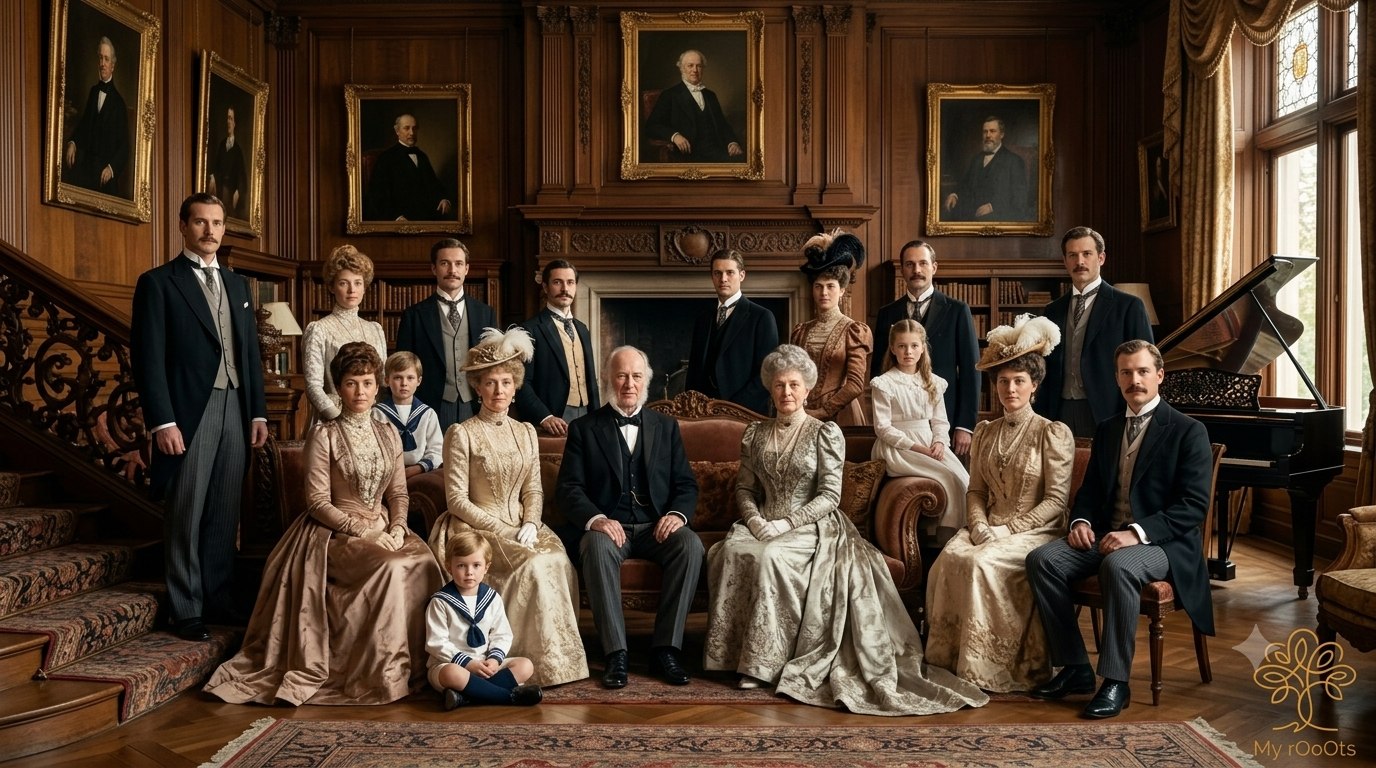
Vanderbilt Family Tree - America's Gilded Age Dynasty
The Vanderbilts are an American family who rose from Dutch farming stock on Staten Island to hold the largest private fortune in the United States, built by Cornelius Vanderbilt, known as the Commodore, out of nineteenth century shipping and railroads, and known today for the Gilded Age houses their descendants built and for figures from Consuelo, Duchess of Marlborough, to the journalist Anderson Cooper. ## Origins on Staten Island The family descends from Jan Aertsen van der Bilt, a Dutch settler who reached New Netherland in the seventeenth century and whose descendants farmed on Staten Island for generations. Cornelius Vanderbilt (1794-1877) was born there, the son of a boatman, and began work as a teenager carrying freight across New York Harbour in a single sailing barge. He married his first cousin Sophia Johnson in 1813. ## The railroad fortune Vanderbilt moved from sail to steam, dominated the Hudson River and coastal trade, and after the Civil War turned to railroads, consolidating the New York Central system and building Grand Central Depot. He left almost the whole fortune to one son, William Henry Vanderbilt, who nearly doubled it in eight years before dividing it evenly among his own eight children. They built the family's great houses: The Breakers and Marble House at Newport, Biltmore House in North Carolina, Hyde Park on the Hudson, Florham in New Jersey and Shelburne Farms in Vermont. ## Notable members The third and fourth generations produced Consuelo Vanderbilt, who married the 9th Duke of Marlborough and became a social reformer in England; the sculptor Gertrude Vanderbilt Whitney, founder of the Whitney Museum of American Art; Alfred Gwynne Vanderbilt, who died in the sinking of the Lusitania; and Harold Stirling Vanderbilt, who won the America's Cup three times and invented contract bridge. The modern line runs through Reginald Claypoole Vanderbilt to the designer Gloria Vanderbilt and her son, the CNN anchor Anderson Cooper. ## Significance No American family is more closely identified with the Gilded Age. The Vanderbilts set the pattern for how new industrial wealth was spent, and then for how quickly such a fortune disperses across many heirs. What endures is institutional: Vanderbilt University, the Whitney Museum, and the houses at Newport, Hyde Park, Shelburne and Asheville that are now museums and public estates. | Fact | Details | | --- | --- | | Founder | Cornelius Vanderbilt (1794-1877), the Commodore | | Origin | Staten Island, New York, of Dutch descent | | Source of wealth | Steamboat shipping, then the New York Central railroads | | Famous houses | The Breakers, Marble House, Biltmore House, Hyde Park | | Best known members | Consuelo Vanderbilt, Gertrude Vanderbilt Whitney, Gloria Vanderbilt, Anderson Cooper | | Generations covered | Five, from the Commodore to Anderson Cooper |
Want your family here?
Build your family tree for free, then opt in from your family's settings page. Our team reviews every family before it's listed.