Public Family Trees
Real families, shared by their owners and reviewed by our team - browse the stories and connections behind them.
Stuart Family Tree - The House of Stuart from Mary, Queen of Scots to Bonnie Prince Charlie
The House of Stuart was the royal dynasty that ruled Scotland from 1371 and both Scotland and England from 1603 until 1714, giving Britain fourteen monarchs from Robert II to Queen Anne as well as the Jacobite claimants who carried its cause into exile. Spelled Stewart in Scotland and Stuart after Mary, Queen of Scots adopted the French form, the family holds the unusual distinction of having united two crowns by inheritance rather than conquest, and of ending in a disputed succession that reshaped the British constitution. ## Origins The family took its name from its office. The Stewarts were hereditary High Stewards of Scotland, a post granted in the twelfth century to a Breton house settled in Renfrewshire. In 1315 Walter Stewart, 6th High Steward, married Marjorie Bruce, daughter of King Robert the Bruce. Their son became Robert II in 1371 when the direct Bruce line failed, and the stewardship turned into a crown. For more than two centuries afterwards the Stewarts ruled Scotland alone, through a run of reigns cut short by battle, captivity and long royal minorities that left the nobility unusually powerful. ## Notable members James IV, the most cultivated of the Scottish kings, married Margaret Tudor in 1503 and so planted the claim that would carry his descendants to the English throne. His granddaughter Mary, Queen of Scots became queen at six days old, reigned briefly and turbulently, and was deposed in 1567 and executed in England twenty years later. Her son, James VI of Scotland, inherited the English crown in 1603 as James I and became the first monarch to rule both kingdoms. His son Charles I lost the Civil Wars and his throne; Charles II returned at the Restoration in 1660; James II and VII was deposed in the Revolution of 1688, after which his daughters Mary II and Anne reigned in his place. In exile his son James Francis Edward Stuart and grandson Charles Edward Stuart, remembered as Bonnie Prince Charlie, led the Jacobite attempts to recover the throne, ending with the rising of 1745. ## Significance No other British dynasty changed the shape of the state so much. The Stuarts brought Scotland and England under one sovereign, presided over the King James Bible and the theatre of Shakespeare's late career, lost a king to Parliament, and provoked the settlements of 1689 and 1701 that made the monarchy answerable to Parliament and Protestant by statute. When Queen Anne died childless in 1714, the crown passed under the Act of Settlement to the descendants of her cousin Sophia of Hanover, granddaughter of James VI and I, so every British monarch since is still a Stuart descendant. | Fact | Details | | --- | --- | | Founder | Robert II, King of Scots from 1371 | | Ruled | Scotland 1371 to 1714; England and Ireland 1603 to 1714 | | Origin | Renfrewshire, Scotland | | Union of the Crowns | 1603, under James VI of Scotland and I of England | | Last reigning monarch | Anne, Queen of Great Britain, died 1714 | | Jacobite claimants | James Francis Edward, Charles Edward and Henry Benedict Stuart | | Succeeded by | The House of Hanover, through Sophia of Hanover |
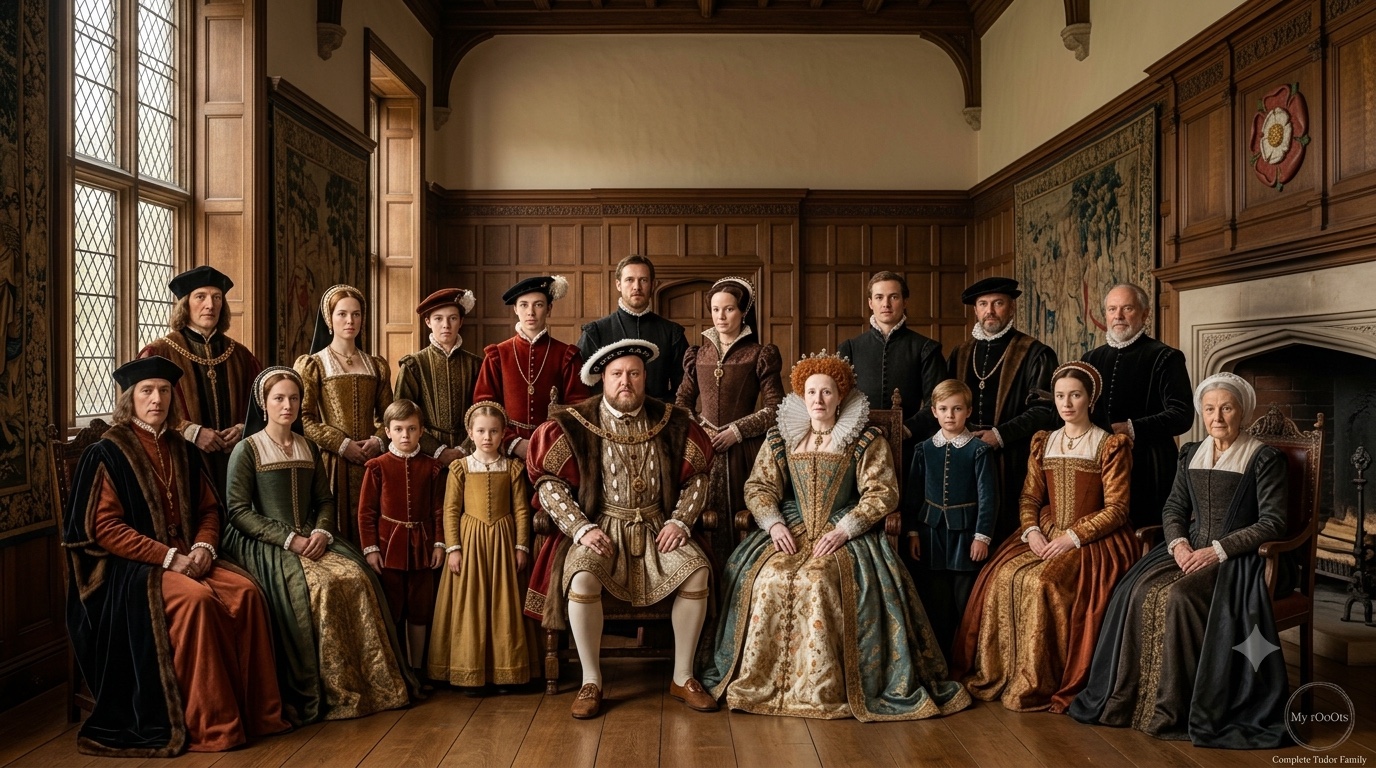
Tudor Family Tree - The House of Tudor from Henry VII to Elizabeth I
The House of Tudor was the royal family that ruled England and Wales from 1485 to 1603, founded by Henry VII after his victory at Bosworth Field and ending with the death of his granddaughter Elizabeth I. In five reigns the dynasty took England out of the Roman Catholic church, made the monarch the head of a national religion, and turned a peripheral kingdom into a naval and literary power. This tree follows the line from the Welsh courtier Owen Tudor and the dowager queen Catherine of Valois down to Elizabeth I, together with the Brandon, Grey and Clifford cousins and the Scottish line that ended in James VI and I. ## Origins The family name comes from Penmynydd in Anglesey, north Wales, where the Tudors were landed gentry in the service of the princes of Gwynedd. Owen Tudor came to the English court in the 1420s and married Catherine of Valois, the widow of Henry V. Their sons Edmund and Jasper Tudor were half-brothers of Henry VI, who raised them to earldoms in 1452. Edmund's marriage to Lady Margaret Beaufort, a great-granddaughter of John of Gaunt, added the senior Lancastrian claim to the throne, and their only child, born after his father's death, became Henry VII. His marriage to Elizabeth of York, eldest daughter of Edward IV, joined the two houses whose rivalry had driven the Wars of the Roses and gave the dynasty its red and white rose. ## Notable members Henry VII rebuilt the crown's finances and secured the new dynasty through marriage alliances with Spain and Scotland. Henry VIII married six times and broke with Rome, and his three surviving children each reigned in turn: Edward VI as a Protestant boy king, Mary I as the first queen to rule England in her own right, and Elizabeth I for forty-four years. Around them stand the cousins who carried royal blood without the crown, among them Lady Jane Grey, queen for nine days, her sisters Catherine and Mary Grey, and Margaret Pole, Countess of Salisbury, one of the last Plantagenets. ## The Scottish and Suffolk lines Henry VII's daughters carried the blood outward. Margaret Tudor married James IV of Scotland, and her line runs through James V and Mary, Queen of Scots, to James VI and I, who inherited England in 1603. Mary Tudor married Charles Brandon, 1st Duke of Suffolk, and their daughters Frances and Eleanor Brandon produced the Grey and Clifford claimants whom Henry VIII's will preferred over the Scottish descendants of his elder sister. ## Significance No English dynasty changed the country more in so few generations. The Tudors created the Church of England, absorbed the wealth of the monasteries into the crown, brought Wales formally into the English legal and parliamentary system, and built the navy that met the Spanish Armada. The Elizabethan settlement shaped English religion for centuries, and the Elizabethan decades produced Shakespeare, Spenser and the first English voyages to the Americas. When Elizabeth I died unmarried in 1603, the throne passed peacefully to her Scottish cousin, and the two crowns were joined in one person for the first time. | Fact | Details | |---|---| | Origin | Penmynydd, Anglesey, Wales | | Ruled | England, Wales and Ireland, 1485 to 1603 | | Founder | Owen Tudor, through his son Edmund Tudor | | Monarchs | Henry VII, Henry VIII, Edward VI, Mary I, Elizabeth I | | Emblem | The Tudor rose, red and white combined | | Principal seats | Richmond, Greenwich, Hampton Court and Whitehall palaces | | Ended | Death of Elizabeth I in 1603, succeeded by James VI of Scotland |
Want your family here?
Build your family tree for free, then opt in from your family's settings page. Our team reviews every family before it's listed.