Public Family Trees
Real families, shared by their owners and reviewed by our team - browse the stories and connections behind them.
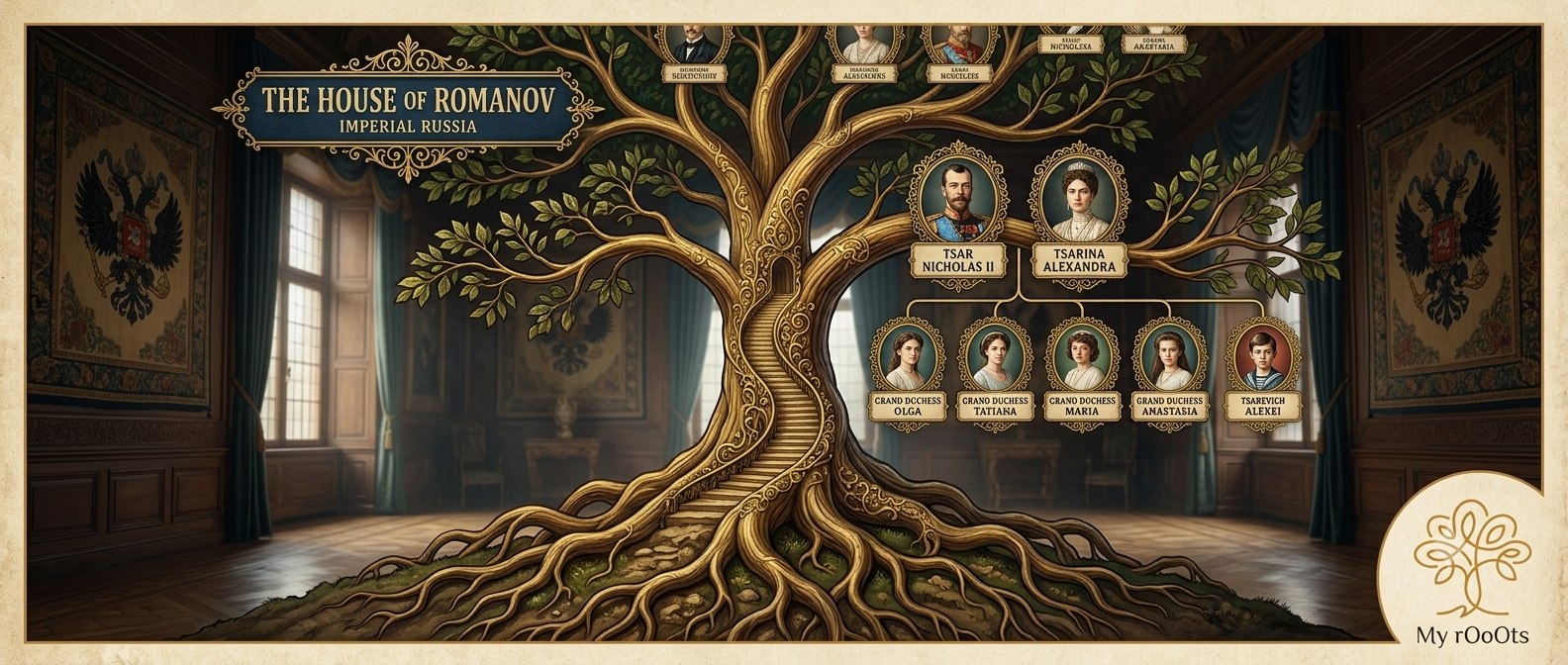
Romanov Family Tree - Tsar Nicholas II and the Last Imperial House of Russia
The Romanov family ruled the Russian Empire for more than three centuries, and this tree traces the dynasty's final direct line, from Emperor Nicholas I through to his great-great-grandson Nicholas II, the last Tsar of Russia, and the imperial household that perished with him in 1918. ## Origins of the Line The House of Romanov had governed Russia since 1613, but this tree begins with Nicholas I, who reigned from 1825 to 1855 and whose descendants form an unbroken line to the end of the dynasty. His son Alexander II, the 'Tsar Liberator' who abolished serfdom in 1861, married Maria Alexandrovna and fathered both his successor, Alexander III, and Grand Duke Sergei Alexandrovich, who later governed Moscow and married Elizabeth Feodorovna, elder sister of the future Empress Alexandra. Alexander III, who married Maria Feodorovna (born Princess Dagmar of Denmark), presided over a conservative, stable reign before his early death in 1894 brought his son Nicholas II to the throne at the age of twenty-six. ## The Last Imperial Family Nicholas II married Alexandra Feodorovna, born Princess Alix of Hesse and a granddaughter of Britain's Queen Victoria, in 1894. Their five children, Grand Duchesses Olga, Tatiana, Maria, and Anastasia, and Tsarevich Alexei, grew up largely secluded within the palaces of Tsarskoye Selo and Peterhof. Alexei's haemophilia, inherited through his mother, shaped the family's private life profoundly, drawing them into a controversial dependence on Grigori Rasputin. Nicholas's siblings, Grand Duke Michael Alexandrovich, Grand Duchess Xenia Alexandrovna, and Grand Duchess Olga Alexandrovna, lived through the same collapse: Michael was briefly named Nicholas's successor in March 1917 before declining the crown, ending over three centuries of Romanov rule, while Xenia and Olga escaped Russia with their mother in 1919 and lived out their lives in exile. ## Notable Members and Their Legacy Beyond the throne, this branch of the family produced figures remembered for reasons other than politics: Elizabeth Feodorovna, widowed in 1905, founded a Moscow convent devoted to charitable work; the four Romanov sisters served as wartime nurses; and Anastasia became the subject of one of the twentieth century's most persistent identity mysteries, with impostor claims lasting decades until DNA testing in 2007-2009 confirmed her fate. Nicholas II himself remains a defining figure of early twentieth-century history, his reign bridging the industrializing, autocratic Russia of his father and the revolutionary Russia that followed. ## Significance The direct line traced here represents the final chapter of Romanov rule: a family whose personal history, from Nicholas I's conservative autocracy to Nicholas II's abdication, mirrors Russia's turbulent transition from empire to revolution. Its members remain among the most documented and searched royal figures in history. | Fact | Details | |---|---| | Dynasty | House of Romanov | | Ruling dates covered | 1825-1917 (Nicholas I to Nicholas II's abdication) | | Last reigning Tsar | Nicholas II (r. 1894-1917) | | Root figure | Nicholas II | | Notable in-laws | Alexandra Feodorovna (Hesse), Maria Feodorovna (Denmark), Elizabeth Feodorovna (Hesse) | | End of dynasty's rule | March 1917, with Michael Alexandrovich's refusal of the throne |
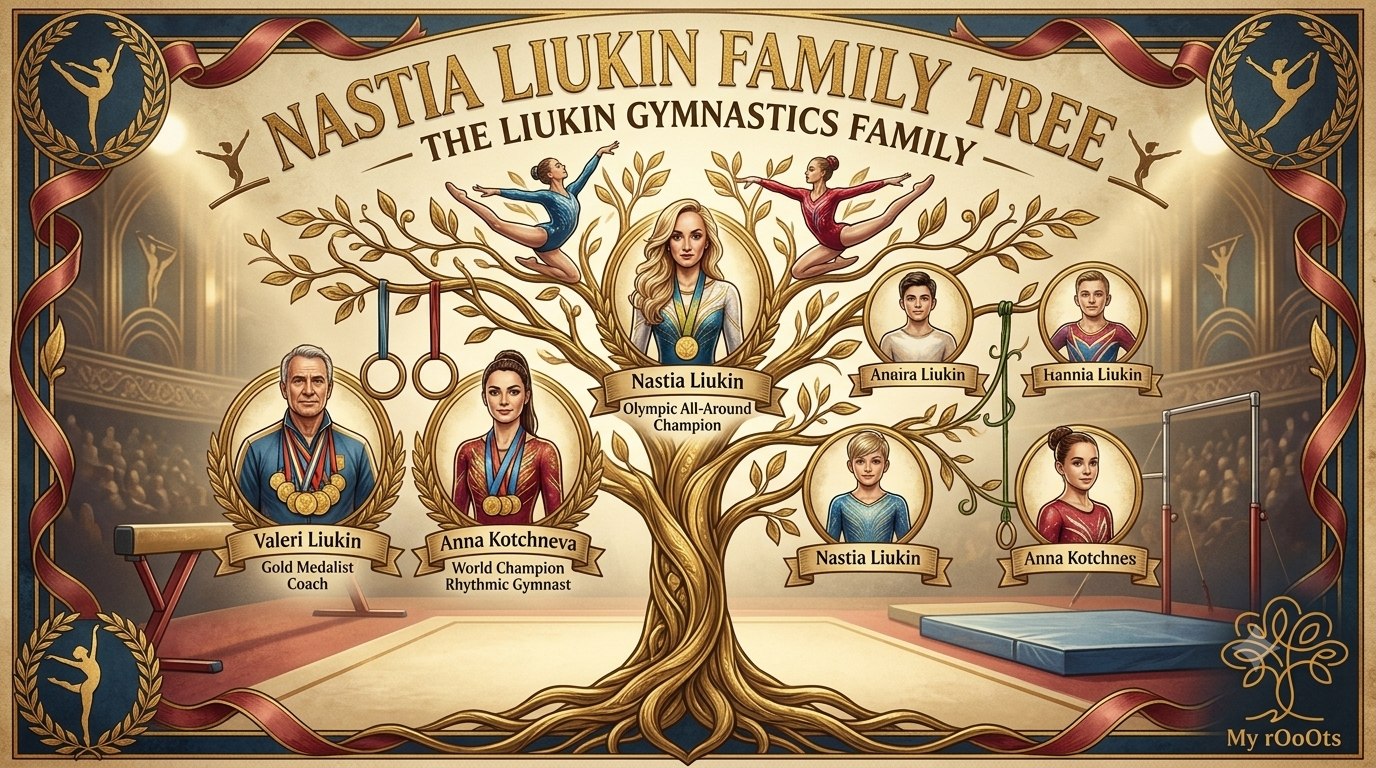
Nastia Liukin Family Tree - The Liukin Gymnastics Family
The Liukins are a gymnastics family of champions: Olympic gold medallist Valeri Liukin, world champion Anna Kotchneva and their daughter Nastia Liukin. Nastia won the 2008 Olympic all-around title. ## Origins Valeri Liukin was born in Aktyubinsk, in the Kazakh SSR, in 1966, and became one of the leading gymnasts of the Soviet team, the first to perform a triple back somersault on floor. Anna Kotchneva was born in Moscow in 1970 and won the clubs title at the 1987 World Rhythmic Gymnastics Championships. They married in 1988, the year Valeri won two Olympic golds in Seoul, and their daughter Anastasia, known as Nastia, was born in Moscow in October 1989. When Nastia was two and a half, the family emigrated to the United States, settling first in New Orleans and then in Texas. In 1994 Valeri and his business partner Yevgeny Marchenko opened the World Olympic Gymnastics Academy (WOGA) in Plano, where Valeri went on to coach his daughter. ## Notable members - **Nastia Liukin**, 2008 Olympic all-around champion with five medals in Beijing and nine World Championship medals. - **Valeri Liukin**, 1988 Olympic champion with the team and on high bar, and co-founder of WOGA. - **Anna Kotchneva**, 1987 world clubs champion in rhythmic gymnastics. ## Significance Few families have produced champions in two gymnastics disciplines across two countries. The Liukins carried a Soviet training tradition to Texas, and WOGA became one of the most successful clubs in American gymnastics, producing an Olympic all-around champion coached by her own father. | Fact | Details | |---|---| | Family roots | Aktyubinsk (Kazakhstan) and Moscow (Russia) | | Family home | Plano, Texas, United States | | Best-known member | Nastia Liukin, artistic gymnast | | Olympic champions | Valeri (1988), Nastia (2008) | | World champions | Valeri, Anna and Nastia | | Family gym | World Olympic Gymnastics Academy (WOGA), founded 1994 |
Want your family here?
Build your family tree for free, then opt in from your family's settings page. Our team reviews every family before it's listed.