Public Family Trees
Real families, shared by their owners and reviewed by our team - browse the stories and connections behind them.
Belgian Royal Family Tree - The House of Belgium from Leopold I to Princess Elisabeth
The Belgian royal family, formally the House of Belgium and dynastically a branch of the House of Saxe-Coburg and Gotha, is the reigning family of Belgium, founded when the German prince Leopold of Saxe-Coburg-Saalfeld accepted the throne of the newly independent kingdom in 1831 and continuing today through King Philippe and his heir, Princess Elisabeth, Duchess of Brabant. Belgium became independent from the Netherlands in 1830 and chose a constitutional monarchy. Its National Congress looked abroad for a sovereign who could balance French and British interests, and settled on Leopold, a widowed, well-connected and famously cautious prince who had already turned down the crown of Greece. He took the constitutional oath on 21 July 1831, still the Belgian national day. Seven monarchs have reigned since: Leopold I, Leopold II, Albert I, Leopold III, Baudouin, Albert II and Philippe. ## Origins The dynasty's roots are in the small Thuringian duchy of Saxe-Coburg, whose princes married into half the thrones of nineteenth-century Europe. Leopold I was the uncle of both Queen Victoria and her husband Prince Albert, and his second marriage, to Louise-Marie of Orleans, daughter of the French king Louis Philippe I, tied the new kingdom to Paris as well as London. The crown did not pass in a straight line: Leopold II's only son died at the age of nine, so the succession moved to Leopold II's brother Philippe, Count of Flanders, and then to Philippe's son, Albert I. Every Belgian monarch since 1909 descends from that collateral branch. ## Notable members Leopold II is the most studied and most criticised figure in the family, remembered for the industrial boom and monumental building of his reign and, above all, for his personal rule over the Congo Free State. Albert I and Queen Elisabeth of Bavaria became wartime symbols of Belgian resistance behind the Yser in 1914. Leopold III's surrender in 1940 and his conduct under occupation triggered the political crisis known as the Royal Question and ended in his abdication. Baudouin reigned for 42 years and presided over Congolese independence and Belgium's transformation into a federal state. Daughters of the house carried its blood outward: Charlotte became Empress Carlota of Mexico, Marie-Jose was the last Queen of Italy, and Josephine-Charlotte was Grand Duchess of Luxembourg. ## Significance In a country divided by language, the monarchy has been the one institution claimed by both Flemish and Walloon Belgians, and the king's role in brokering coalition governments remains politically real rather than ceremonial. The family has also changed with the country: equal succession was introduced in 1991, making Princess Elisabeth the first female Duchess of Brabant and the future first queen regnant of the Belgians, and in 2020 a court recognised Delphine of Saxe-Coburg as a daughter of Albert II. | Fact | Details | | --- | --- | | Dynasty | House of Belgium (Saxe-Coburg and Gotha) | | Country | Kingdom of Belgium | | Founder | Leopold I, King of the Belgians (1790-1865) | | Reigning since | 21 July 1831 | | Monarchs to date | Seven, from Leopold I to Philippe | | Current head | King Philippe (born 1960), reigning since 2013 | | Heir apparent | Princess Elisabeth, Duchess of Brabant (born 2001) | | Principal residences | Royal Palace of Brussels, Castle of Laeken | | Motto | L'union fait la force / Eendracht maakt macht |
Bernadotte Family Tree - The Swedish Royal House from Charles XIV John to Princess Estelle
The House of Bernadotte is the royal family of Sweden, founded by the French marshal Jean-Baptiste Bernadotte, who was elected Swedish crown prince in 1810 and reigned from 1818 as King Charles XIV John, and it has held the throne in an unbroken line ever since, down to King Carl XVI Gustaf, Crown Princess Victoria and Princess Estelle. ## Origins The dynasty began far from Sweden, in the Gascon town of Pau, where Jean-Baptiste Bernadotte was born in 1763 as the son of a provincial lawyer. He rose through the revolutionary French army to become a Marshal of the Empire and Prince of Pontecorvo. In 1810 the Swedish Riksdag, left without an heir after the deposition of Gustav IV Adolf and the accession of the childless Charles XIII, unexpectedly offered the succession to the French marshal. He accepted, converted to Lutheranism, took the name Charles John and in 1818 became king of both Sweden and Norway. His marriage to Desiree Clary, a Marseille merchant's daughter once engaged to Napoleon, produced the dynasty's second king, Oscar I. ## Notable members Oscar I's marriage to Josephine of Leuchtenberg, a granddaughter of the Empress Josephine, brought a descent from Sweden's older royal houses into the line, and Gustaf V's marriage to Victoria of Baden, a great granddaughter of the deposed Gustav IV Adolf, reinforced it. Later generations produced an unusual number of figures known for work outside the court: Prince Eugen, one of Sweden's foremost landscape painters; Gustaf VI Adolf, a working archaeologist and botanist; and Sigvard Bernadotte, an industrial designer. The family's daughters carried the name into the other Scandinavian monarchies and into Belgium: Ingrid became queen of Denmark, Astrid queen of the Belgians and Martha crown princess of Norway, which makes this tree a close relative of the Glucksburg line. ## Significance Under the Bernadottes the Swedish monarchy moved from real political power to a purely ceremonial role, settled by the constitution of 1974. In 1980 Sweden became the first monarchy to adopt full absolute primogeniture, making the infant Crown Princess Victoria heir ahead of her younger brother. Carl XVI Gustaf, who became heir at nine months old and king in 1973, is the longest reigning monarch in Swedish history. Several princes of the house lost their royal titles by marrying commoners and were created Counts of Wisborg by the Grand Duke of Luxembourg, a kinsman through Queen Sophia of Nassau, which is why the Bernadotte name is borne today both by a reigning royal house and by a line of counts. | Fact | Details | | --- | --- | | Family name | House of Bernadotte | | Country | Sweden, and Norway until 1905 | | Founder | Charles XIV John, born Jean-Baptiste Bernadotte (1763 to 1844) | | Reigning since | 1818 | | Monarchs | Charles XIV John, Oscar I, Charles XV, Oscar II, Gustaf V, Gustaf VI Adolf, Carl XVI Gustaf | | Current head | King Carl XVI Gustaf, reigning since 1973 | | Heir apparent | Crown Princess Victoria, Duchess of Vastergotland | | Principal residences | Stockholm Palace, Drottningholm Palace, Haga Palace | | Royal motto | "For Sweden, with the times" (Carl XVI Gustaf) |
Orange-Nassau Family Tree - The Dutch Royal House from William I to Catharina-Amalia
The House of Orange-Nassau is the royal family of the Netherlands, the dynasty that has given the country every monarch since William I was proclaimed king in 1815 and that is headed today by King Willem-Alexander, whose eldest daughter Catharina-Amalia, Princess of Orange, is heir to the throne. ## Origins The family takes its name from the principality of Orange in southern France and the German county of Nassau, brought together in the sixteenth century in the person of William of Orange, known as William the Silent, who led the Dutch revolt against Spanish rule. For more than two centuries his descendants served the Dutch Republic as stadtholders rather than sovereigns. The republic fell to French invasion in 1795 and the family went into exile in Britain and Prussia. It was William Frederick, son of the last stadtholder William V, who returned in 1813 as sovereign prince and in 1815 became the first King of the Netherlands as William I, ruling Luxembourg as grand duke at the same time. ## Notable members Seven generations descend from William I and his wife Wilhelmina of Prussia. His son William II commanded Dutch troops at Waterloo and accepted the liberal constitution of 1848 that turned the country into a parliamentary monarchy. The long reign of William III ended in a dynastic crisis: all three of his sons died before him, and the crown passed to Wilhelmina, the ten year old daughter of his second marriage to Emma of Waldeck and Pyrmont. Wilhelmina reigned for fifty eight years and became the voice of Dutch resistance, broadcasting from exile in London during the Second World War. Her daughter Juliana, remembered as the citizen queen, saw the Netherlands through decolonisation and the North Sea flood of 1953. Juliana's eldest daughter Beatrix reigned from 1980 to 2013, when she abdicated in favour of Willem-Alexander, the first Dutch king since 1890. ## Significance Three queens regnant in succession, Wilhelmina, Juliana and Beatrix, gave the Netherlands 123 years of unbroken female rule between 1890 and 2013, an unusual record among European monarchies. Each of them handed the crown on by abdication rather than at death, a Dutch habit the family has now followed four times. The monarchy itself was stripped of real political power in 1848 and has survived by adapting to it, trading authority for a bicycling, broadly informal public style that remains one of the most popular institutions in the country. The title Prince or Princess of Orange, held today by Catharina-Amalia, still marks the heir, and the family's colour gives the Netherlands its national orange. ## Quick facts | Fact | Details | | --- | --- | | House | Orange-Nassau (Oranje-Nassau) | | Country | Netherlands, with Luxembourg in personal union until 1890 | | First king | William I, reigned 1815 to 1840 | | Monarchs since 1815 | Seven: William I, William II, William III, Wilhelmina, Juliana, Beatrix, Willem-Alexander | | Current head | King Willem-Alexander, king since 30 April 2013 | | Heir apparent | Catharina-Amalia, Princess of Orange | | Principal residences | Noordeinde and Huis ten Bosch palaces, The Hague | | Motto | Je maintiendrai (I will maintain) |
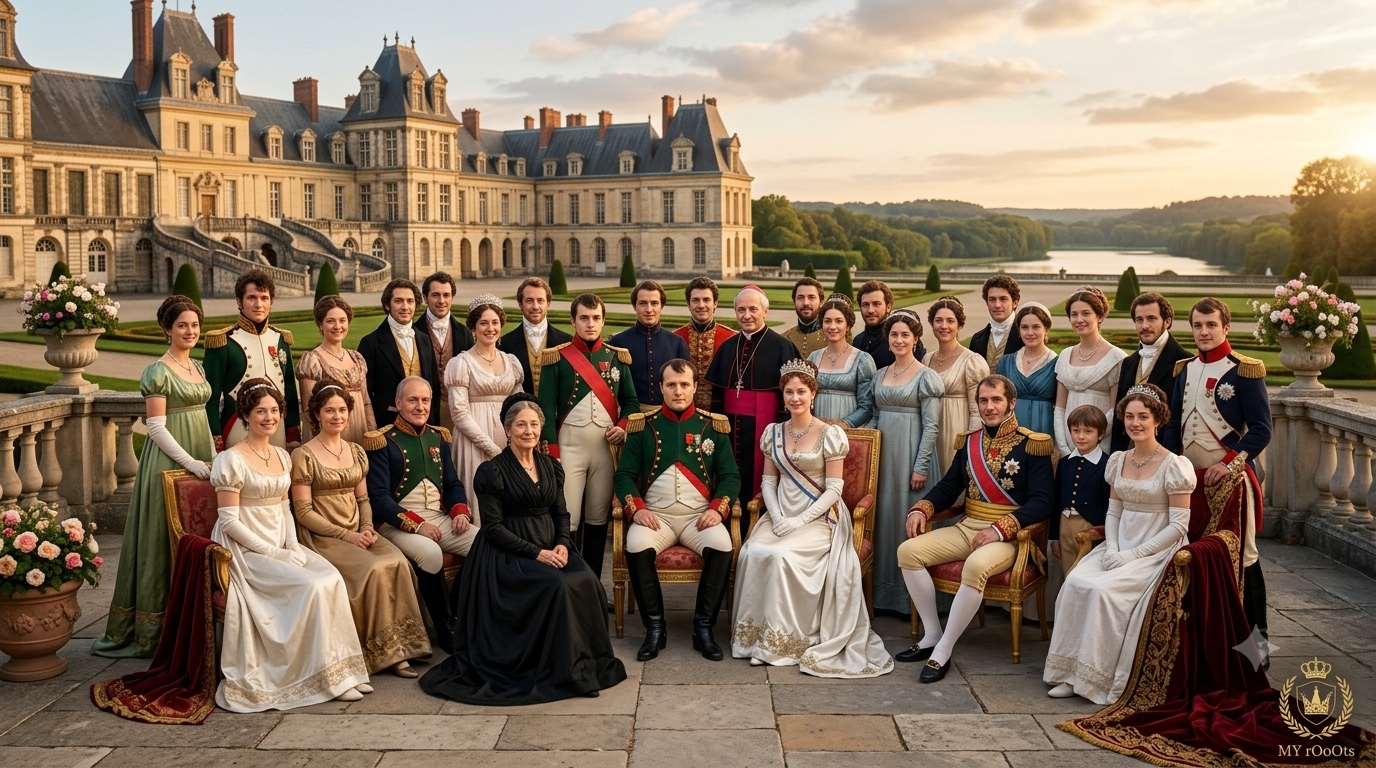
Bonaparte Family Tree - The House of Bonaparte from Napoleon I to Today
The House of Bonaparte is the French imperial dynasty founded by Napoleon I, a family of minor Corsican nobles from Ajaccio who within one generation ruled France and placed brothers and sisters on the thrones of Spain, Holland, Naples and Westphalia, and whose senior line survives today in Jean-Christophe, Prince Napoleon. The family descends from Carlo Buonaparte, an Ajaccio lawyer, and Letizia Ramolino, whose eight surviving children were born between 1768 and 1784 on an island that had only just passed from Genoese to French rule. The second son, Napoleon, became First Consul in 1799 and Emperor of the French in 1804, and the whole family rose with him. ## Origins in Corsica The Buonaparte were a patrician family of Ajaccio with roots traced to Tuscany, holding local office and a modest estate rather than great wealth. Carlo Buonaparte studied law at Pisa, served in the Corsican assembly and secured French recognition of the family's noble status, which opened the military academies of Brienne and Paris to his sons. After his death in 1785 Letizia Ramolino held the household together, later presiding over the imperial court as Madame Mere and outliving the Empire itself. ## Notable members Napoleon I is the figure the family is remembered for: general of the Italian and Egyptian campaigns, author of the Civil Code, and Emperor until his abdication in 1815 and exile on Saint Helena. His siblings became sovereigns in their own right, Joseph in Naples and Spain, Louis in Holland, Elisa in Tuscany, Caroline in Naples with her husband Joachim Murat, and Jerome in Westphalia. Napoleon's only legitimate son, Napoleon II, was titled King of Rome. The dynasty returned to power through Louis and Hortense de Beauharnais's son, who ruled as Napoleon III from 1852 to 1870 alongside Empress Eugenie. Later generations produced the ornithologist Charles Lucien Bonaparte and the celebrated Paris salon hostess Princess Mathilde. ## Significance No other modern European family moved so far so quickly, and few left as deep a mark. The Napoleonic Code still underpins the civil law of much of continental Europe and Latin America, while the Second Empire rebuilt Paris into the city of boulevards visitors see today. Two empires, two exiles and a princely line that continues in the present make the Bonapartes the most consequential of the newer European houses. | Fact | Details | | --- | --- | | Family name | Bonaparte, originally Buonaparte | | Place of origin | Ajaccio, Corsica, with earlier roots in Tuscany | | Founding couple | Carlo Buonaparte and Letizia Ramolino | | Best known member | Napoleon I, Emperor of the French | | Thrones held | France, Italy, Spain, Holland, Naples, Westphalia | | Imperial periods | First Empire 1804 to 1815, Second Empire 1852 to 1870 | | Current head of the house | Jean-Christophe, Prince Napoleon, born 1986 | | Generations in this tree | Five, from Carlo Buonaparte to Jean-Christophe |
Want your family here?
Build your family tree for free, then opt in from your family's settings page. Our team reviews every family before it's listed.