Public Family Trees
Real families, shared by their owners and reviewed by our team - browse the stories and connections behind them.
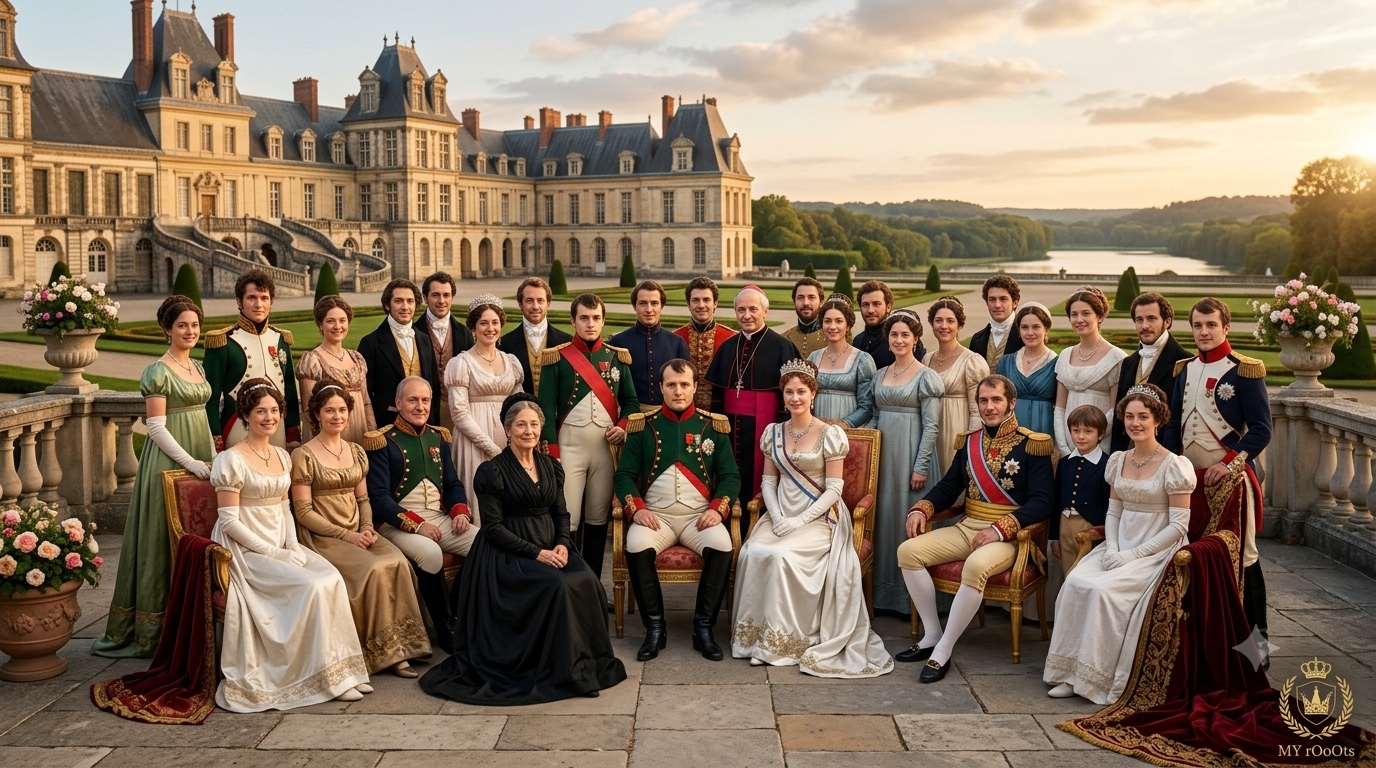
Bonaparte Family Tree - The House of Bonaparte from Napoleon I to Today
The House of Bonaparte is the French imperial dynasty founded by Napoleon I, a family of minor Corsican nobles from Ajaccio who within one generation ruled France and placed brothers and sisters on the thrones of Spain, Holland, Naples and Westphalia, and whose senior line survives today in Jean-Christophe, Prince Napoleon. The family descends from Carlo Buonaparte, an Ajaccio lawyer, and Letizia Ramolino, whose eight surviving children were born between 1768 and 1784 on an island that had only just passed from Genoese to French rule. The second son, Napoleon, became First Consul in 1799 and Emperor of the French in 1804, and the whole family rose with him. ## Origins in Corsica The Buonaparte were a patrician family of Ajaccio with roots traced to Tuscany, holding local office and a modest estate rather than great wealth. Carlo Buonaparte studied law at Pisa, served in the Corsican assembly and secured French recognition of the family's noble status, which opened the military academies of Brienne and Paris to his sons. After his death in 1785 Letizia Ramolino held the household together, later presiding over the imperial court as Madame Mere and outliving the Empire itself. ## Notable members Napoleon I is the figure the family is remembered for: general of the Italian and Egyptian campaigns, author of the Civil Code, and Emperor until his abdication in 1815 and exile on Saint Helena. His siblings became sovereigns in their own right, Joseph in Naples and Spain, Louis in Holland, Elisa in Tuscany, Caroline in Naples with her husband Joachim Murat, and Jerome in Westphalia. Napoleon's only legitimate son, Napoleon II, was titled King of Rome. The dynasty returned to power through Louis and Hortense de Beauharnais's son, who ruled as Napoleon III from 1852 to 1870 alongside Empress Eugenie. Later generations produced the ornithologist Charles Lucien Bonaparte and the celebrated Paris salon hostess Princess Mathilde. ## Significance No other modern European family moved so far so quickly, and few left as deep a mark. The Napoleonic Code still underpins the civil law of much of continental Europe and Latin America, while the Second Empire rebuilt Paris into the city of boulevards visitors see today. Two empires, two exiles and a princely line that continues in the present make the Bonapartes the most consequential of the newer European houses. | Fact | Details | | --- | --- | | Family name | Bonaparte, originally Buonaparte | | Place of origin | Ajaccio, Corsica, with earlier roots in Tuscany | | Founding couple | Carlo Buonaparte and Letizia Ramolino | | Best known member | Napoleon I, Emperor of the French | | Thrones held | France, Italy, Spain, Holland, Naples, Westphalia | | Imperial periods | First Empire 1804 to 1815, Second Empire 1852 to 1870 | | Current head of the house | Jean-Christophe, Prince Napoleon, born 1986 | | Generations in this tree | Five, from Carlo Buonaparte to Jean-Christophe |
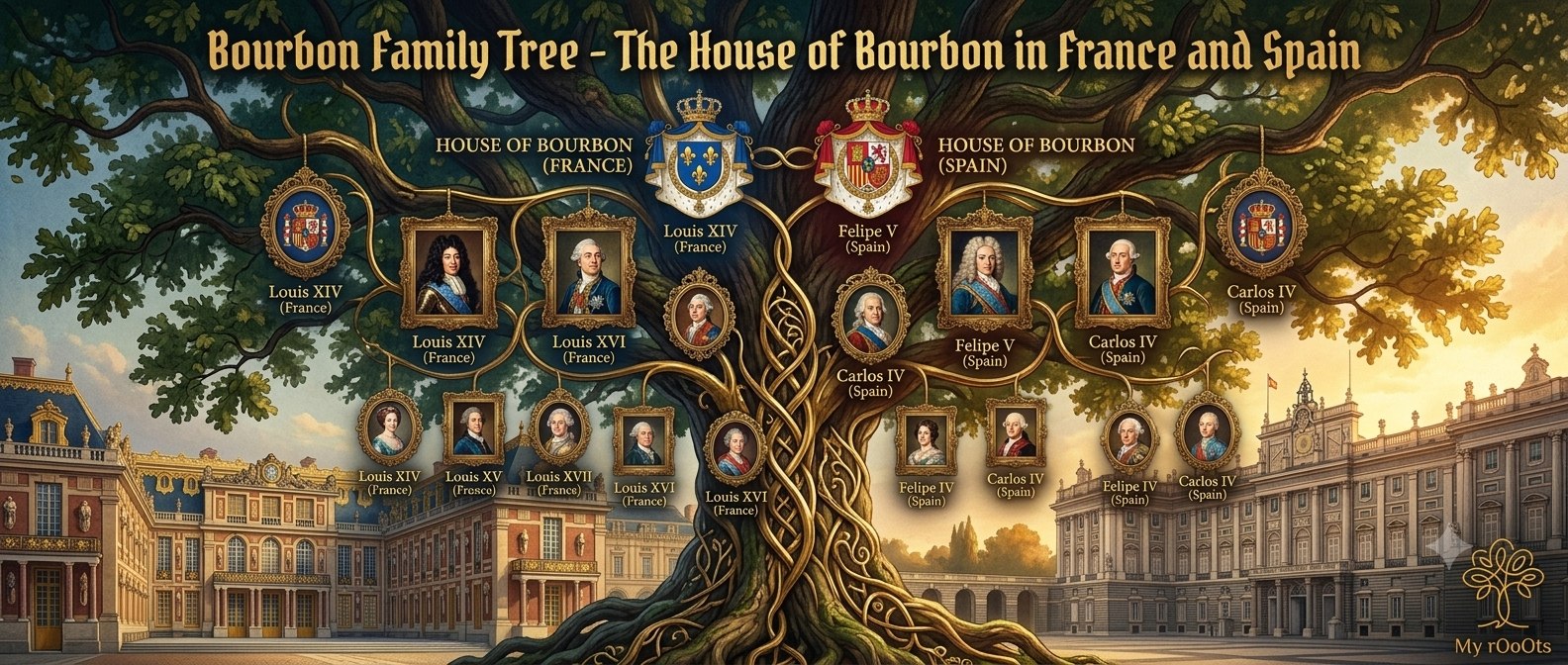
Bourbon Family Tree - The House of Bourbon in France and Spain
The House of Bourbon is a European royal dynasty, descended in the male line from the Capetian kings of France, that ruled France from 1589 to 1792 and again from 1814 to 1848, and that still reigns in Spain today under King Felipe VI. Over four centuries its members also held the thrones of Navarre, Naples and Sicily, Parma and Etruria, which makes it one of the most widely established royal houses in European history. ## Origins The family takes its name from the lordship of Bourbon in the Auvergne, centred on Bourbon-l'Archambault. Its royal line descends from Robert, Count of Clermont, a younger son of King Louis IX of France, whose marriage to Beatrice of Burgundy, heiress of Bourbon, carried the name into the Capetian house in 1272. For three centuries afterwards the Bourbons were powerful French princes of the blood rather than kings. That changed with Antoine de Bourbon, Duke of Vendome, whose marriage to Jeanne d'Albret, queen regnant of Navarre, produced Henry of Navarre. When the Valois line died out in 1589, Henry was the senior Capetian heir, and he took the French throne as Henry IV. ## Notable members Henry IV ended the French Wars of Religion and issued the Edict of Nantes in 1598. His son Louis XIII, guided by Cardinal Richelieu, built the centralised state that Louis XIV, the Sun King, carried to its height across a reign of seventy-two years, the longest of any European sovereign, and to the palace of Versailles. Louis XV and then Louis XVI inherited that system, and Louis XVI and his queen, Marie Antoinette, were swept away by the French Revolution in 1792. The dynasty returned with Louis XVIII in 1814 and Charles X in 1824, and in 1830 the crown passed to Louis Philippe I of the cadet House of Orleans, the last king to rule in France. ## The Spanish branch In 1700 the childless Charles II of Spain left his crown to Philip, Duke of Anjou, a grandson of Louis XIV. Philip became Philip V, the first Bourbon king of Spain, at the cost of the War of the Spanish Succession, which ended with his renunciation of any claim to the French throne. His descendants include the reforming Charles III, Ferdinand VII, Isabella II, Alfonso XII and Alfonso XIII, who left Spain in 1931. The monarchy was restored in 1975 under Juan Carlos I, grandson of Alfonso XIII, who presided over Spain's transition to democracy and abdicated in 2014 in favour of his son Felipe VI. Felipe's elder daughter Leonor, Princess of Asturias, is heir to the throne. ## Significance No other family links the absolute monarchy of Versailles to a working constitutional monarchy in twenty-first century Madrid. Bourbon marriages tied the house to the Habsburgs of Austria and Spain, the dukes of Savoy, the Medici of Florence and the British royal family, so a Bourbon family tree doubles as a map of European dynastic politics from the Reformation to the present day. | Fact | Details | | --- | --- | | Family name | House of Bourbon (Maison de Bourbon, Casa de Borbon) | | Place of origin | Bourbon-l'Archambault, Auvergne, France | | Founder of the line | Robert, Count of Clermont (1256-1317), son of Louis IX | | First king of France | Henry IV, reigned 1589 to 1610 | | Last king to rule France | Louis Philippe I, reigned 1830 to 1848 | | First king of Spain | Philip V, reigned 1700 to 1746 | | Head of the house in Spain | King Felipe VI, since 2014 | | Heir in Spain | Leonor, Princess of Asturias | | Principal seats | Versailles, Fontainebleau, the Louvre, the Royal Palace of Madrid |
Want your family here?
Build your family tree for free, then opt in from your family's settings page. Our team reviews every family before it's listed.