Public Family Trees/Hohenzollern Family Tree - Prussia's Royal House from Frederick the Great to Kaiser Wilhelm II
Hohenzollern Family Tree - Prussia's Royal House from Frederick the Great to Kaiser Wilhelm II
Explore 53 people across 13 generations of the Hohenzollern family, built with My rOoOts.
53
People
13
Generations
2
Living
51
Passed on
16
Marriages
63 yrs
Avg. lifespan
Family Tree
53 members mapped across 13 generations
Loading family tree…
Your turn
Build a tree like this for your own family
Free, with no sign-up to start. Add yourself, then your parents and grandparents, and watch it grow.
About the Hohenzollern family
The House of Hohenzollern is the German dynasty that ruled Brandenburg from 1415, held the Prussian crown from 1701, and gave Germany its three emperors between 1871 and the fall of the monarchy in 1918. This tree follows the senior Prussian line in one unbroken descent, from Frederick William the Great Elector, through the kings of Prussia and the German Emperors, down to Georg Friedrich, Prince of Prussia, the present head of the house.
At a glance
- Family name
- Hohenzollern
- Place of origin
- Hohenzollern Castle, Swabia, southern Germany
- Ruled
- Brandenburg from 1415, Prussia from 1618, Germany from 1871
- Royal title
- King in Prussia from 1701, King of Prussia from 1772
- Imperial title
- German Emperor, 1871 to 1918
- German Emperors
- Wilhelm I, Frederick III, Wilhelm II
- Monarchy ended
- 9 November 1918
- Present head of the house
- Georg Friedrich, Prince of Prussia, since 1994
- Principal residences
- Berlin City Palace, Sanssouci and Cecilienhof at Potsdam, Charlottenburg
- Branch shown here
- The senior Prussian line only, not Hohenzollern-Sigmaringen
13 generations, 1627 to 1976
1627
Gen 1
Louise Henriette of Nassau1657
Gen 2
Frederick I of Prussia1688
Gen 3
Frederick William I of Prussia1709
Gen 4
Wilhelmine of Prussia1744
Gen 5
Frederick William II of Prussia1770
Gen 6
Frederick William III of Prussia1795
Gen 7
Frederick William IV of Prussia1831
Gen 8
Frederick III of Germany1859
Gen 9
Wilhelm II of Germany1883
Gen 10
Eitel Friedrich of Prussia1909
Gen 11
Hubertus of Prussia1940
Gen 12
Michael of Prussia1976
Gen 13
Georg Friedrich of Prussia
Read the full historyHide the full history
Origins
The family takes its name from Hohenzollern Castle on a hill in the Swabian Alb, where a line of counts is recorded from the eleventh century. A Swabian Zollern married into the burgraviate of Nuremberg in 1192, and the Franconian branch that grew from it spent two centuries accumulating lands and credit with the Holy Roman Emperors. The decisive moment came in 1415, when Emperor Sigismund invested Frederick VI of Nuremberg as Elector of Brandenburg in return for his political and financial support. The Duchy of Prussia, a separate inheritance lying outside the Empire, passed to the Brandenburg electors in 1618, and Frederick William, the Great Elector, welded the two into a single functioning state after the devastation of the Thirty Years' War.
Notable members
Frederick I turned the electorate into a kingdom in 1701. His son Frederick William I, the Soldier King, built the army and the treasury that his own son, Frederick the Great, used to seize Silesia and to make Prussia a European power, while also composing music, building Sanssouci and corresponding with Voltaire. Queen Louise became the emotional centre of Prussian resistance to Napoleon. Wilhelm I, with Otto von Bismarck as his minister president, was proclaimed German Emperor at Versailles in 1871. His son Frederick III and the liberal English princess he married, Victoria, daughter of Queen Victoria, reigned for only ninety nine days. Wilhelm II, the last Kaiser, abdicated in 1918 and died in Dutch exile in 1941.
Significance
No other German family shaped the modern state so directly. Hohenzollern rulers created the Prussian civil service, compulsory schooling and the general staff, sponsored the Berlin academies and the Humboldt university model, and then used Prussian power to unify Germany around themselves. The monarchy ended with the revolution of November 1918, but the house continues as a private family: the headship passed from Wilhelm II to his eldest son, then to Louis Ferdinand, and in 1994 to Georg Friedrich, whose own father and uncles are part of the succession story told in this tree.
Quick facts
Notable Members
Key figures from 13 generations of the Hohenzollern family
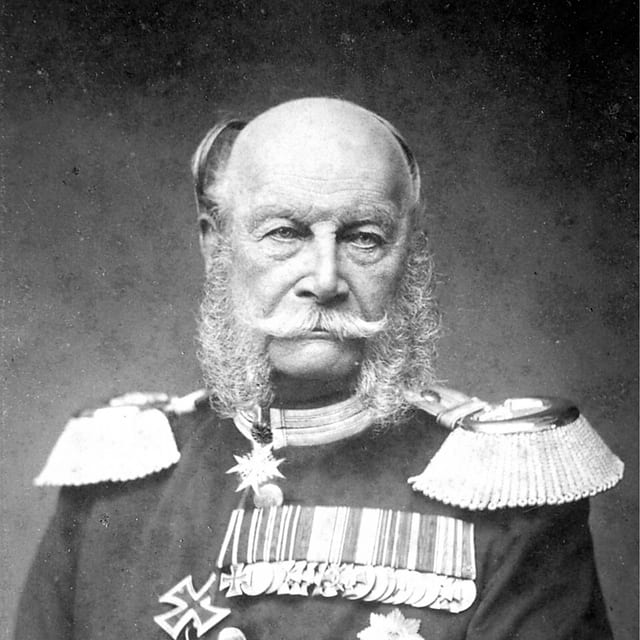 Gen 7
Gen 7Wilhelm I of Prussia
1797 - 1888
German Emperor and King of Prussia
Photo: Wilhelm Kuntzemüller, Public domain, via Wikimedia Commons
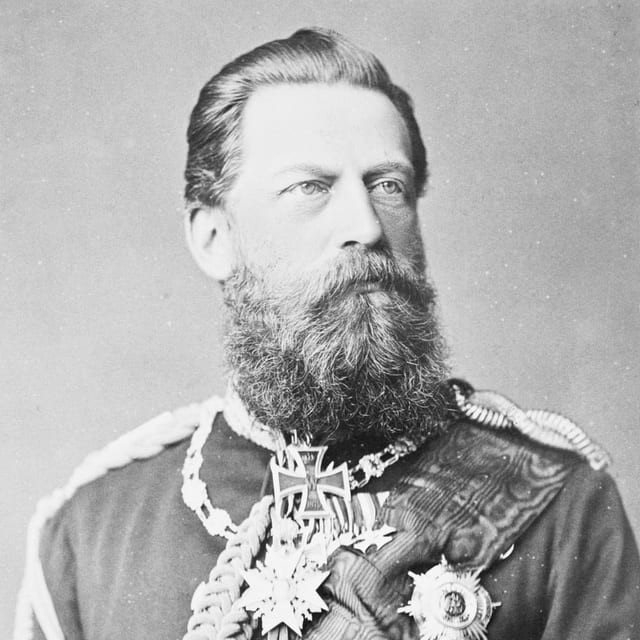 Gen 8
Gen 8Frederick III of Germany
1831 - 1888
German Emperor and King of Prussia
Photo: Reichard & Lindener, Public domain, via Wikimedia Commons

Family Members
Showing 11 of 53 people
Louise Henriette of Nassau
Gen 1 · 1627 - 1667
Louise Henriette of Nassau was Electress of Brandenburg as the first wife of Frederick William, the Great Elector, whom she married in 1646. A daughter of Frederick Henry, Prince of Orange, and Amalia of Solms-Braunfels, she was raised in the Dutch Republic and brought Netherlandish ideas of land drainage, agriculture and garden design to the sandy country around Berlin. The town of Oranienburg, where she rebuilt a country residence, is named after her family. She wrote hymns in the German Reformed tradition, several of which stayed in use long after her death. Of her children, Frederick I survived to become the first King in Prussia, making her the ancestress of the Prussian royal line. She died in 1667 at the age of thirty nine.
Frederick I of Prussia
Gen 2 · 1657 - 1713
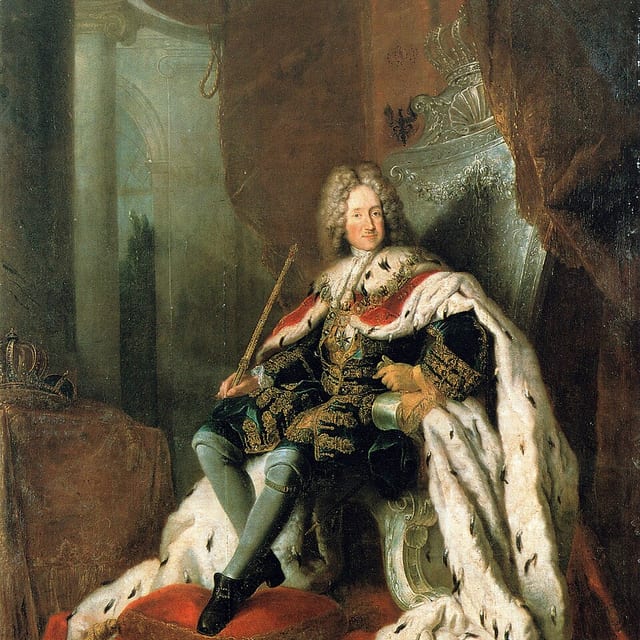
Frederick I was the first King in Prussia, reigning from 1701 until 1713, having succeeded his father the Great Elector as Elector Frederick III of Brandenburg in 1688. Born at Koenigsberg, he negotiated the Crown Treaty with Emperor Leopold I, promising Prussian troops for the War of the Spanish Succession in exchange for recognition of a royal title, and crowned himself at Koenigsberg on 18 January 1701. His court at Berlin was lavish by Prussian standards. He founded the Academy of Arts and, with his wife Sophia Charlotte of Hanover, the Academy of Sciences, and he built the palace of Charlottenburg. His son Frederick William I and grandson Frederick the Great both reacted against his taste for ceremony and expense.
Frederick William I of Prussia
Gen 3 · 1688 - 1740
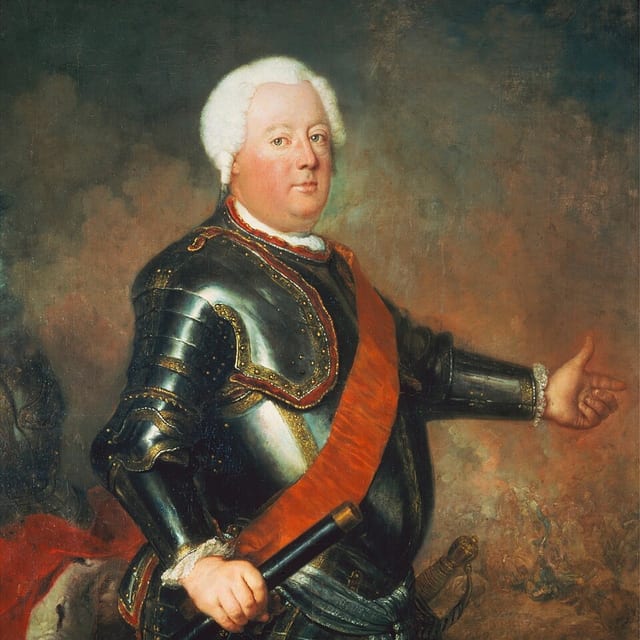
Frederick William I, called the Soldier King, was King in Prussia and Elector of Brandenburg from 1713 until 1740. Born in Berlin, the son of Frederick I and Sophia Charlotte of Hanover, he dismantled his father's expensive court, reorganised the administration into the General Directory, introduced compulsory primary schooling and left his heir the best drilled army in Europe together with a full treasury. He was known for his regiment of unusually tall soldiers and for the harsh discipline he imposed on his eldest son, the future Frederick the Great, whose attempt to flee Prussia in 1730 ended in a court martial. With his wife Sophia Dorothea of Hanover he had fourteen children, among them a king of Prussia and a queen of Sweden.
Wilhelmine of Prussia
Gen 4 · 1709 - 1758
Wilhelmine of Prussia was Margravine of Brandenburg-Bayreuth and the eldest sister of Frederick the Great, to whom she remained unusually close all her life. Born in Berlin in 1709 to Frederick William I and Sophia Dorothea of Hanover, she married Frederick, Margrave of Brandenburg-Bayreuth, in 1731 after her mother's plan for a marriage into the British royal family collapsed. At Bayreuth she became a notable patron and builder, responsible for the Hermitage and the Margravial Opera House, and she composed music of her own. Her memoirs are the frankest surviving account of life at her father's court and a principal source for her brother's youth. She died in 1758 during the Seven Years' War.
Frederick William II of Prussia
Gen 5 · 1744 - 1797
Frederick William II was King of Prussia from 1786 until 1797, succeeding his uncle Frederick the Great, who had no children. Born in Berlin in 1744, the son of Prince Augustus William and Luise Amalie of Brunswick-Wolfenbuettel, he relaxed his uncle's austere regime, ended the state monopolies on coffee and tobacco, and spent generously on music and architecture. The Brandenburg Gate was built in his reign, and he was a competent cellist to whom Ludwig van Beethoven dedicated the two cello sonatas of his Opus 5. In policy he was less successful, intervening against revolutionary France, accepting the separate peace of Basel in 1795, and taking part in the Second and Third Partitions of Poland. His eldest son succeeded him as Frederick William III.
Frederick William III of Prussia
Gen 6 · 1770 - 1840
Frederick William III was King of Prussia from 1797 until 1840, through the years of Prussia's collapse before Napoleon and its recovery. Born at Potsdam in 1770, he married Louise of Mecklenburg-Strelitz in 1793, and the couple became unusually popular. His attempt at neutrality ended in the catastrophic defeats at Jena and Auerstedt in 1806 and the Treaty of Tilsit, after which he backed the reforms of Stein, Hardenberg, Scharnhorst and Humboldt that rebuilt the Prussian state, army and university system. He joined the alliance that defeated Napoleon between 1813 and 1815 and gained the Rhineland at the Congress of Vienna. In 1817 he merged the Lutheran and Reformed congregations into the Prussian Union of churches. Two of his sons, Frederick William IV and Wilhelm I, succeeded him in turn.
Frederick William IV of Prussia
Gen 7 · 1795 - 1861
Frederick William IV was King of Prussia from 1840 until 1861, the eldest son of Frederick William III and Queen Louise. Born in Berlin in 1795, he was a gifted draughtsman with a passion for architecture who worked closely with Karl Friedrich Schinkel and Friedrich August Stueler on the building of Potsdam and Berlin, and who pressed for the completion of Cologne Cathedral. Romantic and conservative by temperament, he was overtaken by the revolution of 1848: he conceded a constitution but refused the imperial crown offered to him by the Frankfurt Parliament in 1849, calling it a crown from the gutter. From 1857 he was unable to govern, and his brother Wilhelm acted as regent before succeeding him. His marriage to Elisabeth Ludovika of Bavaria was childless.
Frederick III of Germany
Gen 8 · 1831 - 1888
Frederick III was German Emperor and King of Prussia for ninety nine days in 1888, the shortest reign in the history of his house. Born at Potsdam in 1831, the only son of Wilhelm I and Augusta of Saxe-Weimar-Eisenach, he studied at Bonn, commanded armies with distinction at Koeniggraetz in 1866 and at Woerth and Sedan in 1870, and was created crown prince of the new empire in 1871. With his wife Victoria, the eldest daughter of Queen Victoria, he favoured liberal parliamentary government on the British model, which set him at odds with Otto von Bismarck throughout his father's long reign. He was already seriously unwell when he finally succeeded in March 1888, and he died at Potsdam in June, leaving the throne to his eldest son, Wilhelm II.
Wilhelm II of Germany
Gen 9 · 1859 - 1941
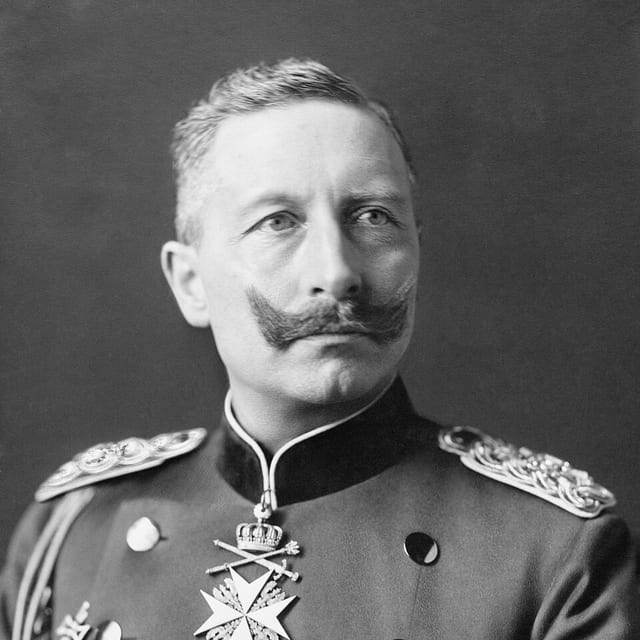
Wilhelm II was the last German Emperor and King of Prussia, reigning from 1888 until his abdication in 1918. Born in Berlin in 1859, the eldest son of Frederick III and Victoria, Princess Royal, he was a grandson of both Wilhelm I and Queen Victoria. He dismissed Otto von Bismarck in 1890 and pursued a personal and assertive foreign policy, building a battle fleet that antagonised Britain and backing Austria-Hungary in the crisis of July 1914. His impulsive speeches and interviews repeatedly embarrassed his own governments, and by the later years of the First World War real authority had passed to the army command. He abdicated in November 1918 and spent the rest of his life at Doorn in the Netherlands, where he died in 1941. With Augusta Victoria he had six sons and one daughter.
Eitel Friedrich of Prussia
Gen 10 · 1883 - 1942
Prince Eitel Friedrich of Prussia was the second son of Wilhelm II and Augusta Victoria. Born at Potsdam in 1883, he was brought up for the army and commanded the First Regiment of Foot Guards in the First World War, serving on both the Western and Eastern fronts and receiving the order Pour le Merite. In 1906 he married Duchess Sophie Charlotte of Oldenburg; the marriage produced no children and was dissolved in 1926. After the fall of the monarchy he held office in veterans' organisations, including the Stahlhelm league of former front line soldiers, and he lived at Potsdam, in the Villa Ingenheim, where he died in 1942.
Hubertus of Prussia
Gen 11 · 1909 - 1950
Prince Hubertus of Prussia was the third son of Crown Prince Wilhelm and Duchess Cecilie of Mecklenburg-Schwerin. Born at Potsdam in 1909, he trained in agriculture and served as a Luftwaffe officer until 1943, when the regime dismissed members of the former ruling houses from the armed forces. He married Princess Maria Anna von Sayn-Wittgenstein-Berleburg in 1941 and, after that marriage ended, Princess Magdalene Reuss of Koestritz in 1943. Looking for a new life once the family's Silesian estates were lost, he emigrated to South West Africa, where he took up farming near Windhoek. He died there in 1950 at the age of forty, leaving one daughter.
Is this your family?
Claim this tree to correct it, add relatives, and keep it up to date yourself.
Claim this treeStart your own family tree
Build yours for free, then send relatives a link to fill in their side of the family.
Start my tree, freeRelationship Explorer
How are two people related?
Pick any two names in the tree to trace the exact line of descent, marriage or shared ancestor connecting them.
Frederick I of Prussia is Georg Friedrich of Prussia's 9x Great-Grandfather.
- 👨Georg Friedrich of Prussiason of
- 👨Louis Ferdinand of Prussiason of
- 👨Louis Ferdinand of Prussiason of
- 👨Wilhelm of Prussiason of
- 👨Wilhelm II of Germanyson of
- 👨Frederick III of Germanyson of
- 👨Wilhelm I of Prussiason of
- 👨Frederick William III of Prussiason of
- 👨Frederick William II of Prussiason of
- 👨Augustus William of Prussiason of
- 👨Frederick William I of Prussiason of
- 👨Frederick I of Prussia
Find out how you're related to your own cousins.
Build your treeIs this your family?
Claim the Hohenzollern family tree to take it over, edit it, and add family members yourself.
Frequently Asked Questions
How many people are in the Hohenzollern family tree?+−
This family tree currently documents 53 people across 13 recorded generations.
How many generations does the Hohenzollern family tree span?+−
13 generations are recorded so far, and may grow as more history is added.
How many marriages are recorded?+−
16 marriages are recorded in this family.
Where is the Hohenzollern family from?+−
The most commonly recorded native place is Berlin, Kingdom of Prussia.
Start building your own family story
Create a tree in minutes, import a GEDCOM file, or explore more public family trees.
Free. Private by default. GEDCOM export any time.