Interactive family tree
Habsburg Family Tree - The House of Habsburg Family Tree
40 people documented: explore the full interactive family tree
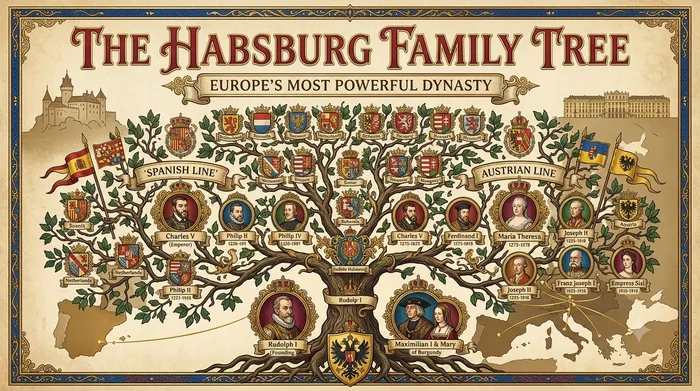
The Habsburg Family Tree: Europe’s Most Powerful Dynasty
For more than six hundred years the Habsburgs stood at the centre of European power. Through a combination of military success, political skill, and especially strategic marriage, they built one of the largest and most enduring dynastic networks in history. This guide explains the Habsburg family tree in clear stages, from modest beginnings to the height of empire and final collapse.
Origins of the Habsburgs
The family took its name from Habsburg Castle in what is now Switzerland. They began as local counts. Their rise became dramatic in 1273 when Rudolf I was elected King of the Romans (the title of the ruler of the Holy Roman Empire). From that point the Habsburgs steadily expanded their influence in Central Europe.
A famous motto summed up their preferred method: “Let others wage war; you, happy Austria, marry.” Marriage alliances brought them the Burgundian inheritance, the Spanish kingdoms, the Netherlands, and much of Italy.
Simplified Core Family Tree
A complete Habsburg tree is vast. The following diagram shows the essential main line and the great split into Spanish and Austrian branches:
Rudolf I of Habsburg (1218–1291)
└── ... (several generations)
└── Maximilian I (1459–1519)
m. Mary of Burgundy
└── Philip the Handsome (1478–1506)
m. Joanna of Castile
└── Charles V (1500–1558)
│   (Holy Roman Emperor & King of Spain)
├── Spanish Branch
│   └── Philip II of Spain (1527–1598)
│       └── ... → Charles II of Spain (1661–1700)
│           (Spanish line ends 1700)
└── Austrian Branch
└── Ferdinand I (1503–1564)
└── ... → Maria Theresa (1717–1780)
└── ... → Franz Joseph I (1830–1916)
└── Charles I (1887–1922)
(Last Emperor of Austria-Hungary)
This outline highlights the pivotal figures and the division that shaped European politics for generations.
The Great Split: Spanish and Austrian Lines
Charles V inherited an enormous collection of territories: Spain and its overseas empire, the Burgundian lands, the Austrian hereditary lands, and the title of Holy Roman Emperor. The burden was too great for one ruler. He divided the inheritance:
- The Spanish branch received Spain, the Netherlands, parts of Italy, and the American colonies.
- The Austrian branch received the Central European lands and continued to supply Holy Roman Emperors.
The Spanish Habsburgs reached their height under Philip II but died out in the male line with the childless Charles II in 1700. The resulting succession crisis triggered the War of the Spanish Succession.
The Austrian Habsburgs continued. When the male line threatened to fail, Maria Theresa secured the inheritance through the Pragmatic Sanction and strong leadership. Her descendants ruled the Austrian Empire and later the dual monarchy of Austria-Hungary.
Key Figures at a Glance
| Ruler | Dates | Significance |
|---|---|---|
| Rudolf I | 1218–1291 | First Habsburg King of the Romans |
| Maximilian I | 1459–1519 | Expanded power through Burgundian marriage |
| Charles V | 1500–1558 | Ruled the largest European empire of his day |
| Philip II | 1527–1598 | Peak of Spanish Habsburg power |
| Maria Theresa | 1717–1780 | Preserved and reformed the Austrian inheritance |
| Franz Joseph I | 1830–1916 | Long-ruling emperor of Austria-Hungary |
| Charles I | 1887–1922 | Last Habsburg emperor; empire dissolved 1918 |
The End of Habsburg Rule
The Austro-Hungarian Empire collapsed at the end of the First World War. Emperor Charles I renounced participation in state affairs in 1918 (he did not formally abdicate). The various territories became independent republics or were absorbed into other states. Habsburg rule over major European lands ended after more than six centuries.
Descendants of the family still exist today and remain private citizens, although some continue to use historical titles in social contexts.
Why the Habsburg Tree Matters
The Habsburg family tree demonstrates how marriage, inheritance law, and dynastic strategy could shape the map of Europe. It also shows the limits of such power: genetic problems from repeated intermarriage (especially visible in the Spanish line), nationalist movements, and modern war ultimately ended the empire.
For students of history and genealogy, the Habsburgs offer a clear lesson in the importance of recording names, marriages, and lines of descent. Their story is unusually well documented, making it possible to follow the rise and division of the dynasty in detail.
Recording Your Own Family History
Few families possess an empire, yet every family has relationships and stories worth preserving. A digital family tree makes it easier to organise names, dates, and connections so they remain clear for future generations.
You can begin building a private record for free, with no sign-up required, at the My rOoOts create-tree page. The family tree generator offers a simple starting point. An ancestor timeline generator helps place generations against historical periods. When relatives contribute information, a relationship calculator can clarify how people are linked.
Conclusion
The Habsburg family tree stretches from a Swiss castle in the thirteenth century to the fall of Austria-Hungary in 1918. Through strategic marriages the dynasty acquired vast territories and split into powerful Spanish and Austrian branches. Although their rule ended more than a century ago, the Habsburgs remain a defining example of how one family could dominate European politics for generations.
Studying their tree offers both a window into the continent’s past and a reminder of the lasting value of careful genealogical records — a practice that belongs to imperial dynasties and ordinary families alike.
Editor's picks
6 August 2026
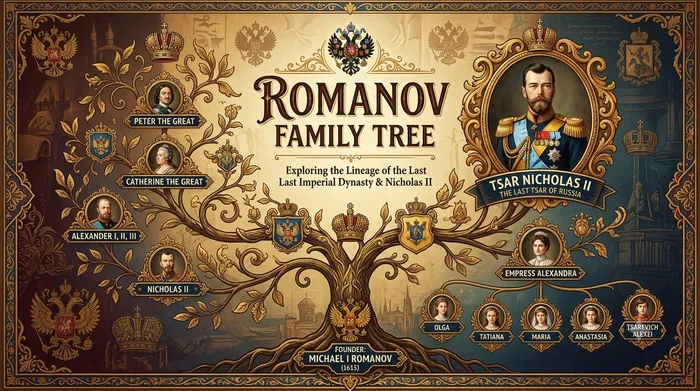
The Romanov Family Tree and the Last Tsar of Russia
Explore the Romanov family tree, focusing on Tsar Nicholas II, the last Emperor of Russia, his wife Alexandra, their five children, and the end of the dynasty in 1918.
6 August 2026
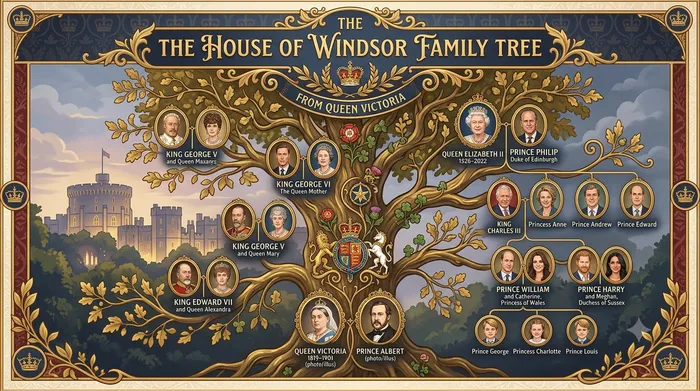
The House of Windsor Family Tree from Queen Victoria to Today
Explore the House of Windsor family tree from Queen Victoria through George V, Elizabeth II, and King Charles III to the present generation of British royals.
6 August 2026
The British Royal Family Tree Explained Simply
A simple guide to the British Royal Family tree, from Queen Elizabeth II to King Charles III, the Prince of Wales, and the next generation of working royals.
6 August 2026
The Tuareg: Desert Nomads and Their Clan-Based Genealogy
Explore the Tuareg people of the Sahara, their nomadic heritage, clan-based social structure, and how genealogy shapes identity, status, and family history across the desert.
6 August 2026
Polynesian Family Trees: How Oral Genealogy Preserved Ancestors for Centuries
Discover how Polynesian societies used oral genealogy to preserve family trees for centuries, linking people to ancestors, land, and identity across the Pacific.

6 August 2026
Ainu Family History and the Indigenous Heritage of Japan
Explore Ainu family history and the indigenous heritage of Japan, including culture, ancestry, historical challenges, and how descendants can preserve their roots today.
6 August 2026
The Genealogy of the Champa Kingdom: Tracing Cham Ancestry
Explore the history of the Champa Kingdom and learn how Cham ancestry, clan traditions, and family records help modern descendants trace their roots across Vietnam and beyond.
4 August 2026
The World’s Largest and Most Powerful Dynasties in History: Empires, Royal Families, and Lasting Legacies
Explore the world’s largest and most powerful dynasties, from the Qing and Romanovs to the Mughals and Habsburgs, and discover how royal family trees shaped global history.
Create Your Family Tree for Free
Start building your family history in minutes with the My rOoOts Free Family Tree Creator. Add parents, grandparents, children, and relatives, organize generations visually, and create a beautiful family tree that you can save and share.
👉 Create your free family tree: Free Family Tree Creator
No design skills required. Simply enter your family details and generate a clear, easy-to-read family tree online for free.
Check Zodiac Compatibility for Any Two People
Curious about how well two people match based on their date of birth? Try the My rOoOts Zodiac Compatibility Tool to compare zodiac signs, explore relationship compatibility, and get a quick compatibility score for couples, friends, or family members.
👉 Check compatibility now: Zodiac Compatibility Calculator
You can enter two dates of birth and even mention the relationship type to get a more personalized compatibility result.
Download a Free Family Tree Template
Want to draw your family tree yourself? The My rOoOts Family Tree Template provides a free printable blank pedigree chart for documenting your family history across multiple generations.
👉 Download a free family tree template: Family Tree Template
Choose a 3-generation, 4-generation, or 5-generation family tree template and save it as a PDF for printing, writing, and documenting your ancestors.
Discover the Meaning and Origin of Your Surname
Ever wondered where your family name came from? Use the My rOoOts Surname Meaning Lookup to explore surname meanings, origins, history, and etymology from different regions and cultures around the world.
👉 Discover your surname meaning: Surname Meaning Lookup
Learn more about your last name and explore the possible linguistic, geographic, cultural, and historical roots behind your family surname.
Start your family tree free
No account needed to begin. Build it in minutes, then save it whenever you're ready.
Build your family tree