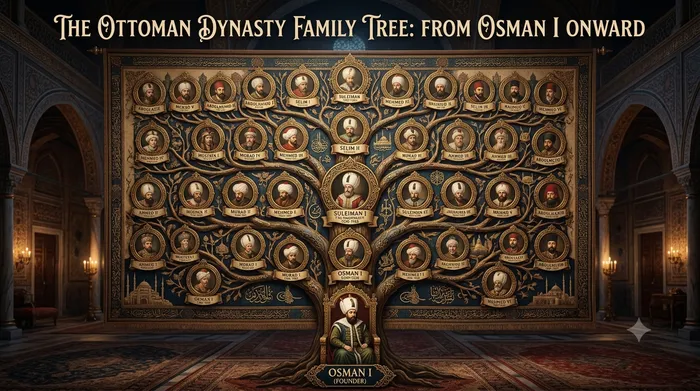
The Ottoman Dynasty Family Tree from Osman I Onward
The Ottoman Dynasty was one of the longest-ruling families in world history. Founded by Osman I around 1299, it governed a vast empire that at its height stretched across three continents. The dynasty lasted until 1922, when the sultanate was abolished. This guide presents a clear overview of the main line of the Ottoman family tree from its founder to the final sultan.
Foundations of the Dynasty
Osman I (r. c. 1299–1323/4) was a Turkish tribal leader in northwest Anatolia. From a small frontier principality, his descendants built a powerful state. Early expansion under Orhan, Murad I, and Bayezid I turned the Ottomans into a major regional power. The conquest of Constantinople in 1453 by Mehmed II marked the transformation into a true empire.
Simplified Main Line of Ottoman Sultans
The full Ottoman family tree is enormous because of numerous sons, concubines, and complex succession practices. Below is a simplified direct line of the most important sultans:
Osman I (c. 1299–1323/4)
└── Orhan (c. 1323/4–1362)
└── Murad I (1362–1389)
└── Bayezid I (1389–1402)
└── Mehmed I (1413–1421)
└── Murad II (1421–1451)
└── Mehmed II the Conqueror (1451–1481)
└── Bayezid II (1481–1512)
└── Selim I (1512–1520)
└── Suleiman I the Magnificent (1520–1566)
└── Selim II (1566–1574)
└── Murad III (1574–1595)
└── Mehmed III (1595–1603)
└── Ahmed I (1603–1617)
└── ... (later sultans)
└── Abdulmejid I (1839–1861)
└── Abdul Hamid II (1876–1909)
└── Mehmed V (1909–1918)
└── Mehmed VI (1918–1922)  ← Last Sultan
Key Periods and Major Sultans
| Period | Major Figures | Highlights |
|---|---|---|
| Rise (14th–15th c.) | Osman I, Orhan, Murad I, Bayezid I, Mehmed II | Foundation, Balkans expansion, conquest of Constantinople |
| Classical Age (16th c.) | Selim I, Suleiman the Magnificent | Peak territorial extent, legal and cultural flowering |
| Transformation (17th–18th c.) | Murad IV, later sultans | Military challenges, administrative changes |
| Late Empire (19th–20th c.) | Mahmud II, Abdul Hamid II, Mehmed VI | Reforms, decline, World War I, end of dynasty |
Suleiman I (the Magnificent) is widely regarded as the peak of Ottoman power. His long reign saw major military campaigns, legal reforms, and a flourishing of arts and architecture.
Succession Practices
Ottoman succession was not based on strict primogeniture (eldest son inherits). In earlier centuries, civil war between brothers was common, and the practice of fratricide was sometimes used to prevent rivalry. From the 17th century onward, a more stable system developed in which the oldest male member of the dynasty usually inherited the throne. This change reduced internal conflict but also meant that some sultans came to power relatively late in life.
The End of the Dynasty
After defeat in World War I, the Ottoman Empire was partitioned. The sultanate was abolished on 1 November 1922. Mehmed VI, the 36th and last sultan, left Istanbul. The caliphate, held by a member of the family, was abolished in 1924. Members of the Ottoman family lived in exile for decades; some descendants have since returned to Turkey as private citizens.
Why the Ottoman Family Tree Matters
The Ottoman tree illustrates how a single family maintained power for more than six centuries through military success, flexible administration, religious legitimacy, and careful management of succession. It also shows the eventual limits of dynastic rule in the face of nationalism, modern warfare, and political change.
Recording Long Family Histories
Royal houses such as the Ottomans kept detailed genealogical records over many generations. Ordinary families can apply the same principle on a smaller scale. A clear digital family tree helps preserve names, relationships, and stories so they remain understandable for future generations.
You can begin building your own private family tree for free, with no sign-up required, at the My rOoOts create-tree page.
The family tree generator offers a simple starting point. An ancestor timeline generator places generations against historical periods. When relatives contribute information, a relationship calculator helps clarify connections.
Conclusion
The Ottoman Dynasty family tree begins with Osman I around 1299 and continues through a long line of sultans, including Mehmed II the Conqueror and Suleiman the Magnificent, until Mehmed VI in 1922. For more than six centuries the family ruled one of the most important empires in world history. Studying this tree offers insight into power, succession, and endurance — and it reminds us of the lasting value of recording family relationships carefully across generations.
Editor's picks
8 August 2026
The Chola Dynasty Family Tree Explained
Explore the Chola Dynasty family tree from Vijayalaya to Rajaraja I, Rajendra I, and the later rulers who built one of South India’s greatest empires.
8 August 2026
The Gupta Dynasty Family Tree of India
Explore the Gupta Dynasty family tree of India, from Sri Gupta and Chandragupta I to Samudragupta, Chandragupta II Vikramaditya, and the later rulers of India’s Golden Age.
8 August 2026
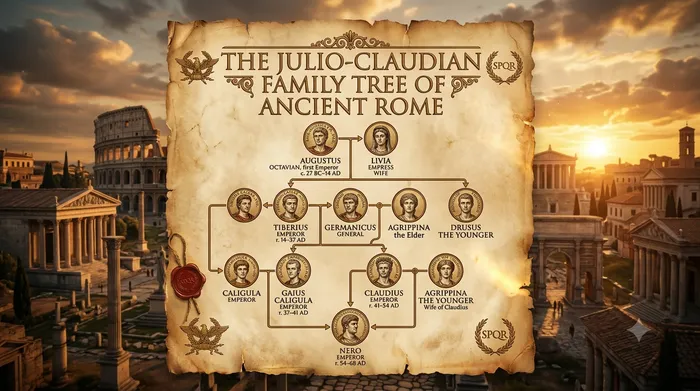
The Julio-Claudian Family Tree of Ancient Rome
Explore the Julio-Claudian family tree of ancient Rome, from Augustus to Nero, including the complex ties of blood, adoption, and marriage that shaped the first imperial dynasty.
8 August 2026
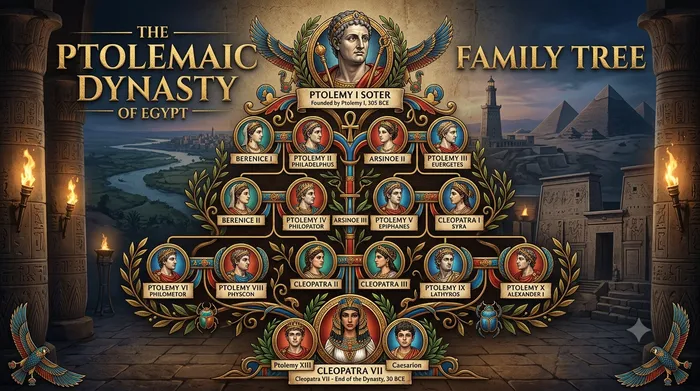
The Ptolemaic Dynasty Family Tree of Egypt
Explore the Ptolemaic Dynasty family tree of Egypt, from Ptolemy I Soter to Cleopatra VII, including the complex royal marriages and the end of pharaonic rule.
8 August 2026
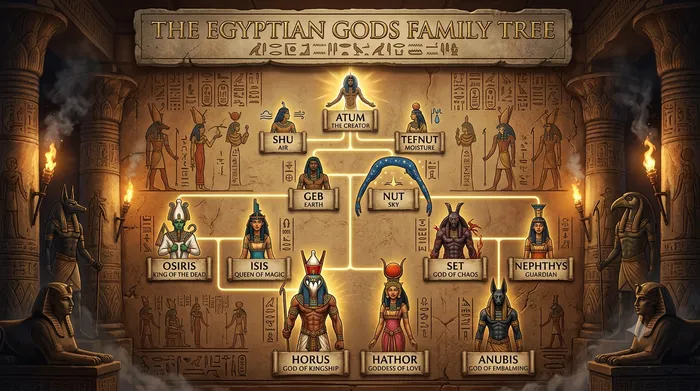
The Egyptian Gods Family Tree for Beginners
A simple beginner’s guide to the Egyptian gods family tree, from Atum and the Ennead of Heliopolis to Osiris, Isis, Horus, and the main divine relationships.
8 August 2026
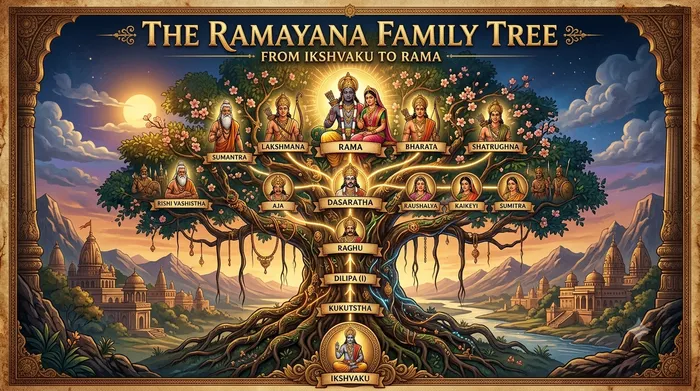
The Ramayana Family Tree from Ikshvaku to Rama
Explore the Ramayana family tree from Ikshvaku, founder of the Solar Dynasty, through legendary kings to Rama, Lakshmana, Bharata and Shatrughna in a clear simplified guide.
7 August 2026
The Mahabharata Family Tree Explained: Kuru, Pandava and Kaurava Lineage
Understand the Mahabharata family tree in clear steps. Trace the Kuru dynasty from Shantanu to the Pandavas and Kauravas and see how the great war became a family conflict.

7 August 2026
The Buddha’s Family Tree and Shakya Clan Origins: A Clear Historical Guide
Explore the Buddha’s family tree and the origins of the Shakya clan. Learn about Kapilavastu, the Ikshvaku link, and the key relatives of Siddhartha Gautama.
6 August 2026
The Bourbon Family Tree Across France and Spain
Explore the Bourbon family tree from its French royal origins under Henry IV to the Spanish Bourbons who still reign today, including key kings and dynastic links.
6 August 2026
The Habsburg Family Tree: Europe’s Most Powerful Dynasty
Explore the Habsburg family tree, from their Swiss origins to the Spanish and Austrian branches that dominated European politics for centuries through marriage and empire.
6 August 2026
The Romanov Family Tree and the Last Tsar of Russia
Explore the Romanov family tree, focusing on Tsar Nicholas II, the last Emperor of Russia, his wife Alexandra, their five children, and the end of the dynasty in 1918.
6 August 2026
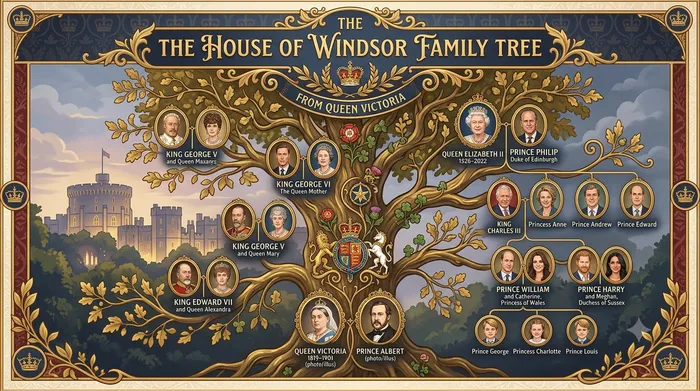
The House of Windsor Family Tree from Queen Victoria to Today
Explore the House of Windsor family tree from Queen Victoria through George V, Elizabeth II, and King Charles III to the present generation of British royals.

6 August 2026
The British Royal Family Tree Explained Simply
A simple guide to the British Royal Family tree, from Queen Elizabeth II to King Charles III, the Prince of Wales, and the next generation of working royals.
Create Your Family Tree for Free
Start building your family history in minutes with the My rOoOts Free Family Tree Creator. Add parents, grandparents, children, and relatives, organize generations visually, and create a beautiful family tree that you can save and share.
👉 Create your free family tree: Free Family Tree Creator
No design skills required. Simply enter your family details and generate a clear, easy-to-read family tree online for free.
Check Zodiac Compatibility for Any Two People
Curious about how well two people match based on their date of birth? Try the My rOoOts Zodiac Compatibility Tool to compare zodiac signs, explore relationship compatibility, and get a quick compatibility score for couples, friends, or family members.
👉 Check compatibility now: Zodiac Compatibility Calculator
You can enter two dates of birth and even mention the relationship type to get a more personalized compatibility result.
Download a Free Family Tree Template
Want to draw your family tree yourself? The My rOoOts Family Tree Template provides a free printable blank pedigree chart for documenting your family history across multiple generations.
👉 Download a free family tree template: Family Tree Template
Choose a 3-generation, 4-generation, or 5-generation family tree template and save it as a PDF for printing, writing, and documenting your ancestors.
Discover the Meaning and Origin of Your Surname
Ever wondered where your family name came from? Use the My rOoOts Surname Meaning Lookup to explore surname meanings, origins, history, and etymology from different regions and cultures around the world.
👉 Discover your surname meaning: Surname Meaning Lookup
Learn more about your last name and explore the possible linguistic, geographic, cultural, and historical roots behind your family surname.
Start your family tree free
No account needed to begin. Build it in minutes, then save it whenever you're ready.
Build your family tree