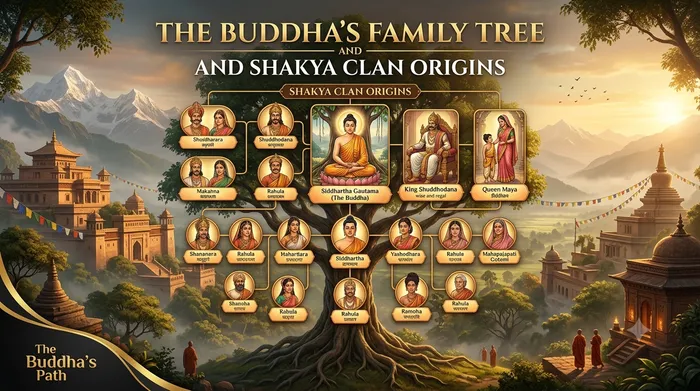
The Buddha’s Family Tree and Shakya Clan Origins
The historical Buddha, Siddhartha Gautama, was born into the Shakya clan, a small but significant community in the foothills of the Himalayas. Understanding his family tree and the origins of the Shakyas helps place his life in its proper social and political context. This guide gathers the main traditional accounts and what modern scholarship can reasonably say about them.
Note on sources: Most details come from early Buddhist texts such as the Pali Canon, the Mahavamsa, and later commentaries. These blend historical memory with legend. Archaeology and comparative study help separate the two.
Who Were the Shakyas?
The Shakyas (Pali: Sakya or Sakiya) were a Kshatriya clan living in the region that today straddles the India-Nepal border. Their main centre was Kapilavastu. They organised themselves as a gana-sangha, an aristocratic republic or oligarchy in which decisions were taken by an assembly of clan leaders rather than a single hereditary monarch.
By the time of the Buddha (roughly 5th–4th century BCE), the Shakyas functioned as a vassal community under the larger kingdom of Kosala. They retained internal autonomy but owed deference to the Kosalan king.
Traditional Origin Myth
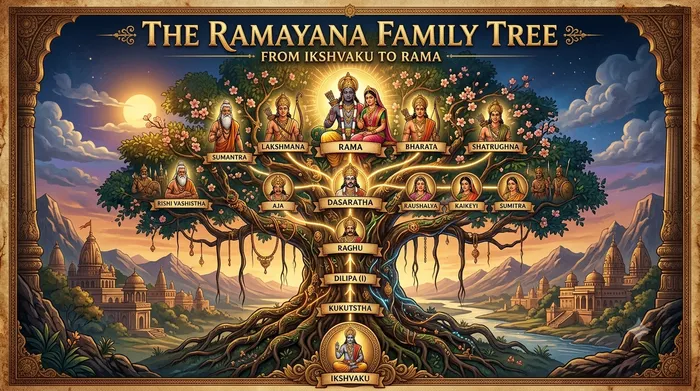
Buddhist texts preserve a consistent origin story. The Shakyas claimed descent from the legendary king Okkāka (Sanskrit: Ikshvaku), a figure linked to the solar dynasty (Adicca or Suryavansha).
According to the story:
- Okkāka had children by his chief queen.
- After her death he remarried and, under the influence of the new queen, decided to pass the throne to her son.
- He therefore banished his elder children.
- The exiles travelled toward the Himalayas and settled near the hermitage of the sage Kapila.
- They founded a town that became known as Kapilavastu.
- Because they settled in a grove of saka (teak or sal) trees, or because the king praised them as “capable” (sakya), the clan took the name Shakya.
- To keep the bloodline pure, the brothers and sisters married among themselves (with the eldest sister treated as a mother figure).
This legend also explains the close relationship with the neighbouring Koliya clan, who shared a similar origin story and regularly intermarried with the Shakyas.
The Immediate Family of the Buddha
Traditional genealogies give the following close relatives:
Paternal Side
- Great-grandfather line: Traced back through Jayasena and earlier figures to Okkāka.
- Grandfather: Sihahanu (also written Simhahanu or Singhahanu).
- Father: Suddhodana, an elected or leading chief of the Shakya assembly rather than an absolute king in the later monarchical sense.
- Paternal uncles: Several brothers of Suddhodana are named in the texts (including those who later supported or opposed the Buddha’s mission).
Maternal Side
- Mother: Maya (Mayadevi), who died shortly after giving birth.
- Maternal grandfather: Often identified as Anjana or a Koliya chief of Devadaha.
- Stepmother and aunt: Mahaprajapati Gotami, Maya’s sister, who raised Siddhartha after Maya’s death and later became the first nun.
Own Generation and Descendants
- Wife: Yasodhara (also called Bhaddakaccana), a cousin from the Koliya side.
- Son: Rahula.
- Half-brother: Nanda (son of Suddhodana and Mahaprajapati).
- Cousins: Several important early disciples, including Ananda and Devadatta, belonged to the wider family circle.
These relationships show how tightly the Shakya and Koliya elites intermarried. The pattern helped maintain clan identity in a small territory.
Simplified Family Outline
A concise view of the core line often presented in traditional accounts runs roughly as follows:
- Okkāka (legendary founder figure)
- ... (several generations)
- Jayasena
- Sihahanu
- Suddhodana + Maya
- Siddhartha Gautama (the Buddha)
- Rahula
Collateral lines produced many of the early Buddhist community’s leading figures.
Political and Social Context
The Shakyas were not a large kingdom. Their territory was modest, centred on agricultural settlements in the Tarai belt. Status within the clan depended on birth into the leading families and participation in the assembly. Suddhodana’s position was that of a prominent chief rather than a sovereign king of the type found in Magadha or Kosala.
This republican background may help explain certain features of early Buddhist organisation, which also valued assembly discussion and collective decision-making.
The End of the Shakya Clan as a Political Entity
Traditional accounts state that during or shortly after the Buddha’s lifetime the Shakya community was attacked and largely destroyed by Virudhaka (Vidudabha), son of the Kosalan king. Many Shakyas were killed; others dispersed. Later Buddhist literature remembers this event with sorrow. Some modern communities in parts of Uttar Pradesh and Nepal still carry the Shakya name and regard themselves as distant descendants, though the continuous political entity ended in antiquity.
What Modern Scholarship Adds
Scholars generally accept that a Shakya clan existed in the region of Kapilavastu and that Siddhartha Gautama was born into one of its leading families. Exact details of the genealogy before Suddhodana remain legendary. Debates continue about:
- The precise location of Kapilavastu (candidates include Tilaurakot in Nepal and Piprahwa in India).
- The degree of “Aryan” versus indigenous or mixed ancestry.
- Whether any Central Asian (Saka/Scythian) connection exists (a minority view).
Most historians treat the Okkāka story as a classic origin myth that gave the clan prestige by linking it to the solar dynasty, a common strategy among ancient Indian ruling groups.
Why the Family Tree Still Matters
Knowing the Buddha’s family background helps readers understand several points:
- He grew up inside a privileged but not imperial elite.
- His decision to leave home occurred against a backdrop of clan duty and expected leadership.
- Many of his early followers and opponents came from the same small circle of related families.
- The later destruction of the Shakyas gave early Buddhism a poignant historical memory of impermanence applied to an entire community.
Conclusion
The Buddha’s family tree is rooted in the Shakya clan, a small republican community that claimed solar-dynasty ancestry through the legendary Okkāka. His father Suddhodana, mother Maya, stepmother Mahaprajapati, wife Yasodhara and son Rahula form the well-attested core of the immediate family. Wider kinship ties linked the Shakyas to the Koliyas and placed them under the shadow of Kosala.
While legendary elements surround the deeper genealogy, the historical outline remains clear enough: Siddhartha Gautama was born into a leading family of a modest but self-aware clan on the edge of the Gangetic plain. That social location shaped the early conditions of his life and, indirectly, the community that formed around his teaching.
For readers interested in the human and historical setting of early Buddhism, the Shakya origins and family relationships offer a concrete starting point free of later mythological elaboration.
Create Your Family Tree for Free
Start building your family history in minutes with the My rOoOts Free Family Tree Creator. Add parents, grandparents, children, and relatives, organize generations visually, and create a beautiful family tree that you can save and share.
👉 Create your free family tree: Free Family Tree Creator
No design skills required. Simply enter your family details and generate a clear, easy-to-read family tree online for free.
Check Zodiac Compatibility for Any Two People
Curious about how well two people match based on their date of birth? Try the My rOoOts Zodiac Compatibility Tool to compare zodiac signs, explore relationship compatibility, and get a quick compatibility score for couples, friends, or family members.
👉 Check compatibility now: Zodiac Compatibility Calculator
You can enter two dates of birth and even mention the relationship type to get a more personalized compatibility result.
Download a Free Family Tree Template
Want to draw your family tree yourself? The My rOoOts Family Tree Template provides a free printable blank pedigree chart for documenting your family history across multiple generations.
👉 Download a free family tree template: Family Tree Template
Choose a 3-generation, 4-generation, or 5-generation family tree template and save it as a PDF for printing, writing, and documenting your ancestors.
Discover the Meaning and Origin of Your Surname
Ever wondered where your family name came from? Use the My rOoOts Surname Meaning Lookup to explore surname meanings, origins, history, and etymology from different regions and cultures around the world.
👉 Discover your surname meaning: Surname Meaning Lookup
Learn more about your last name and explore the possible linguistic, geographic, cultural, and historical roots behind your family surname.
Start your family tree free
No account needed to begin. Build it in minutes, then save it whenever you're ready.
Build your family tree