Romani or Gypsy? Understanding the Correct Terms and Their History
Many people encounter the words “Romani” and “Gypsy” when reading about European history, DNA results, or family stories. The two terms are not interchangeable. Understanding the difference, the history behind each word, and the lived experience of the people they describe is essential for accurate research and respectful conversation.
Preferred Terminology Today
Most international organizations, scholars, and Romani activists prefer the terms Romani or Roma. These are endonyms — names the people use for themselves. “Gypsy” is an exonym (a name given by outsiders) that originated from a historical misunderstanding and is widely regarded as outdated or offensive in many contexts.
| Term | Type | Current Status | Notes |
|---|---|---|---|
| Romani / Roma | Endonym | Preferred in most formal and activist contexts | Used by the majority of communities and institutions |
| Sinti | Endonym | Preferred by specific groups in Germany/Austria | Distinct subgroup with its own identity |
| Gypsy | Exonym | Often considered pejorative | Still used by some individuals and in certain regional traditions |
| Traveller | Mixed | Context-dependent | Can refer to Irish Travellers or other groups, not always Romani |
Some communities, particularly certain British Romanichal families, continue to use “Gypsy” or related terms as a self-identifier. Outside those specific contexts, “Romani” or “Roma” is the safer and more respectful choice.
Origins of the Romani People
Genetic, linguistic, and historical evidence shows that the Romani people originated in the northwestern part of the Indian subcontinent. Linguistic studies link Romani languages to Indo-Aryan languages spoken in India. DNA research consistently finds a South Asian genetic component in Romani populations across Europe, mixed with varying amounts of Middle Eastern and European ancestry acquired during centuries of migration.
A simplified view of the major ancestral layers often looks like this:
South Asian ancestral core
├── Northwestern Indian source populations
├── Admixture during westward migration
│   ├── Middle Eastern / West Asian components
│   └── European components (acquired after arrival in Europe)
└── Regional variation across Europe
    ├── Higher European admixture in Western groups
    └── Retention of stronger South Asian signal in some Eastern groups
The migration out of India is generally dated between the 8th and 12th centuries CE. Groups moved through Persia and the Byzantine Empire before entering Europe in larger numbers from the 14th century onward.
A Brief Timeline of Migration and History
| Period | Key Developments |
|---|---|
| ~500–1000 CE | Ancestral groups leave northwestern India |
| 11th–13th centuries | Presence in the Middle East and Anatolia |
| 14th–15th centuries | Arrival in the Balkans and progressive movement into Central and Western Europe |
| 15th–18th centuries | Mixture of acceptance, regulation, and persecution in various European states |
| 19th–20th centuries | Emancipation in some regions, continued discrimination in others |
| 1930s–1945 | Porajmos (the Romani Holocaust) under Nazi regime and collaborators |
| Post-1945 | Civil rights movements, cultural revival, and ongoing struggles for recognition |
The Porajmos resulted in the deaths of hundreds of thousands of Romani people. Recognition of this genocide has grown in recent decades, though it remains less widely known than other aspects of the Holocaust.
Major Subgroups
The Romani population is not monolithic. Over centuries of migration and settlement, distinct groups developed their own dialects, customs, and self-names.
| Group / Subgroup | Primary Regions | Notes |
|---|---|---|
| Roma | Widespread across Europe | Broad umbrella term |
| Sinti | Germany, Austria, France, Italy | Distinct identity and dialect |
| Kalderash | Eastern Europe, diaspora | Traditionally metalworkers |
| Romanichal | Britain | English Romani community |
| Manouche | France | Closely related to Sinti |
| Iberian Romani | Spain, Portugal (Calé) | Strong local cultural adaptation |
These groups often maintain strong internal kinship networks and oral family histories. Documenting those networks can be challenging because of historical mobility, name changes, and gaps in official records.
Language and Cultural Continuity
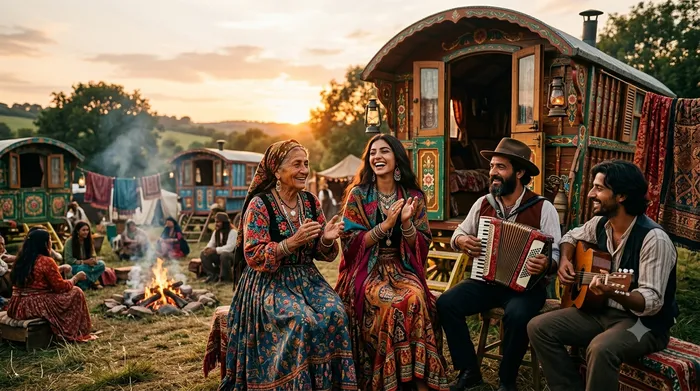
Romani languages belong to the Indo-Aryan branch of the Indo-European family. Despite centuries in Europe, many dialects retain core vocabulary and grammatical features from their Indian origins. Culture has also preserved distinctive traditions in music, storytelling, craftsmanship, and social organization, even while absorbing local influences.
Why the Distinction Matters for Family History
When researching family stories that involve Romani ancestry, using accurate terminology shows respect and improves the quality of research. Older documents may use “Gypsy,” “Egyptian,” or local equivalents. Modern researchers and DNA matches are more likely to respond positively to “Romani” or the specific subgroup name.
Family trees in Romani communities often involve complex kinship systems, frequent movement, and strong oral transmission of history. A clear digital record can help preserve names, relationships, and stories that might otherwise be lost.
Tools designed for multi-generational families are particularly useful here. An interactive tree allows relatives to add information across borders while keeping control over privacy. You can begin building such a record for free at the My rOoOts create-tree page. The family tree generator offers a simple starting point, and the ancestor timeline generator can help place migration generations against historical periods. A relationship calculator may also clarify kinship terms when working across different cultural naming systems.
Practical Advice for Researchers
- Use “Romani” or “Roma” in modern writing unless a specific individual or community prefers another term.
- Treat “Gypsy” as a historical or community-specific term rather than a neutral descriptor.
- Cross-check oral history with available records, DNA matches, and local archives.
- Be sensitive to the history of persecution when discussing results or sharing trees.
- Focus on named individuals and documented relationships rather than broad ethnic labels alone.
Conclusion
“Romani” is the term preferred by most of the people it describes and by contemporary scholarship. “Gypsy” is an older external name rooted in a mistaken belief about Egyptian origins and is often viewed as pejorative. The Romani people themselves trace their origins to northwestern India, followed by a long westward migration that brought them into Europe centuries ago.
Understanding this history and using respectful language strengthens both public knowledge and private family research. For those whose family stories include Romani ancestors, combining careful terminology with a well-organized digital family tree helps preserve a complex and resilient heritage for future generations. Starting that tree is straightforward, and the result can become a lasting record of names, journeys, and relationships that official histories have frequently overlooked.
Create Your Family Tree for Free
Start building your family history in minutes with the My rOoOts Free Family Tree Creator. Add parents, grandparents, children, and relatives, organize generations visually, and create a beautiful family tree that you can save and share.
👉 Create your free family tree: Free Family Tree Creator
No design skills required. Simply enter your family details and generate a clear, easy-to-read family tree online for free.
Check Zodiac Compatibility for Any Two People
Curious about how well two people match based on their date of birth? Try the My rOoOts Zodiac Compatibility Tool to compare zodiac signs, explore relationship compatibility, and get a quick compatibility score for couples, friends, or family members.
👉 Check compatibility now: Zodiac Compatibility Calculator
You can enter two dates of birth and even mention the relationship type to get a more personalized compatibility result.
Download a Free Family Tree Template
Want to draw your family tree yourself? The My rOoOts Family Tree Template provides a free printable blank pedigree chart for documenting your family history across multiple generations.
👉 Download a free family tree template: Family Tree Template
Choose a 3-generation, 4-generation, or 5-generation family tree template and save it as a PDF for printing, writing, and documenting your ancestors.
Discover the Meaning and Origin of Your Surname
Ever wondered where your family name came from? Use the My rOoOts Surname Meaning Lookup to explore surname meanings, origins, history, and etymology from different regions and cultures around the world.
👉 Discover your surname meaning: Surname Meaning Lookup
Learn more about your last name and explore the possible linguistic, geographic, cultural, and historical roots behind your family surname.
Start your family tree free
No account needed to begin. Build it in minutes, then save it whenever you're ready.
Build your family tree