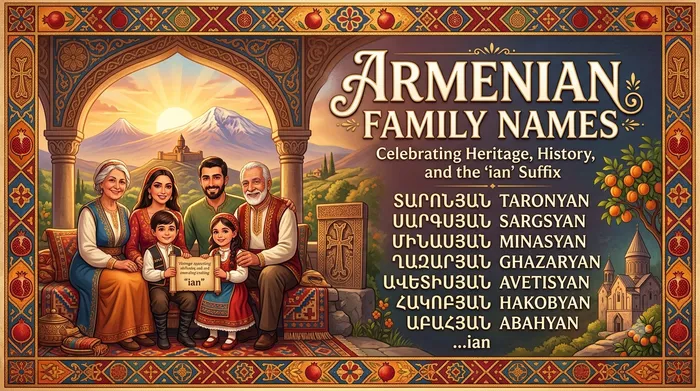
Armenian Family Names: What They Reveal About Ancestral Origins
Armenian family names are among the most distinctive in the world. The great majority end in -ian or -yan, a suffix that means “son of” or “descendant of.” These names carry layered information about ancestry, geography, occupation, and historical experience. For anyone exploring Armenian roots, understanding how these names were formed is one of the most useful starting points.
The Meaning of the -ian / -yan Suffix
The endings -ian (common in Western Armenian) and -yan (common in Eastern Armenian) are patronymic. They originally indicated descent from a male ancestor whose given name formed the root of the surname.
Examples include:
| Surname | Root Name | Meaning |
|---|---|---|
| Petrosian / Petrosyan | Petros | Son of Petros (Peter) |
| Sargsyan | Sargis | Son of Sargis |
| Khachatryan | Khachatur | Son of Khachatur |
| Grigoryan | Grigor | Son of Grigor (Gregory) |
| Harutyunyan | Harutyun | Son of Harutyun |
Over time the suffix became fixed and hereditary, turning personal descriptions into permanent family names.
Main Types of Armenian Surnames
Armenian surnames generally fall into several categories:
Armenian surname origins
├── Patronymic (most common)
│   └── Based on a male ancestor’s given name
├── Occupational
│   └── Derived from a trade or profession
├── Geographic / Toponymic
│   └── Linked to a village, town, or region
├── Descriptive or Nickname-based
│   └── Based on a personal trait or characteristic
└── Noble or Clan names
└── Older aristocratic or house names
Patronymic names form the largest group.
Occupational names may refer to metalworking, commerce, priesthood, or other traditional roles.
Geographic names often end in -tsi (meaning “from”), such as Vanetsi (from Van) or Karin-tsi (from Erzurum/Karin).
Noble names sometimes preserve older endings such as -uni.
Western vs Eastern Armenian Naming Patterns
Historical and political divisions created noticeable differences:
| Feature | Western Armenian | Eastern Armenian |
|---|---|---|
| Common suffix | -ian | -yan |
| Geographic focus | Ottoman Empire territories | Russian Empire / Soviet Armenia |
| Diaspora influence | Strong in Middle East, Europe, Americas | Strong in former Soviet states and Iran |
| Spelling variations | Often adapted to French, English, Arabic | Often adapted to Russian |
When families migrated, local languages frequently changed the spelling of the same original name. The same ancestral line might appear as “Petrosian,” “Bedrosian,” or “Petrossian” depending on the country of settlement.
What Names Reveal About Ancestral Origins
A careful reading of an Armenian surname can suggest several things:
- The given name of a male ancestor living several generations ago
- Possible regional origin within the historic Armenian highlands (for example, names linked to Van, Bitlis, Karin, Artsakh, or Syunik)
- Social or professional background of earlier generations
- Religious or cultural environment (many root names are Christian saints’ names)
- Migration history, visible through spelling changes in diaspora communities
Names alone rarely prove exact village origin, but they provide valuable clues that can be tested against oral history, church records, and DNA results.
Historical Influences on Armenian Names
Armenian naming practices absorbed elements from neighboring cultures over centuries:
- Persian and Arabic influences during earlier periods
- Turkish administrative and linguistic influence under the Ottoman Empire
- Russian forms during the imperial and Soviet eras
- Local adaptations in Lebanon, Syria, France, the United States, and elsewhere
Despite these external layers, the core Armenian pattern of the -ian/-yan patronymic remained remarkably stable.
Practical Tips for Researching Armenian Family Names
- Collect every spelling variation that appears in documents, passports, and family papers.
- Note whether the family used Western or Eastern Armenian dialect forms.
- Record any known village, town, or region of origin, even if incomplete.
- Compare the root name with common Armenian given names of the 18th and 19th centuries.
- Cross-reference with church baptismal and marriage records where available.
- Treat family stories about name changes at borders or during immigration as important research leads.
Building an Armenian Family Tree
Armenian communities have long valued genealogy. Many families preserved oral histories and written notes about ancestors, especially after the disruptions of the early 20th century. Organizing this information in a clear digital format helps protect it and makes it easier to share with relatives across the diaspora.
A digital family tree can hold original and adapted name spellings, places of origin, migration routes, and personal stories in one private place. You can begin building that record for free, with no sign-up required, at the My rOoOts create-tree page.
The family tree generator offers a simple way to start with known names and relationships. An ancestor timeline generator can place generations against key historical periods. When relatives from different countries contribute, a relationship calculator helps clarify kinship terms across languages and traditions.
Conclusion
Armenian family names ending in -ian or -yan are living records of ancestry. Most began as simple statements of descent from a particular male ancestor and later absorbed information about place, occupation, and historical experience. Differences between Western and Eastern forms, as well as spelling changes in the diaspora, add further layers of meaning.
For anyone tracing Armenian roots, the family name is rarely just a label. It is a starting clue that points toward earlier generations, forgotten villages, and the long journey of a people. Preserving those names, together with the stories that accompany them, in a well-organized digital family tree ensures that the connection to ancestral origins remains clear for future generations.
Create Your Family Tree for Free
Start building your family history in minutes with the My rOoOts Free Family Tree Creator. Add parents, grandparents, children, and relatives, organize generations visually, and create a beautiful family tree that you can save and share.
👉 Create your free family tree: Free Family Tree Creator
No design skills required. Simply enter your family details and generate a clear, easy-to-read family tree online for free.
Check Zodiac Compatibility for Any Two People
Curious about how well two people match based on their date of birth? Try the My rOoOts Zodiac Compatibility Tool to compare zodiac signs, explore relationship compatibility, and get a quick compatibility score for couples, friends, or family members.
👉 Check compatibility now: Zodiac Compatibility Calculator
You can enter two dates of birth and even mention the relationship type to get a more personalized compatibility result.
Download a Free Family Tree Template
Want to draw your family tree yourself? The My rOoOts Family Tree Template provides a free printable blank pedigree chart for documenting your family history across multiple generations.
👉 Download a free family tree template: Family Tree Template
Choose a 3-generation, 4-generation, or 5-generation family tree template and save it as a PDF for printing, writing, and documenting your ancestors.
Discover the Meaning and Origin of Your Surname
Ever wondered where your family name came from? Use the My rOoOts Surname Meaning Lookup to explore surname meanings, origins, history, and etymology from different regions and cultures around the world.
👉 Discover your surname meaning: Surname Meaning Lookup
Learn more about your last name and explore the possible linguistic, geographic, cultural, and historical roots behind your family surname.
Start your family tree free
No account needed to begin. Build it in minutes, then save it whenever you're ready.
Build your family tree