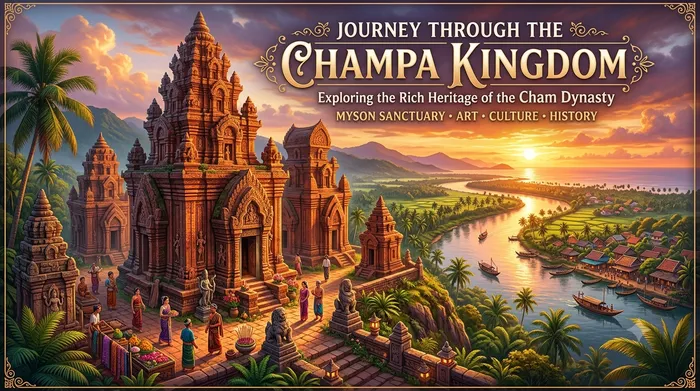
The Genealogy of the Champa Kingdom: Tracing Cham Ancestry
The Champa Kingdom was one of the most distinctive civilizations of mainland Southeast Asia. For more than a thousand years, Cham polities flourished along the central and southern coasts of present-day Vietnam. Although the kingdom no longer exists, its people — the Cham — continue to maintain language, religion, and family traditions. Understanding the history of Champa is an essential first step for anyone tracing Cham ancestry.
Who Were the Cham and Where Was Champa?
The Cham are an Austronesian people. Their language belongs to the Malayo-Polynesian branch and is related to languages spoken in Indonesia, Malaysia, and the Philippines. This linguistic connection points to ancient maritime migrations from Island Southeast Asia into the Indochinese coast.
Champa was not a single centralized empire for most of its history. It was a collection of principalities and city-states that shared culture, religion, and trade interests. Major centers existed in regions corresponding to modern Quảng Nam, Bình Định, Ninh Thuận, Bình Thuận, and further south at different periods.
| Period | Approximate Dates | Key Developments |
|---|---|---|
| Early Champa | 2nd–8th centuries | Formation of coastal polities, Indian cultural influence |
| Classical Champa | 9th–15th centuries | Temple building, trade, conflicts with neighbors |
| Decline and Fragmentation | 15th–19th centuries | Gradual loss of territory to Đại Việt |
| Final Absorption | Early 19th century | Last Cham territories incorporated |
Religion and Cultural Identity
Champa absorbed strong Indian cultural influences. Hinduism, especially the worship of Shiva, became prominent, and later Buddhism also played a role. Magnificent temple complexes such as Mỹ Sơn reflect this era.
From the 15th–17th centuries onward, Islam spread among many Cham communities, particularly in the south. Today Cham populations include both Hindu (Balamon) and Muslim (Bani and other) groups, each preserving distinct religious and social traditions.
Cham cultural layers
├── Austronesian linguistic roots
├── Hindu-Buddhist period (temples, royal cults)
├── Islamic influence (from circa 15th century)
└── Local clan and matrilineal traditions
Social Structure and Genealogy
Traditional Cham society placed significant emphasis on lineage and clan. In several Cham groups, especially among Hindu Cham, matrilineal principles influenced inheritance and social identity. Clan affiliation often determined marriage rules, ritual roles, and community standing.
Genealogical knowledge was transmitted through:
- Oral family histories
- Clan or lineage names
- Religious specialists and ritual records
- Local chronicles and temple traditions (where they survived)
Because political power fragmented and written archives were limited or lost, oral tradition and community memory remain especially important for reconstructing family lines.
Historical Pressures and Migration
Champa faced repeated military pressure from the expanding Vietnamese (Đại Việt) state to the north and occasional conflicts with Khmer kingdoms to the west. Over centuries, Cham territories shrank. Major defeats in the 15th century accelerated the loss of northern Cham lands.
As territories were absorbed, some Cham communities remained in place under new rulers, while others migrated. Significant Cham populations settled in Cambodia, and smaller groups moved elsewhere in Southeast Asia. These movements created diaspora branches that still exist today.
Modern Cham Communities
Today Cham people live primarily in:
- Vietnam (especially Ninh Thuận, Bình Thuận, and parts of the Mekong Delta)
- Cambodia
- Smaller communities in other countries
They continue to speak Cham dialects (though language shift is occurring in some areas), maintain religious practices, and preserve clan identities. For many families, knowledge of ancestral villages, clan names, and religious affiliation forms the core of genealogical identity.
Tracing Cham Ancestry in Practice
Researching Cham family history usually involves several complementary approaches:
- Collecting oral histories from older relatives about clan, village, and migration
- Recording both Cham and Vietnamese (or Khmer) versions of names
- Noting religious tradition (Hindu Balamon, Muslim Bani, or others)
- Identifying ancestral districts or villages in central or southern Vietnam
- Examining any surviving family documents, photographs, or ritual records
- Connecting with community organizations and cultural associations
DNA testing can sometimes indicate broader Austronesian or Southeast Asian ancestry components, but it cannot by itself identify specific Cham lineage. Documentary and oral evidence remain essential.
Building a Cham Family Tree
Because Cham genealogical knowledge is often distributed across relatives and communities, organizing the information in one place is especially valuable. A clear digital family tree can capture clan names, ancestral villages, religious affiliation, migration stories, and relationships that might otherwise remain fragmented.
You can begin building such a record for free, with no sign-up required, at the My rOoOts create-tree page.
The family tree generator offers a simple way to start with known names and connections. An ancestor timeline generator helps place generations against the historical periods of the Champa Kingdom. When relatives from different branches or countries contribute, a relationship calculator can assist with clarifying kinship terms across languages and traditions.
Conclusion
The Champa Kingdom was a long-lasting Austronesian civilization on the coast of present-day Vietnam. Its people developed a distinctive culture shaped by Indian religious influences, maritime trade, and later Islamic traditions. Although the kingdom itself disappeared in the early 19th century, Cham communities continue to preserve language, religion, and lineage knowledge.
For descendants seeking to trace Cham ancestry, the most reliable path combines oral family history, clan and village information, religious tradition, and careful documentation. Organizing these elements in a digital family tree helps protect a rich but often under-recorded heritage and makes it accessible to future generations.
Create Your Family Tree for Free
Start building your family history in minutes with the My rOoOts Free Family Tree Creator. Add parents, grandparents, children, and relatives, organize generations visually, and create a beautiful family tree that you can save and share.
👉 Create your free family tree: Free Family Tree Creator
No design skills required. Simply enter your family details and generate a clear, easy-to-read family tree online for free.
Check Zodiac Compatibility for Any Two People
Curious about how well two people match based on their date of birth? Try the My rOoOts Zodiac Compatibility Tool to compare zodiac signs, explore relationship compatibility, and get a quick compatibility score for couples, friends, or family members.
👉 Check compatibility now: Zodiac Compatibility Calculator
You can enter two dates of birth and even mention the relationship type to get a more personalized compatibility result.
Download a Free Family Tree Template
Want to draw your family tree yourself? The My rOoOts Family Tree Template provides a free printable blank pedigree chart for documenting your family history across multiple generations.
👉 Download a free family tree template: Family Tree Template
Choose a 3-generation, 4-generation, or 5-generation family tree template and save it as a PDF for printing, writing, and documenting your ancestors.
Discover the Meaning and Origin of Your Surname
Ever wondered where your family name came from? Use the My rOoOts Surname Meaning Lookup to explore surname meanings, origins, history, and etymology from different regions and cultures around the world.
👉 Discover your surname meaning: Surname Meaning Lookup
Learn more about your last name and explore the possible linguistic, geographic, cultural, and historical roots behind your family surname.
Start your family tree free
No account needed to begin. Build it in minutes, then save it whenever you're ready.
Build your family tree