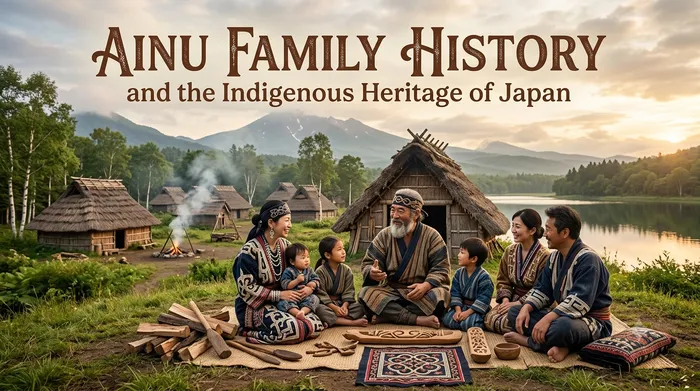
Ainu Family History and the Indigenous Heritage of Japan
The Ainu are the indigenous people of northern Japan, with deep roots in Hokkaido and historical presence in the Kuril Islands, southern Sakhalin, and parts of northern Honshu. Their language, spiritual traditions, and family histories form a distinct heritage that long predates the modern Japanese state. For descendants and researchers, understanding Ainu family history means looking at both cultural continuity and the effects of centuries of contact, assimilation, and revival.
Who Are the Ainu?
The Ainu developed a unique culture adapted to the forests, rivers, and coasts of the north. Traditional life centered on hunting, fishing (especially salmon), gathering, and a rich spiritual system based on kamuy — divine beings present in animals, plants, and natural forces.
The Ainu language is distinct from Japanese and is generally regarded as a language isolate or small language family. Oral literature, including epic tales known as yukar, preserved history, values, and cosmology across generations.
| Aspect | Traditional Ainu Characteristics |
|---|---|
| Homeland | Hokkaido, Kurils, southern Sakhalin, northern Honshu |
| Language | Ainu (distinct from Japanese) |
| Spirituality | Animistic, centered on kamuy |
| Livelihood | Hunting, fishing, gathering |
| Social memory | Oral histories and epic narratives |
Historical Relations with Neighboring Peoples
Ainu communities traded with Japanese (Wajin) settlers and with peoples further north for centuries. Over time, Japanese political and economic expansion increased pressure on Ainu lands and autonomy.
During the Meiji period (late 19th and early 20th centuries), government policies promoted settlement of Hokkaido, land redistribution, and cultural assimilation. Ainu people faced restrictions on traditional practices, language use, and livelihood. Many were pushed into agriculture or wage labor, and discrimination became widespread.
These policies disrupted family continuity in several ways: forced relocation, name changes, suppression of language, and gaps in official records.
Family Names, Records, and Oral Tradition
Traditional Ainu society transmitted identity and history primarily through oral means. Family and clan knowledge, hunting territories, ritual responsibilities, and ancestral stories were remembered and recited rather than written in the same way as Japanese household registers.
Later incorporation into the Japanese family registration system (koseki) created written records, but these often reflected assimilation pressures. Some Ainu families adopted or were assigned Japanese-style surnames. As a result, modern researchers frequently combine:
- Oral family histories
- Local Hokkaido records and ethnographic accounts
- Surviving traditional names and place names
- Community knowledge held by elders
Ainu family history sources
├── Oral tradition and elder knowledge
├── Family stories of place and livelihood
├── Official registers (often incomplete or altered)
├── Place names and territorial memory
└── Modern community and cultural records
Genetic and Ancestral Context
Genetic studies show that Ainu populations carry distinct ancestry components linked to early peoples of the region, with connections to other ancient Northeast Asian groups. At the same time, centuries of interaction produced varying degrees of admixture with neighboring populations.
DNA tests can sometimes indicate elevated genetic affinity with Ainu or related northern populations, but they cannot alone prove specific family lines. Documentary and oral evidence remain essential for reconstructing particular genealogies.
Modern Recognition and Cultural Revival
In 2019 the Japanese government officially recognized the Ainu as an indigenous people of Japan. This step followed decades of activism by Ainu individuals and organizations seeking acknowledgment of history, cultural rights, and dignity.
Today there is renewed interest in language revitalization, traditional crafts, dance, and ceremony. Museums, cultural centers, and community groups in Hokkaido play important roles in education and transmission. For many families, this broader revival supports personal efforts to recover and record ancestral knowledge.
Tracing and Preserving Ainu Family History
Practical research often begins with conversations with older relatives about places of origin in Hokkaido, traditional livelihoods, family stories, and any remembered Ainu names or customs. Local historical materials, community associations, and ethnographic collections can provide further context.
Because records may be fragmented, organizing what exists becomes especially valuable. A clear digital family tree can hold names (both traditional and Japanese-style), places, stories, and relationships in one private space that relatives can help expand.
You can begin building such a record for free, with no sign-up required, at the My rOoOts create-tree page. The family tree generator offers a simple starting point. An ancestor timeline generator helps place generations against historical periods of contact and change. When family members from different branches contribute, a relationship calculator can assist with clarifying connections.
Conclusion
Ainu family history is inseparable from the wider indigenous heritage of northern Japan. It includes a distinctive language, spiritual worldview, oral literature, and long experience of both independence and external pressure. Although assimilation policies created gaps in language and records, oral tradition and modern cultural revival continue to sustain identity.
For descendants and researchers, careful collection of family stories, attention to place and community knowledge, and organized documentation offer the best path forward. Preserving these elements in a digital family tree helps ensure that Ainu ancestral connections remain visible and accessible for future generations.
Create Your Family Tree for Free
Start building your family history in minutes with the My rOoOts Free Family Tree Creator. Add parents, grandparents, children, and relatives, organize generations visually, and create a beautiful family tree that you can save and share.
👉 Create your free family tree: Free Family Tree Creator
No design skills required. Simply enter your family details and generate a clear, easy-to-read family tree online for free.
Check Zodiac Compatibility for Any Two People
Curious about how well two people match based on their date of birth? Try the My rOoOts Zodiac Compatibility Tool to compare zodiac signs, explore relationship compatibility, and get a quick compatibility score for couples, friends, or family members.
👉 Check compatibility now: Zodiac Compatibility Calculator
You can enter two dates of birth and even mention the relationship type to get a more personalized compatibility result.
Download a Free Family Tree Template
Want to draw your family tree yourself? The My rOoOts Family Tree Template provides a free printable blank pedigree chart for documenting your family history across multiple generations.
👉 Download a free family tree template: Family Tree Template
Choose a 3-generation, 4-generation, or 5-generation family tree template and save it as a PDF for printing, writing, and documenting your ancestors.
Discover the Meaning and Origin of Your Surname
Ever wondered where your family name came from? Use the My rOoOts Surname Meaning Lookup to explore surname meanings, origins, history, and etymology from different regions and cultures around the world.
👉 Discover your surname meaning: Surname Meaning Lookup
Learn more about your last name and explore the possible linguistic, geographic, cultural, and historical roots behind your family surname.
Start your family tree free
No account needed to begin. Build it in minutes, then save it whenever you're ready.
Build your family tree