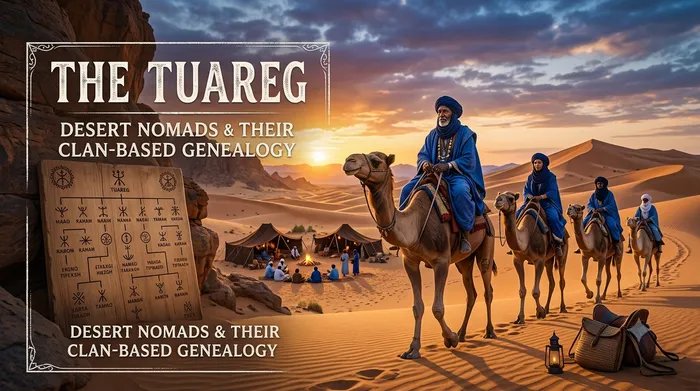
The Tuareg: Desert Nomads and Their Clan-Based Genealogy
The Tuareg are an Amazigh (Berber) people whose traditional homeland stretches across the central Sahara. Known for their distinctive indigo-dyed veils, camel pastoralism, and deep knowledge of the desert, the Tuareg have maintained a social system in which clan affiliation and genealogy play a central role. For anyone interested in their family history, understanding clan structure is essential.
Who Are the Tuareg?
The Tuareg live mainly in present-day Mali, Niger, Algeria, Libya, and Burkina Faso. Historically they were highly mobile pastoralists, moving with herds of camels, goats, and sometimes cattle across vast arid zones. Their language belongs to the Berber branch of the Afro-Asiatic family and is known as Tamasheq, Tamajaq, or related dialects depending on the region.
Tuareg culture is famous for the tagelmust, the turban and face veil traditionally worn by men, and for a rich tradition of poetry, music, and oral literature. They also preserve the Tifinagh script, an ancient writing system still used in cultural and modern contexts.
| Aspect | Traditional Features |
|---|---|
| Homeland | Central Sahara (Mali, Niger, Algeria, Libya, etc.) |
| Livelihood | Camel and goat pastoralism |
| Language | Tamasheq / Tamajaq (Berber) |
| Social organization | Hierarchical clan and confederation system |
| Cultural markers | Veil, silver jewelry, oral poetry, Tifinagh |
Clan Structure and Social Hierarchy
Tuareg society was traditionally organized into large confederations composed of multiple clans and lineages. Status was strongly tied to birth and genealogy. A simplified view of the classic hierarchy includes:
Traditional Tuareg social categories
├── Noble clans (ihaggaren / imajaghan)
├── Vassal or tributary groups
├── Religious specialists (ineslemen)
├── Artisans (inaden)
└── Groups of dependent or formerly enslaved status
Noble clans often controlled access to resources, led political and military affairs, and maintained prestigious genealogies. Marriage rules, alliance patterns, and social expectations were closely linked to these clan identities. Knowing one’s precise lineage confirmed belonging and rank within the wider system.
Although modern life, drought, conflict, and state policies have altered many economic and political realities, clan identity continues to matter for social relations and self-understanding in many Tuareg communities.
The Importance of Genealogy
Genealogy among the Tuareg is not a private hobby. It is a core part of social knowledge. Elders and specialists transmit detailed information about ancestors, clan origins, alliances, and historical migrations. Accurate genealogical knowledge could affect:
- Rights to pasture and water
- Marriage eligibility
- Political influence within a confederation
- Claims to noble or other status
Oral transmission remained the primary method for centuries. Stories of founding ancestors, heroic figures, and important migrations were woven into the broader historical memory of each group.
Historical Pressures and Change
Tuareg societies experienced major disruption during the colonial period and after the independence of Saharan states. Droughts in the late 20th century, economic change, rebellion, and displacement forced many families toward towns and semi-sedentary life. These pressures sometimes weakened the regular transmission of detailed genealogical knowledge, especially when families were scattered or when younger generations grew up far from traditional desert routes.
At the same time, many Tuareg communities have worked to maintain language, cultural practices, and historical awareness. Clan names and family origin stories remain important markers of identity even in urban or diaspora settings.
Tracing Tuareg Family History Today
Researching Tuareg ancestry usually begins with oral information:
- Clan and sub-clan names
- Known places of seasonal migration or origin
- Stories of notable ancestors
- Links to specific confederations
Written records may exist in colonial archives, local administrative documents, or modern civil registration, but coverage is uneven. Combining family testimony with regional historical knowledge offers the strongest results.
DNA testing can sometimes indicate broader North African or Sahelian ancestry components, yet it cannot replace clan-level oral information. Genealogy among the Tuareg has always been a social and cultural fact as much as a biological one.
Recording Clan and Family Knowledge
Because genealogical knowledge is often held by older relatives and distributed across extended networks, organizing it in a clear format helps prevent loss. A digital family tree can store clan names, ancestral places, migration notes, and relationships in one private space that family members can help expand.
You can begin building such a record for free, with no sign-up required, at the My rOoOts create-tree page. The family tree generator provides a simple starting point. An ancestor timeline generator helps place generations against historical periods of mobility and change. When relatives from different regions contribute, a relationship calculator can assist with clarifying kinship connections.
Conclusion
The Tuareg are a Saharan Amazigh people whose traditional life centered on nomadic pastoralism and a complex clan-based social system. Genealogy served as a practical and cultural foundation for status, marriage, resource rights, and collective identity. Although modern pressures have transformed many aspects of desert life, clan affiliation and ancestral knowledge continue to shape how many Tuareg understand themselves and their history.
For families seeking to preserve this heritage, careful collection of oral information and organized documentation remain essential. Recording clan names, stories, and relationships in a digital family tree helps ensure that the genealogical traditions of the Sahara remain accessible to future generations.
Create Your Family Tree for Free
Start building your family history in minutes with the My rOoOts Free Family Tree Creator. Add parents, grandparents, children, and relatives, organize generations visually, and create a beautiful family tree that you can save and share.
👉 Create your free family tree: Free Family Tree Creator
No design skills required. Simply enter your family details and generate a clear, easy-to-read family tree online for free.
Check Zodiac Compatibility for Any Two People
Curious about how well two people match based on their date of birth? Try the My rOoOts Zodiac Compatibility Tool to compare zodiac signs, explore relationship compatibility, and get a quick compatibility score for couples, friends, or family members.
👉 Check compatibility now: Zodiac Compatibility Calculator
You can enter two dates of birth and even mention the relationship type to get a more personalized compatibility result.
Download a Free Family Tree Template
Want to draw your family tree yourself? The My rOoOts Family Tree Template provides a free printable blank pedigree chart for documenting your family history across multiple generations.
👉 Download a free family tree template: Family Tree Template
Choose a 3-generation, 4-generation, or 5-generation family tree template and save it as a PDF for printing, writing, and documenting your ancestors.
Discover the Meaning and Origin of Your Surname
Ever wondered where your family name came from? Use the My rOoOts Surname Meaning Lookup to explore surname meanings, origins, history, and etymology from different regions and cultures around the world.
👉 Discover your surname meaning: Surname Meaning Lookup
Learn more about your last name and explore the possible linguistic, geographic, cultural, and historical roots behind your family surname.
Start your family tree free
No account needed to begin. Build it in minutes, then save it whenever you're ready.
Build your family tree