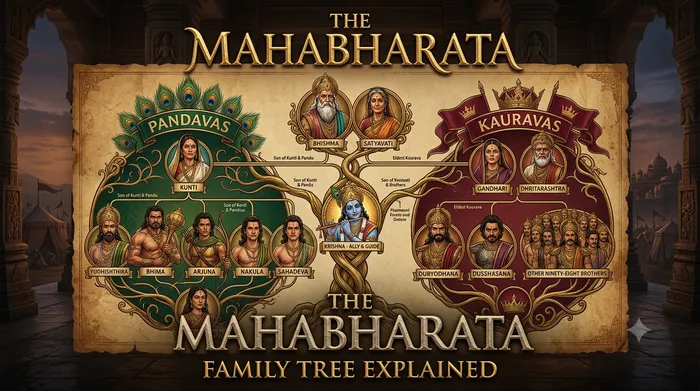
Interactive family tree
Lord Krishna Family Tree - Mahabharata Family Tree
35 people documented: explore the full interactive family tree
The Mahabharata Family Tree Explained
The Mahabharata is at heart a family story. The great war of Kurukshetra is fought between two branches of the same royal house: the Pandavas and the Kauravas. Both descend from the ancient Kuru lineage. Understanding the family tree removes much of the confusion that readers often feel when names and relationships multiply.
This guide lays out the main line in a straightforward way, focusing on the characters who drive the epic.
Note: The epic mixes historical memory, legend and theological elements. The genealogy below follows the traditional account preserved in the text itself.
The Broader Ancestral Background
The Kuru dynasty belongs to the Lunar line (Chandravamsha). Key early figures include:
- Yayati and his son Puru
- Dushyanta and Shakuntala
- Their son Bharata, after whom the Bharata lineage and the land of Bharatavarsha are named
Many generations later the line produces King Kuru, who gives his name to the Kuru kingdom and to Kurukshetra. Several generations after Kuru comes Pratipa, father of Shantanu. From Shantanu onward the genealogy becomes central to the epic’s plot.
Shantanu and the Critical Generation
Shantanu, king of Hastinapura, is the pivotal early figure.
He first marries the river goddess Ganga. They have eight sons; seven are returned to the river. The eighth survives and is named Devavrata, later known as Bhishma. Bhishma takes a lifelong vow of celibacy so that his father can marry again.
Shantanu then marries Satyavati. They have two sons:
- Chitrangada (dies young)
- Vichitravirya
Satyavati had earlier borne a son to the sage Parashara. That son is Vyasa (Krishna Dvaipayana), the traditional author of the Mahabharata and a key actor in the succession.
The Succession Crisis and Niyoga
Vichitravirya marries Ambika and Ambalika but dies without children. To preserve the line, Satyavati asks Vyasa to father sons with the two widows through the ancient practice of niyoga.
The results are:
- Dhritarashtra (born to Ambika) – born blind
- Pandu (born to Ambalika) – born pale or afflicted
- Vidura (born to a maidservant) – wise but of mixed status
These three men become the fathers of the next generation that will fight the war.
The Kaurava Branch
Dhritarashtra marries Gandhari. Through a long and unusual pregnancy they have one hundred sons and one daughter. The eldest son is Duryodhana. His closest brother is Dushasana. The entire group is known as the Kauravas (descendants of Kuru, though the name is applied especially to this branch).
Dhritarashtra also has a son named Yuyutsu by a Vaishya woman; Yuyutsu later fights on the Pandava side.
The Pandava Branch
Pandu marries two wives: Kunti and Madri.
Because of a curse, Pandu cannot father children himself. Kunti possesses a boon that allows her to invoke gods. The sons are therefore:
- Yudhishthira – son of Dharma (Yama), born to Kunti
- Bhima – son of Vayu, born to Kunti
- Arjuna – son of Indra, born to Kunti
- Nakula and Sahadeva – twin sons of the Ashvins, born to Madri
These five are the Pandavas. Although they are legally the sons of Pandu, their divine parentage is openly acknowledged in the epic.
Kunti had earlier invoked Surya and given birth to Karna, whom she set adrift. Karna is therefore the eldest brother of the Pandavas, though this is revealed only much later.
Key Marriages That Shape the Story
- The five Pandavas marry Draupadi (daughter of Drupada) jointly.
- Arjuna also marries Subhadra (Krishna’s sister); their son is Abhimanyu.
- Abhimanyu marries Uttara; their posthumous son is Parikshit, who continues the line after the war.
- Duryodhana’s daughter and other Kaurava children play smaller roles.
Krishna himself is related through the Yadava line. Kunti is the sister of Vasudeva (Krishna’s father), making Krishna a first cousin to the Pandavas.
Simplified Core Tree
A compact view of the central relationships:
Shantanu
- with Ganga → Bhishma
- with Satyavati → Chitrangada, Vichitravirya
- (Satyavati earlier) → Vyasa
Vyasa (by niyoga)
- with Ambika → Dhritarashtra
- with Ambalika → Pandu
- with maid → Vidura
Dhritarashtra + Gandhari → Duryodhana and the 99 brothers (Kauravas)
Pandu + Kunti/Madri → Yudhishthira, Bhima, Arjuna, Nakula, Sahadeva (Pandavas)
Kunti + Surya (earlier) → Karna
Arjuna + Subhadra → Abhimanyu → Parikshit → Janamejaya
Why the Family Tree Matters
The entire conflict is an internal succession dispute. Both sides have plausible claims:
- The Kauravas are the sons of the elder brother (Dhritarashtra).
- The Pandavas are the sons of the younger brother (Pandu) who actually ruled, and Yudhishthira is older than Duryodhana.
Add to this Bhishma’s vow, the blindness of Dhritarashtra, the divine births, Karna’s hidden identity, and the web of marriages, and the stage is set for a tragedy in which almost every major warrior is related by blood or marriage.
After the War
The Pandavas win, but the cost is the near destruction of the Kuru line. Yudhishthira rules, then the brothers retire. The throne passes to Parikshit, son of Abhimanyu, and later to Janamejaya. The family continues, yet the epic presents the war as a catastrophic cleansing of a dynasty that could no longer contain its own rivalries.
Conclusion
The Mahabharata family tree is complex because the story itself is about the breakdown of family order. From Shantanu and Satyavati through Vyasa’s intervention to the two rival sets of cousins, every major event grows out of kinship, succession and conflicting duties.
Once the main branches are clear — Bhishma’s generation, the generation of Dhritarashtra and Pandu, and the generation of the Pandavas and Kauravas — the epic’s human drama becomes far easier to follow. The war is not fought between strangers. It is fought inside one extended family whose tangled relationships make the tragedy both intimate and vast.
Create Your Family Tree for Free
Start building your family history in minutes with the My rOoOts Free Family Tree Creator. Add parents, grandparents, children, and relatives, organize generations visually, and create a beautiful family tree that you can save and share.
👉 Create your free family tree: Free Family Tree Creator
No design skills required. Simply enter your family details and generate a clear, easy-to-read family tree online for free.
Check Zodiac Compatibility for Any Two People
Curious about how well two people match based on their date of birth? Try the My rOoOts Zodiac Compatibility Tool to compare zodiac signs, explore relationship compatibility, and get a quick compatibility score for couples, friends, or family members.
👉 Check compatibility now: Zodiac Compatibility Calculator
You can enter two dates of birth and even mention the relationship type to get a more personalized compatibility result.
Download a Free Family Tree Template
Want to draw your family tree yourself? The My rOoOts Family Tree Template provides a free printable blank pedigree chart for documenting your family history across multiple generations.
👉 Download a free family tree template: Family Tree Template
Choose a 3-generation, 4-generation, or 5-generation family tree template and save it as a PDF for printing, writing, and documenting your ancestors.
Discover the Meaning and Origin of Your Surname
Ever wondered where your family name came from? Use the My rOoOts Surname Meaning Lookup to explore surname meanings, origins, history, and etymology from different regions and cultures around the world.
👉 Discover your surname meaning: Surname Meaning Lookup
Learn more about your last name and explore the possible linguistic, geographic, cultural, and historical roots behind your family surname.
Start your family tree free
No account needed to begin. Build it in minutes, then save it whenever you're ready.
Build your family tree