Few family trees have shaped a nation as dramatically as the Tudors. In just over a century, five monarchs from one family took England from the chaos of civil war to the edge of a global empire, broke the country away from the Catholic Church, and left behind one of history's most tangled succession stories. If you have ever lost track of how Henry VIII, Mary I, and Elizabeth I actually connect, this guide lays out the Tudor family tree in plain terms.
How the Tudors Came to Power
The Tudor dynasty did not start out royal. It began with a marriage: Owen Tudor, a Welsh courtier, secretly wed Catherine of Valois, the widowed queen of Henry V of England. Their grandson, Henry Tudor, had only a thin claim to the English throne, inherited through his mother, Margaret Beaufort, a descendant of King Edward III.
That thin claim became a crown in 1485, when Henry Tudor defeated King Richard III at the Battle of Bosworth Field, ending the Wars of the Roses, the decades-long civil war between the House of Lancaster and the House of York. Henry became King Henry VII and, to unite the two warring sides for good, married Elizabeth of York. Their union is symbolized by the Tudor rose, which combines Lancaster's red rose with York's white one.
The Tudor Family Tree at a Glance
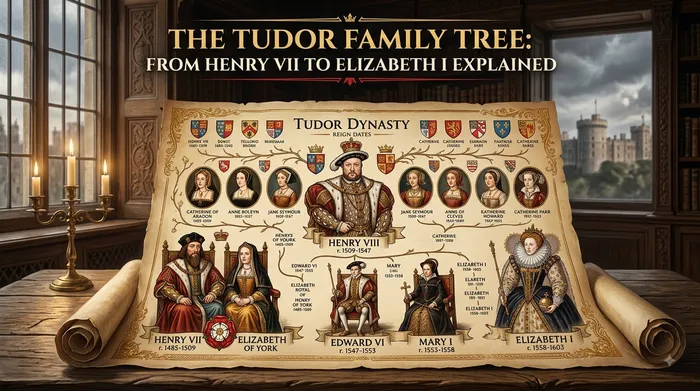
Henry VII (r. 1485-1509) + Elizabeth of York
└── Arthur, Prince of Wales (d. 1502, before taking the throne)
└── Henry VIII (r. 1509-1547)
    ├── with Catherine of Aragon: Mary I (r. 1553-1558)
    ├── with Anne Boleyn: Elizabeth I (r. 1558-1603)
    └── with Jane Seymour: Edward VI (r. 1547-1553)
└── Margaret Tudor (married into the Scottish royal line; ancestor of the Stuarts)
└── Mary Tudor (married Charles Brandon; grandmother of Lady Jane Grey)
Henry VIII and His Six Wives
No Tudor family tree makes sense without Henry VIII's marriages, since each one reshaped who stood in line for the throne:
- Catherine of Aragon - mother of Mary I; the marriage was annulled after 24 years
- Anne Boleyn - mother of Elizabeth I; executed in 1536
- Jane Seymour - mother of Edward VI; died shortly after childbirth
- Anne of Cleves - the marriage was annulled within months
- Catherine Howard - executed in 1542
- Catherine Parr - outlived Henry VIII
Three of these marriages produced the children who would each eventually rule England in turn, which is exactly what makes the succession so easy to lose track of.
Three Siblings, Three Reigns
After Henry VIII died in 1547, the crown passed between his children, each from a different mother:
- Edward VI became king at just nine years old and died at fifteen, never marrying or having children.
- Lady Jane Grey, a great-granddaughter of Henry VII through his younger daughter Mary Tudor, was proclaimed queen for nine days before being deposed and later executed. She is often left off simplified Tudor trees, but she was queen in every legal sense during that brief window.
- Mary I, Henry's eldest child, restored Catholicism and earned the nickname "Bloody Mary" for the religious executions carried out during her reign.
- Elizabeth I, Anne Boleyn's daughter, took the throne in 1558 and reigned for 45 years, presiding over what's often called England's golden age.
Tudor Monarchs at a Glance
| Monarch | Reign | Parents | Known For |
|---|---|---|---|
| Henry VII | 1485-1509 | Edmund Tudor & Margaret Beaufort | Ending the Wars of the Roses |
| Henry VIII | 1509-1547 | Henry VII & Elizabeth of York | Six wives; break with the Catholic Church |
| Edward VI | 1547-1553 | Henry VIII & Jane Seymour | Boy king; died at fifteen |
| Jane Grey | 1553 (9 days) | Frances Brandon & Henry Grey | Disputed, brief succession |
| Mary I | 1553-1558 | Henry VIII & Catherine of Aragon | Restored Catholicism |
| Elizabeth I | 1558-1603 | Henry VIII & Anne Boleyn | England's "Golden Age"; died without an heir |
How the Tudor Line Ended
Elizabeth I never married and left no children, so the Tudor dynasty ended with her death in 1603. The crown passed to her cousin, James VI of Scotland, a great-great-grandson of Henry VII through Margaret Tudor's line, and England and Scotland came under one monarch for the first time, beginning the House of Stuart.
Why the Tudor Family Tree Still Matters for Family Historians
You don't need a royal surname for the Tudor era to matter to your own research. It's a useful anchor point: if you're tracing English ancestry back through parish registers, most of which only begin around 1538 (a recordkeeping requirement introduced under Henry VIII), your earliest traceable ancestors were very likely living through Tudor rule. Knowing which monarch was on the throne when your ancestor was born can help you place their life in context, and understand what records might even exist for that period.
If you're mapping out your own family's timeline alongside historical events like these, a tool built for exactly that kind of layered family history can make the connections much easier to see and share with relatives.
Frequently Asked Questions
Who was the first Tudor king?
Henry VII was the first Tudor monarch, taking the throne in 1485 after defeating Richard III at the Battle of Bosworth Field and ending the Wars of the Roses.
How many children did Henry VIII have who became monarchs?
Three: Edward VI, Mary I, and Elizabeth I, each by a different mother, and each ruling England in turn.
Was Lady Jane Grey really queen?
Yes, briefly. She was proclaimed queen after Edward VI's death in 1553 and reigned for nine days before being deposed by Mary I, who had the stronger claim.
How is the Tudor family related to the British royal family today?
Through Margaret Tudor, Henry VIII's sister, who married into the Scottish royal line. Her descendant James VI of Scotland became James I of England after Elizabeth I died childless, founding the House of Stuart, and the line continues through subsequent dynasties to today's House of Windsor.
Why do Tudor family trees look so complicated?
Because the succession bounced between children of different mothers, an executed cousin, and a nine-day queen, all within about 70 years. Laying it out as a simple diagram, rather than a paragraph, is usually the easiest way to keep it straight.
Editor's picks
8 August 2026
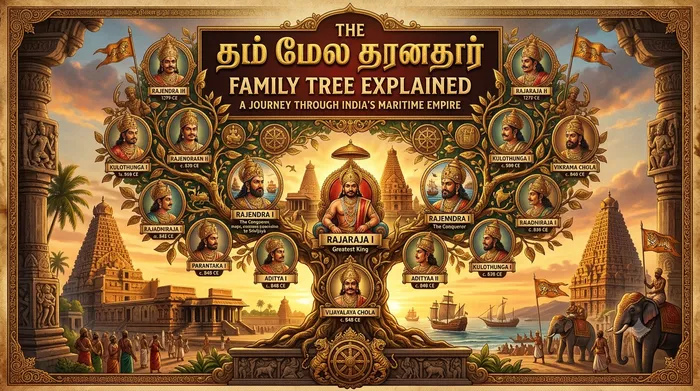
The Chola Dynasty Family Tree Explained
Explore the Chola Dynasty family tree from Vijayalaya to Rajaraja I, Rajendra I, and the later rulers who built one of South India’s greatest empires.
8 August 2026
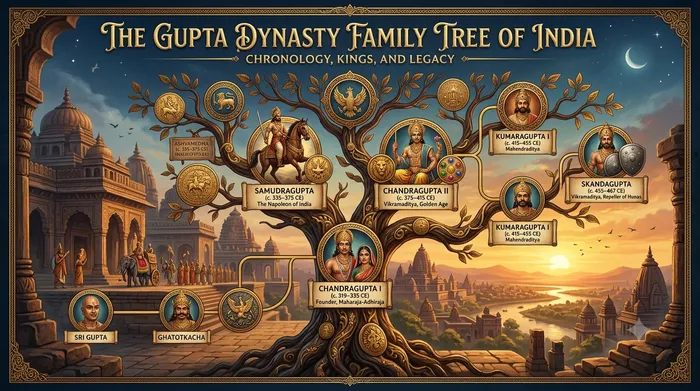
The Gupta Dynasty Family Tree of India
Explore the Gupta Dynasty family tree of India, from Sri Gupta and Chandragupta I to Samudragupta, Chandragupta II Vikramaditya, and the later rulers of India’s Golden Age.
8 August 2026
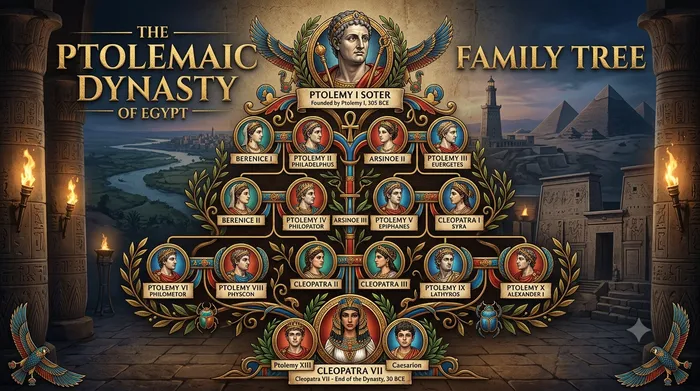
The Ptolemaic Dynasty Family Tree of Egypt
Explore the Ptolemaic Dynasty family tree of Egypt, from Ptolemy I Soter to Cleopatra VII, including the complex royal marriages and the end of pharaonic rule.
Create Your Family Tree for Free
Start building your family history in minutes with the My rOoOts Free Family Tree Creator. Add parents, grandparents, children, and relatives, organize generations visually, and create a beautiful family tree that you can save and share.
👉 Create your free family tree: Free Family Tree Creator
No design skills required. Simply enter your family details and generate a clear, easy-to-read family tree online for free.
Check Zodiac Compatibility for Any Two People
Curious about how well two people match based on their date of birth? Try the My rOoOts Zodiac Compatibility Tool to compare zodiac signs, explore relationship compatibility, and get a quick compatibility score for couples, friends, or family members.
👉 Check compatibility now: Zodiac Compatibility Calculator
You can enter two dates of birth and even mention the relationship type to get a more personalized compatibility result.
Download a Free Family Tree Template
Want to draw your family tree yourself? The My rOoOts Family Tree Template provides a free printable blank pedigree chart for documenting your family history across multiple generations.
👉 Download a free family tree template: Family Tree Template
Choose a 3-generation, 4-generation, or 5-generation family tree template and save it as a PDF for printing, writing, and documenting your ancestors.
Discover the Meaning and Origin of Your Surname
Ever wondered where your family name came from? Use the My rOoOts Surname Meaning Lookup to explore surname meanings, origins, history, and etymology from different regions and cultures around the world.
👉 Discover your surname meaning: Surname Meaning Lookup
Learn more about your last name and explore the possible linguistic, geographic, cultural, and historical roots behind your family surname.
Start your family tree free
No account needed to begin. Build it in minutes, then save it whenever you're ready.
Build your family tree