The Ptolemaic Dynasty Family Tree of Egypt
The Ptolemaic Dynasty was the last ruling house of ancient Egypt. Founded by one of Alexander the Great’s generals, it governed Egypt for nearly 300 years — from 305 BCE until the death of Cleopatra VII in 30 BCE. The family is famous for its Greek origin, its adoption of Egyptian royal traditions, and its frequent brother-sister marriages. This guide presents a clear family tree of the main line.
Origins of the Dynasty
After Alexander the Great died in 323 BCE, his vast empire was divided among his generals. Ptolemy, son of Lagus, took control of Egypt. In 305 BCE he declared himself king as Ptolemy I Soter (“the Savior”), founding the Ptolemaic Dynasty. Although Macedonian-Greek by blood, the Ptolemies presented themselves as pharaohs and supported Egyptian temples and gods.
Simplified Main Family Tree
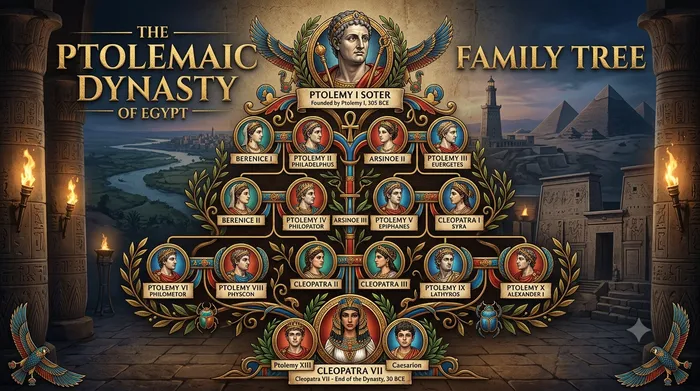
The Ptolemaic family tree is complicated because of repeated sibling marriages and shared names. Below is a clear, simplified version of the main royal line leading to Cleopatra VII:
Ptolemy I Soter (r. 305–282 BCE)
└── Ptolemy II Philadelphus (r. 282–246 BCE)
└── Ptolemy III Euergetes (r. 246–222 BCE)
└── Ptolemy IV Philopator (r. 222–204 BCE)
└── Ptolemy V Epiphanes (r. 204–180 BCE)
└── Ptolemy VI Philometor (r. 180–145 BCE)
└── Ptolemy VIII Euergetes II (Physcon) (r. 145–116 BCE)
└── Ptolemy IX Soter II (r. intermittent)
└── Ptolemy XII Auletes (r. 80–58 & 55–51 BCE)
├── Cleopatra VII (r. 51–30 BCE)
├── Ptolemy XIII
├── Ptolemy XIV
└── Arsinoe IV
Note: This is a simplified direct line. Many rulers had multiple wives (often their sisters) and competing children, which led to frequent civil wars.
Key Rulers at a Glance
| Ruler | Reign (approx.) | Notable Facts |
|---|---|---|
| Ptolemy I Soter | 305–282 BCE | Founder of the dynasty |
| Ptolemy II Philadelphus | 282–246 BCE | Built the Library of Alexandria; married his sister Arsinoe II |
| Ptolemy III Euergetes | 246–222 BCE | Expanded the empire |
| Ptolemy IV Philopator | 222–204 BCE | Won the Battle of Raphia |
| Ptolemy V Epiphanes | 204–180 BCE | Issued the Rosetta Stone decree |
| Ptolemy XII Auletes | 80–51 BCE | Father of Cleopatra VII |
| Cleopatra VII Philopator | 51–30 BCE | Last active ruler; allied with Caesar and Antony |
Cleopatra VII and the Final Generation
Cleopatra VII is the most famous member of the dynasty. She ruled jointly with her younger brothers Ptolemy XIII and later Ptolemy XIV, both of whom she married according to royal custom. After their deaths she ruled alongside her son Ptolemy XV Caesarion (her child with Julius Caesar).
Her relationships with Julius Caesar and later Mark Antony brought Egypt into the center of Roman civil wars. In 30 BCE, after defeat by Octavian (the future Emperor Augustus), Cleopatra and Antony died. Caesarion was killed shortly afterward. With their deaths, the Ptolemaic Dynasty and pharaonic rule in Egypt came to an end. Egypt became a province of the Roman Empire.
Distinctive Features of the Ptolemaic Family
- Sibling marriage: Many Ptolemaic kings married their full or half-sisters to keep power and “divine blood” within the family.
- Greek and Egyptian identity: The rulers spoke Greek and maintained a Macedonian court, yet they appeared on temple walls as traditional Egyptian pharaohs.
- Name repetition: Almost every king was named Ptolemy and many queens were named Cleopatra or Arsinoe, which makes the tree confusing without careful numbering.
- Violence and rivalry: Succession was often decided by murder, exile, or civil war rather than peaceful inheritance.
Why the Ptolemaic Tree Matters
The Ptolemaic family tree shows how a Greek military family transformed itself into the last pharaonic dynasty of Egypt. It also marks the political bridge between the Hellenistic world and the rise of Rome. Cleopatra VII stands at the end of both the Ptolemaic line and three thousand years of Egyptian royal tradition.
Recording Complex Family Histories
Royal families like the Ptolemies show how complicated relationships can become across generations. Ordinary families also face complex connections — multiple marriages, adoptions, blended households, and long lineages. A clear digital family tree helps keep these relationships understandable.
You can begin building your own private family tree for free, with no sign-up required, at the My rOoOts create-tree page.
The family tree generator offers a simple starting point. An ancestor timeline generator places generations against historical periods. When relatives add information, a relationship calculator helps clarify connections.
Conclusion
The Ptolemaic Dynasty ruled Egypt from Ptolemy I Soter in 305 BCE until the death of Cleopatra VII in 30 BCE. Through a mixture of military power, political marriage, and adaptation to Egyptian tradition, the family maintained control for nearly three centuries. Their tree ends with Cleopatra and her son Caesarion, closing the long history of independent pharaonic Egypt.
Studying this dynasty offers both a fascinating chapter of ancient history and a reminder of the value of recording family relationships carefully — whether the family sits on a throne or lives an ordinary life.
Editor's picks
8 August 2026
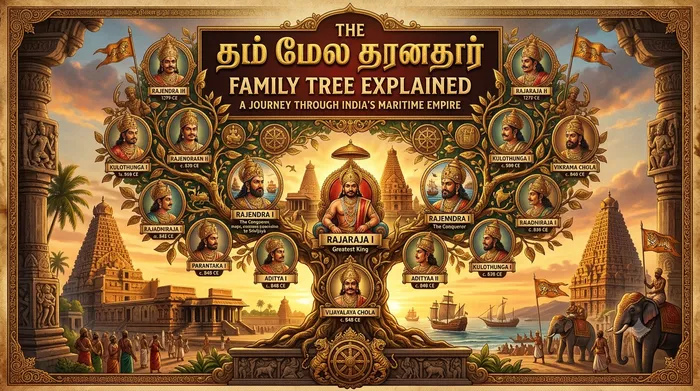
The Chola Dynasty Family Tree Explained
Explore the Chola Dynasty family tree from Vijayalaya to Rajaraja I, Rajendra I, and the later rulers who built one of South India’s greatest empires.
8 August 2026
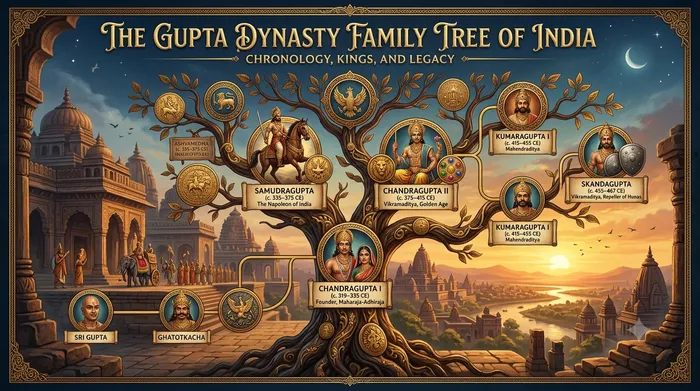
The Gupta Dynasty Family Tree of India
Explore the Gupta Dynasty family tree of India, from Sri Gupta and Chandragupta I to Samudragupta, Chandragupta II Vikramaditya, and the later rulers of India’s Golden Age.
8 August 2026
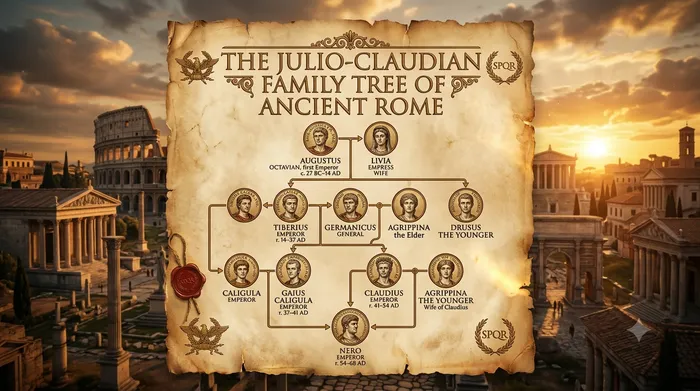
The Julio-Claudian Family Tree of Ancient Rome
Explore the Julio-Claudian family tree of ancient Rome, from Augustus to Nero, including the complex ties of blood, adoption, and marriage that shaped the first imperial dynasty.
8 August 2026
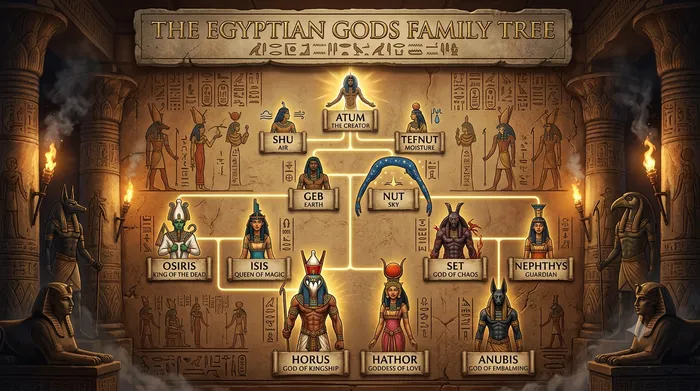
The Egyptian Gods Family Tree for Beginners
A simple beginner’s guide to the Egyptian gods family tree, from Atum and the Ennead of Heliopolis to Osiris, Isis, Horus, and the main divine relationships.
8 August 2026
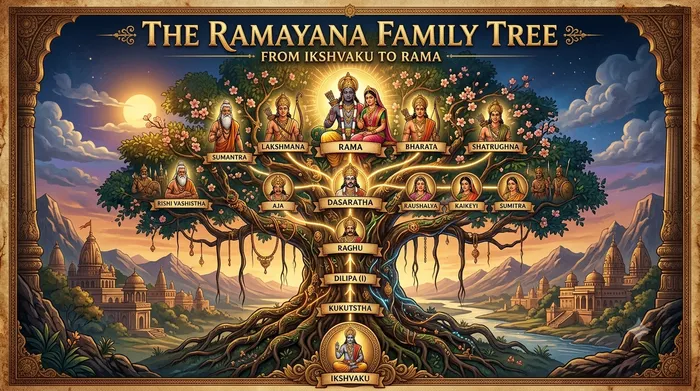
The Ramayana Family Tree from Ikshvaku to Rama
Explore the Ramayana family tree from Ikshvaku, founder of the Solar Dynasty, through legendary kings to Rama, Lakshmana, Bharata and Shatrughna in a clear simplified guide.
7 August 2026
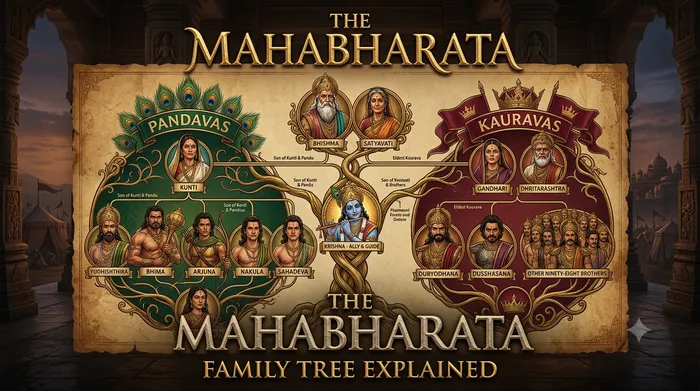
The Mahabharata Family Tree Explained: Kuru, Pandava and Kaurava Lineage
Understand the Mahabharata family tree in clear steps. Trace the Kuru dynasty from Shantanu to the Pandavas and Kauravas and see how the great war became a family conflict.

7 August 2026
The Buddha’s Family Tree and Shakya Clan Origins: A Clear Historical Guide
Explore the Buddha’s family tree and the origins of the Shakya clan. Learn about Kapilavastu, the Ikshvaku link, and the key relatives of Siddhartha Gautama.
Create Your Family Tree for Free
Start building your family history in minutes with the My rOoOts Free Family Tree Creator. Add parents, grandparents, children, and relatives, organize generations visually, and create a beautiful family tree that you can save and share.
👉 Create your free family tree: Free Family Tree Creator
No design skills required. Simply enter your family details and generate a clear, easy-to-read family tree online for free.
Check Zodiac Compatibility for Any Two People
Curious about how well two people match based on their date of birth? Try the My rOoOts Zodiac Compatibility Tool to compare zodiac signs, explore relationship compatibility, and get a quick compatibility score for couples, friends, or family members.
👉 Check compatibility now: Zodiac Compatibility Calculator
You can enter two dates of birth and even mention the relationship type to get a more personalized compatibility result.
Download a Free Family Tree Template
Want to draw your family tree yourself? The My rOoOts Family Tree Template provides a free printable blank pedigree chart for documenting your family history across multiple generations.
👉 Download a free family tree template: Family Tree Template
Choose a 3-generation, 4-generation, or 5-generation family tree template and save it as a PDF for printing, writing, and documenting your ancestors.
Discover the Meaning and Origin of Your Surname
Ever wondered where your family name came from? Use the My rOoOts Surname Meaning Lookup to explore surname meanings, origins, history, and etymology from different regions and cultures around the world.
👉 Discover your surname meaning: Surname Meaning Lookup
Learn more about your last name and explore the possible linguistic, geographic, cultural, and historical roots behind your family surname.
Start your family tree free
No account needed to begin. Build it in minutes, then save it whenever you're ready.
Build your family tree