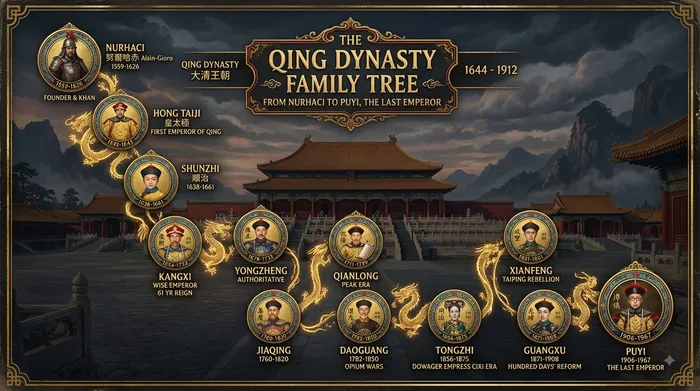
The Qing dynasty ruled China for nearly 300 years, from 1644 until the abdication of the last emperor in 1912, and it did so as a foreign dynasty, founded not by Han Chinese rulers but by the Manchu people from China's northeast. Understanding how the Qing imperial family tree unfolds, from its founder Nurhaci to the famous "Last Emperor" Puyi, is one of the clearest ways to see how China moved from a fragmented set of warring tribes to the world's largest empire, and then into the modern era.
This guide traces the direct imperial line of the Aisin Gioro clan (愛新覺羅), the family that ruled Qing China, generation by generation, along with what each emperor's reign is remembered for.
Nurhaci: The Founder
The Qing story begins with Nurhaci (1559-1626), a Jurchen chieftain who spent decades unifying the fractured Jurchen tribes of Manchuria into a single, disciplined military and political force. In 1616 he declared himself khan of the "Later Jin" dynasty, deliberately invoking the earlier Jin dynasty that had once ruled northern China. Nurhaci never ruled from Beijing himself, but the banner system and military organization he built became the backbone of Qing power for centuries.
Hong Taiji: Naming the Qing
Nurhaci's eighth son, Hong Taiji (1592-1643), inherited a strong but still regional power base and transformed it into an empire-in-waiting. In 1636 he renamed the dynasty "Qing" (meaning "clear" or "pure") and renamed the Jurchen people "Manchu," a rebranding meant to appeal more broadly to Mongol and Han Chinese allies. Hong Taiji died just before the final conquest of Beijing, leaving that triumph to his son.
Shunzhi: The First Qing Emperor in Beijing
The Shunzhi Emperor (r. 1644-1661) was only five years old when the crumbling Ming dynasty collapsed and Qing forces, invited in by a Ming general to help put down a rebellion, took Beijing instead. Shunzhi became the first Qing ruler to actually govern from the imperial capital, though real power for his early reign rested with his regent uncle, Dorgon.
Kangxi, Yongzheng, and Qianlong: The High Qing
The next three generations are considered the peak of Qing power and are often studied together as the "High Qing" era.
- Kangxi Emperor (r. 1661-1722), Shunzhi's son, had the longest reign of any Chinese emperor (61 years) and used it to crush internal rebellions, expand Qing territory into Taiwan and Mongolia, and stabilize the empire's finances.
- Yongzheng Emperor (r. 1722-1735), Kangxi's fourth son, is remembered less for conquest and more for administration: he reformed tax collection, cracked down on corruption, and centralized decision-making in ways that made the empire far more efficient.
- Qianlong Emperor (r. 1735-1796), Yongzheng's son, presided over the Qing's greatest territorial extent, doubling the empire's size through campaigns in Central Asia. He deliberately abdicated in 1796 rather than surpass his grandfather Kangxi's reign length, a rare and symbolically important act of filial respect.
Decline: Jiaqing Through Xianfeng
Qianlong's son Jiaqing (r. 1796-1820) inherited an empire strained by corruption and the costly White Lotus Rebellion. His son Daoguang (r. 1820-1850) presided over the First Opium War (1839-1842), which ended in humiliating defeat and the ceding of Hong Kong to Britain. Daoguang's son Xianfeng (r. 1850-1861) faced the devastating Taiping Rebellion, one of the deadliest conflicts in human history, alongside a second war with Britain and France.
Tongzhi and Guangxu: The Age of Cixi
Xianfeng's son, the Tongzhi Emperor (r. 1861-1875), took the throne as a small child, and real power fell to his mother, the Empress Dowager Cixi, who would go on to dominate Qing politics for nearly half a century. When Tongzhi died without an heir, Cixi arranged for her nephew to succeed him as the Guangxu Emperor (r. 1875-1908), who briefly attempted sweeping modernization during the 1898 Hundred Days' Reform before Cixi had him placed under house arrest for the rest of his life.
Puyi: The Last Emperor
Guangxu died childless, and the throne passed to his young nephew, Puyi, who became emperor in 1908 at just two years old. The Qing dynasty, and with it more than two thousand years of Chinese imperial rule, formally ended when Puyi abdicated in 1912 following the Xinhai Revolution. Puyi's later life, a brief return to the throne as a Japanese puppet ruler in Manchukuo, imprisonment, and eventual life as an ordinary citizen of the People's Republic of China, is often described as one of the most dramatic falls from power in modern history.
Nurhaci (b. 1559) - founded the Later Jin, unified the Jurchen tribes
└── Hong Taiji (son) - renamed the dynasty "Qing" in 1636
    └── Shunzhi Emperor (son) - first Qing emperor to rule from Beijing, 1644
        └── Kangxi Emperor (son) - longest reign in Chinese history
            └── Yongzheng Emperor (son) - centralized imperial administration
                └── Qianlong Emperor (son) - empire's greatest territorial extent
                    └── Jiaqing Emperor (son) - corruption and rebellion take hold
                        └── Daoguang Emperor (son) - First Opium War, 1839-1842
                            └── Xianfeng Emperor (son) - Taiping Rebellion
                                └── Tongzhi Emperor (son) - child emperor, Cixi's regency
                                    └── Guangxu Emperor (nephew) - Hundred Days' Reform, 1898
                                        └── Puyi (nephew) - Last Emperor, abdicated 1912
Why the Qing Family Tree Still Matters
Millions of people around the world today, particularly of Manchu descent, can trace family lines back to clans connected with the Qing court, and the Aisin Gioro surname itself still exists among descendants (some now using the shortened surname Jin). Mapping out an imperial family tree like this one is also a useful template for anyone documenting their own family's history through a similarly turbulent stretch of history, noting not just names and dates, but which historical events each generation actually lived through.
Frequently Asked Questions
Who founded the Qing dynasty?
Nurhaci founded the precursor state, the Later Jin, in 1616. His son Hong Taiji formally renamed it the Qing dynasty in 1636, and Hong Taiji's son, the Shunzhi Emperor, became the first Qing ruler to govern from Beijing in 1644.
Who was the last emperor of the Qing dynasty?
Puyi, who took the throne in 1908 as a two-year-old and abdicated in 1912, ending both the Qing dynasty and over two thousand years of Chinese imperial rule.
What clan did the Qing emperors belong to?
The Qing imperial family belonged to the Aisin Gioro clan, a Manchu noble lineage. Some descendants today still use the shortened surname Jin, derived from the clan name.
Why did Qianlong abdicate before he died?
Qianlong stepped down in 1796 specifically so he would not reign longer than his grandfather, the Kangxi Emperor, whose 61-year reign he considered a mark of respect not to surpass.
How is the Qing dynasty different from earlier Chinese dynasties like the Ming?
The Qing was founded by the Manchu people, an ethnic group from northeastern China, rather than by Han Chinese rulers. It's considered a "conquest dynasty," similar in that respect to the earlier Mongol-led Yuan dynasty.
Editor's picks
8 August 2026
The Chola Dynasty Family Tree Explained
Explore the Chola Dynasty family tree from Vijayalaya to Rajaraja I, Rajendra I, and the later rulers who built one of South India’s greatest empires.
8 August 2026
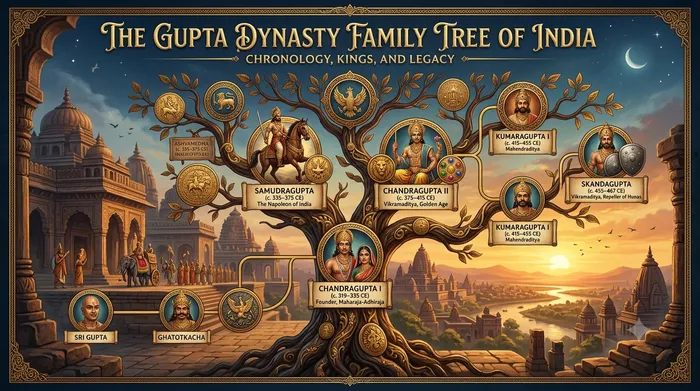
The Gupta Dynasty Family Tree of India
Explore the Gupta Dynasty family tree of India, from Sri Gupta and Chandragupta I to Samudragupta, Chandragupta II Vikramaditya, and the later rulers of India’s Golden Age.
8 August 2026
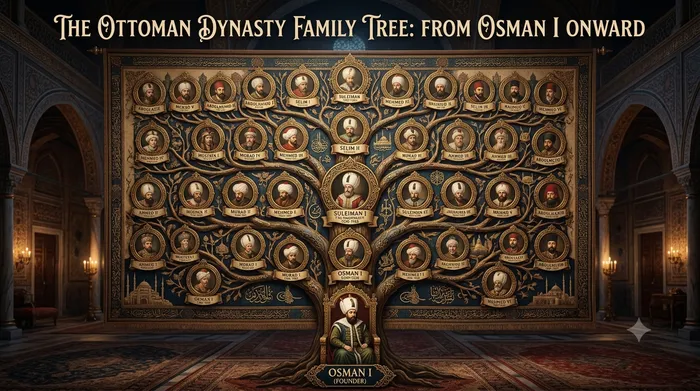
The Ottoman Dynasty Family Tree from Osman I Onward
Explore the Ottoman Dynasty family tree from Osman I to the last sultan Mehmed VI, covering the major sultans who ruled one of history’s longest-lasting empires.
16 August 2026
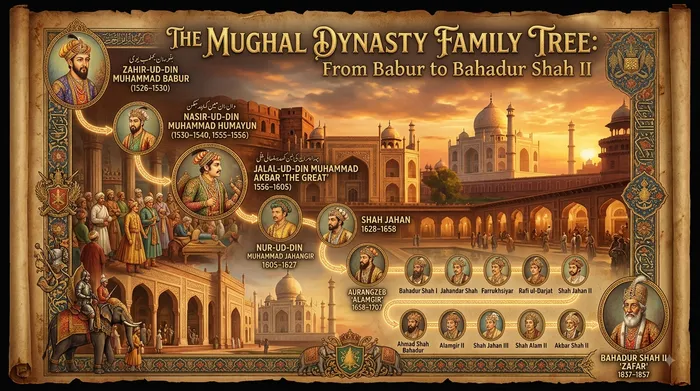
The Mughal Dynasty Family Tree: From Babur to Bahadur Shah II
Trace the Mughal dynasty's family tree across six generations, from founder Babur to the last emperor, Bahadur Shah II, exiled after the 1857 rebellion.
Create Your Family Tree for Free
Start building your family history in minutes with the My rOoOts Free Family Tree Creator. Add parents, grandparents, children, and relatives, organize generations visually, and create a beautiful family tree that you can save and share.
👉 Create your free family tree: Free Family Tree Creator
No design skills required. Simply enter your family details and generate a clear, easy-to-read family tree online for free.
Check Zodiac Compatibility for Any Two People
Curious about how well two people match based on their date of birth? Try the My rOoOts Zodiac Compatibility Tool to compare zodiac signs, explore relationship compatibility, and get a quick compatibility score for couples, friends, or family members.
👉 Check compatibility now: Zodiac Compatibility Calculator
You can enter two dates of birth and even mention the relationship type to get a more personalized compatibility result.
Download a Free Family Tree Template
Want to draw your family tree yourself? The My rOoOts Family Tree Template provides a free printable blank pedigree chart for documenting your family history across multiple generations.
👉 Download a free family tree template: Family Tree Template
Choose a 3-generation, 4-generation, or 5-generation family tree template and save it as a PDF for printing, writing, and documenting your ancestors.
Discover the Meaning and Origin of Your Surname
Ever wondered where your family name came from? Use the My rOoOts Surname Meaning Lookup to explore surname meanings, origins, history, and etymology from different regions and cultures around the world.
👉 Discover your surname meaning: Surname Meaning Lookup
Learn more about your last name and explore the possible linguistic, geographic, cultural, and historical roots behind your family surname.
Start your family tree free
No account needed to begin. Build it in minutes, then save it whenever you're ready.
Build your family tree