At its height in the early 1500s, the Inca Empire stretched roughly 2,500 miles down the spine of the Andes, from present-day Colombia to Chile, making it the largest empire ever assembled in the Americas before European contact. It was ruled from Cusco by a single lineage of emperors known as the Sapa Inca, "the only Inca," whose family tree is unlike almost any other royal genealogy in the world, partly because of who could marry whom.
Who Was the Sapa Inca?
"Sapa Inca" was the title of the supreme ruler, believed by his people to be a direct descendant of Inti, the sun god. Succession wasn't strictly father-to-eldest-son the way it was in most European monarchies. Instead, the ruling Inca often chose the most capable of his sons as heir, sometimes from among many candidates, since Inca emperors practiced polygamy and fathered children with numerous wives.
The Sapa Inca Lineage
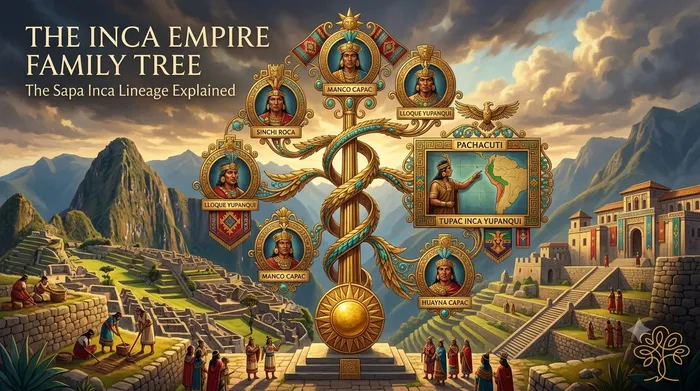
Historians typically trace the dynasty through thirteen rulers, beginning with a founder whose story blends history and legend:
- Manco Capac (legendary founder, c. 1200s) - said to have emerged from Lake Titicaca or the cave of Pacaritambo to found Cusco
- Sinchi Roca, Lloque Yupanqui, Mayta Capac, Capac Yupanqui - early rulers of the Kingdom of Cusco, a regional power that had not yet expanded into an empire
- Inca Roca, Yahuar Huacac, Viracocha Inca - continued to consolidate the Cusco valley region
- Pachacuti (r. c. 1438-1471) - the transformative ruler who defeated the rival Chanka people and began the rapid military expansion that turned Cusco into a true empire, Tawantinsuyu
- Tupac Inca Yupanqui (r. c. 1471-1493) - Pachacuti's son, extended the empire south into Chile and north into Ecuador
- Huayna Capac (r. c. 1493-1527) - his son, ruled the empire at its greatest territorial extent
- Huascar and Atahualpa - Huayna Capac's sons, who fought a brutal civil war over succession after their father's death, likely from smallpox introduced by early contact with Europeans
Manco Capac (legendary founder, c. 1200s)
└── (nine generations of Cusco-region rulers)
    └── Pachacuti (r. c. 1438-1471, founds the Inca Empire)
        └── Tupac Inca Yupanqui (r. c. 1471-1493)
            └── Huayna Capac (r. c. 1493-1527, empire at its peak)
                ├── Huascar (Cusco-based claimant, civil war)
                └── Atahualpa (Quito-based claimant, wins civil war in 1532)
                    └── captured and executed by Francisco Pizarro, 1533
The Civil War That Weakened the Empire Before the Spanish Arrived
When Huayna Capac died unexpectedly around 1527, he left no clear single heir, and his two sons, Huascar and Atahualpa, split the empire between rival power bases in Cusco and Quito. Their civil war lasted several years and left the empire fractured and exhausted just as Francisco Pizarro's small Spanish expedition arrived on the coast in 1532. Atahualpa won the civil war, but within a year, Pizarro had captured and executed him, effectively ending Sapa Inca rule, even though a resistance state led by Inca royal descendants held out in the mountains at Vilcabamba for another 40 years.
Titles and Structure Worth Knowing
- The Sapa Inca's principal wife held the title Coya, and by tradition she was often his full or half-sister, a practice meant to keep the sacred bloodline, believed to descend from the sun, from being diluted by outside families.
- Beyond the Coya, the Sapa Inca took many secondary wives, often the daughters of conquered or allied regional leaders, which helped bind the empire's diverse territories to Cusco through kinship.
- The empire itself was called Tawantinsuyu, "the four regions together," reflecting how it was administratively divided into four quarters radiating from Cusco.
- Royal lineage and property were preserved after an emperor's death through a system called panaca, a kind of royal corporation made up of an emperor's descendants (excluding the heir) that maintained his mummified body, land, and cult of worship, a genealogical structure with almost no equivalent elsewhere in world history.
| Ruler | Approximate Reign | Key Event |
|---|---|---|
| Manco Capac | Legendary, c. 1200s | Founds Cusco |
| Pachacuti | c. 1438-1471 | Founds the Inca Empire |
| Tupac Inca Yupanqui | c. 1471-1493 | Expands into Chile and Ecuador |
| Huayna Capac | c. 1493-1527 | Empire reaches its largest extent |
| Huascar / Atahualpa | c. 1527-1532 | Civil war over succession |
| Atahualpa | 1532-1533 | Captured and executed by Pizarro |
Why This Genealogy Still Matters
Millions of people across Peru, Bolivia, Ecuador, and Chile today can trace ancestry back to communities that lived under Inca rule, and Quechua, the Inca administrative language, is still spoken by roughly 8-10 million people. Understanding the Sapa Inca lineage isn't just ancient history, it's the backbone against which a great deal of Andean family history, migration, and identity still gets understood, in much the same way European family trees are often read against the reigns of a particular royal dynasty.
Frequently Asked Questions
How many Sapa Inca rulers were there?
Historians traditionally count thirteen rulers of the Sapa Inca lineage, from the legendary founder Manco Capac through to Atahualpa, who was captured and executed by the Spanish in 1533.
Why did Inca emperors marry their sisters?
The Sapa Inca's principal wife, the Coya, was often a full or half-sister, a practice intended to preserve a bloodline believed to descend directly from the sun god Inti without mixing it with outside families.
What caused the fall of the Inca Empire?
A devastating civil war between half-brothers Huascar and Atahualpa over succession, likely worsened by a smallpox epidemic that killed their father Huayna Capac, left the empire weakened just before Francisco Pizarro's small Spanish force arrived and captured Atahualpa in 1532.
What was the panaca system?
A panaca was a royal kin group made up of a deceased emperor's descendants, aside from his heir, responsible for preserving his mummified body, property, and legacy. Each new Sapa Inca founded his own panaca, creating a genealogical structure unique to Inca succession.
Is the Inca lineage the same as the broader Inca people?
No. "Inca" originally referred narrowly to the ruling elite descended from the royal Cusco lineage, not to every subject of the empire. Tawantinsuyu was ethnically diverse, and most of its population were Quechua or other Andean peoples governed by, but not related to, the Sapa Inca family line.
Editor's picks
17 August 2026
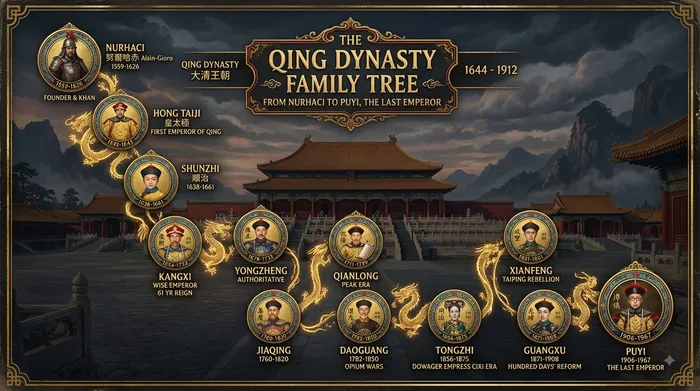
The Qing Dynasty Family Tree: From Nurhaci to Puyi, the Last Emperor
Trace the Qing dynasty's imperial family tree from founder Nurhaci through the High Qing emperors to Puyi, China's last emperor.
8 August 2026
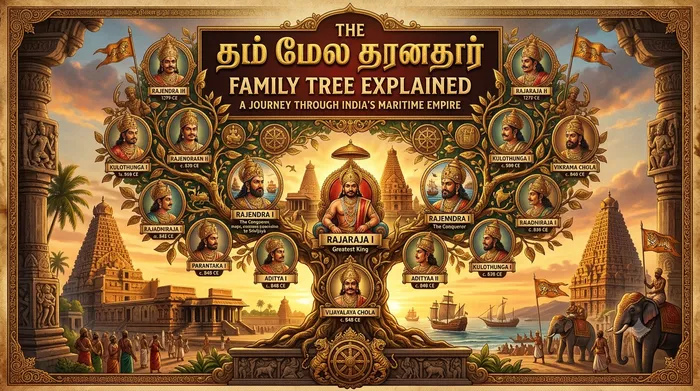
The Chola Dynasty Family Tree Explained
Explore the Chola Dynasty family tree from Vijayalaya to Rajaraja I, Rajendra I, and the later rulers who built one of South India’s greatest empires.
8 August 2026
The Gupta Dynasty Family Tree of India
Explore the Gupta Dynasty family tree of India, from Sri Gupta and Chandragupta I to Samudragupta, Chandragupta II Vikramaditya, and the later rulers of India’s Golden Age.
8 August 2026
The Ottoman Dynasty Family Tree from Osman I Onward
Explore the Ottoman Dynasty family tree from Osman I to the last sultan Mehmed VI, covering the major sultans who ruled one of history’s longest-lasting empires.
19 August 2026
The Japanese Imperial Family Tree: From Jimmu to Naruhito Explained
The Japanese Imperial Family is the world's oldest continuous hereditary monarchy. Here's how its family tree works, from the legendary Emperor Jimmu to Emperor Naruhito today.
Create Your Family Tree for Free
Start building your family history in minutes with the My rOoOts Free Family Tree Creator. Add parents, grandparents, children, and relatives, organize generations visually, and create a beautiful family tree that you can save and share.
👉 Create your free family tree: Free Family Tree Creator
No design skills required. Simply enter your family details and generate a clear, easy-to-read family tree online for free.
Check Zodiac Compatibility for Any Two People
Curious about how well two people match based on their date of birth? Try the My rOoOts Zodiac Compatibility Tool to compare zodiac signs, explore relationship compatibility, and get a quick compatibility score for couples, friends, or family members.
👉 Check compatibility now: Zodiac Compatibility Calculator
You can enter two dates of birth and even mention the relationship type to get a more personalized compatibility result.
Download a Free Family Tree Template
Want to draw your family tree yourself? The My rOoOts Family Tree Template provides a free printable blank pedigree chart for documenting your family history across multiple generations.
👉 Download a free family tree template: Family Tree Template
Choose a 3-generation, 4-generation, or 5-generation family tree template and save it as a PDF for printing, writing, and documenting your ancestors.
Discover the Meaning and Origin of Your Surname
Ever wondered where your family name came from? Use the My rOoOts Surname Meaning Lookup to explore surname meanings, origins, history, and etymology from different regions and cultures around the world.
👉 Discover your surname meaning: Surname Meaning Lookup
Learn more about your last name and explore the possible linguistic, geographic, cultural, and historical roots behind your family surname.
Start your family tree free
No account needed to begin. Build it in minutes, then save it whenever you're ready.
Build your family tree