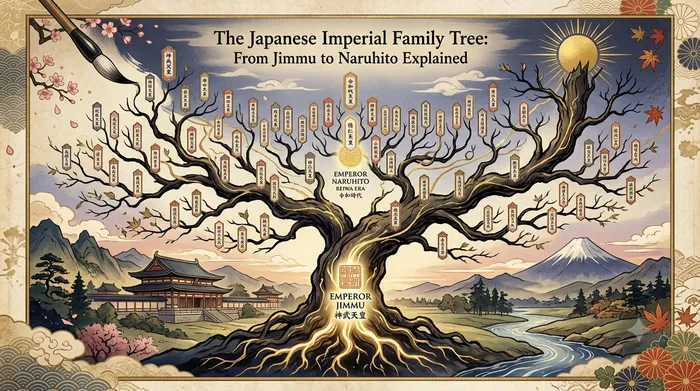
Every royal family tree in this series eventually runs into the same question: which dynasty has actually lasted the longest? The answer isn't the Habsburgs, the Ottomans, or even the British monarchy - it's Japan's Imperial Family, traditionally described as an unbroken line stretching back over 2,600 years to a single founding emperor. Whether or not every early link in that chain can be historically verified, the Chrysanthemum Throne, as it's known, is the oldest continuous hereditary monarchy in the world today.
The Legendary Founder: Emperor Jimmu
According to Japan's earliest chronicles, the Kojiki and Nihon Shoki (both compiled in the early 8th century), the first emperor was Jimmu, said to have ascended the throne in 660 BCE and to be a direct descendant of the sun goddess Amaterasu. Historians generally treat Jimmu and the emperors immediately following him as legendary rather than strictly historical figures - there is little independent evidence for their reigns - but the imperial family has continuously traced its legitimacy back to this founding claim ever since.
Generation Timeline (Approximate)
- 660 BCE (traditional) -> Reign of Emperor Jimmu, legendary founder
- c. 3rd-6th century CE -> Yamato period; historically verifiable emperors begin to emerge
- 794-1185 -> Heian period; emperors hold cultural and religious authority
- 1185-1868 -> Shogunate era; emperors retain the throne but cede political power to military rulers
- 1868 -> Meiji Restoration; imperial political authority formally restored
- 1945-present -> Post-war constitutional monarchy; emperor becomes a symbolic head of state
From Legend to Documented History
By around the 5th and 6th centuries CE, during the Yamato period, the imperial line becomes considerably easier to verify through contemporary records and archaeological evidence. For over a thousand years afterward, Japan's emperors held deep religious and cultural authority as descendants of the sun goddess, even during long stretches - especially the shogunate era from the 12th to 19th centuries - when real political power sat with military rulers like the shoguns rather than the throne itself.
The Meiji Restoration and Modern Emperors
Everything changed in 1868 with the Meiji Restoration, when political power was formally returned to the emperor after centuries of shogunate rule. This ushered in Japan's rapid modernization and a run of emperors whose reigns are still used to name entire eras of Japanese history:
| Emperor | Reign | Era Name |
|---|---|---|
| Meiji | 1867-1912 | Meiji |
| Taisho | 1912-1926 | Taisho |
| Showa (Hirohito) | 1926-1989 | Showa |
| Akihito | 1989-2019 | Heisei |
| Naruhito | 2019-present | Reiwa |
Japan names its historical eras after the reigning emperor, so "Showa" and "Heisei" refer to specific date ranges the way "Victorian" or "Elizabethan" do in British history - a naming convention almost unique to Japan among modern monarchies.
The Current Imperial Family
The present head of the Imperial House is Emperor Naruhito, who ascended the throne in 2019 following his father Akihito's abdication - a rare event in modern imperial history. Naruhito is married to Empress Masako, and the couple's only child is Princess Aiko, born in 2001.
This is where the Japanese Imperial Family tree runs into a genuinely modern controversy: under the 1947 Imperial Household Law, only males in the male line may inherit the throne, and women born into the imperial family lose their royal status entirely if they marry a commoner. Because Naruhito's only child is a daughter, Princess Aiko is not currently in the line of succession. Instead, the throne is set to pass to Naruhito's younger brother, Crown Prince Akishino, and after him to Akishino's son, Prince Hisahito - the only male heir of his generation.
Why Succession Is Under Debate
With so few male heirs remaining in the direct line, Japan has held ongoing public and political debate over whether to allow female succession or reigning empresses, something Japan has actually had in its own history - eight women have reigned as empress regnant across earlier centuries, even though the current law forbids it. No change has been enacted as of today, which means the family tree's next few generations remain unusually narrow for a dynasty this old.
What Makes This Family Tree Different
Most royal family trees in history branch outward across cousins, in-laws and rival claimants. Japan's imperial line, by contrast, has been kept deliberately narrow for most of its history, with succession law and religious tradition working together to preserve a single unbroken male line back to its founding claim - a very different shape from the sprawling, intermarried trees of European dynasties like the Habsburgs or Bourbons.
Frequently Asked Questions
Is Emperor Jimmu considered a real historical figure?
Most historians treat Jimmu and the earliest legendary emperors as founding myths rather than verified historical figures, though the imperial family has continuously claimed descent from him for well over a thousand years of documented history.
Who is next in line to the Japanese throne after Naruhito?
Crown Prince Akishino, Naruhito's younger brother, is first in line, followed by Akishino's son, Prince Hisahito.
Why can't Princess Aiko inherit the throne?
Under Japan's 1947 Imperial Household Law, only men in the male line of the imperial family may inherit the throne, which excludes Naruhito's only child, Princess Aiko, despite her being his direct heir.
Has Japan ever had a reigning empress?
Yes, eight women have reigned as empress regnant in Japanese history, though current succession law does not permit this today.
Why are Japanese historical eras named after emperors?
Japan uses a system called gengo, where each emperor's reign defines a named era (such as Showa or Heisei) used throughout Japanese calendars, media and record-keeping, similar to how "Victorian" describes a period of British history.
Editor's picks
8 August 2026
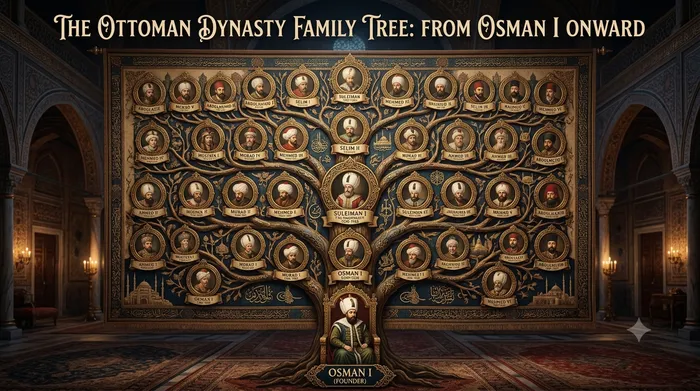
The Ottoman Dynasty Family Tree from Osman I Onward
Explore the Ottoman Dynasty family tree from Osman I to the last sultan Mehmed VI, covering the major sultans who ruled one of history’s longest-lasting empires.
18 August 2026
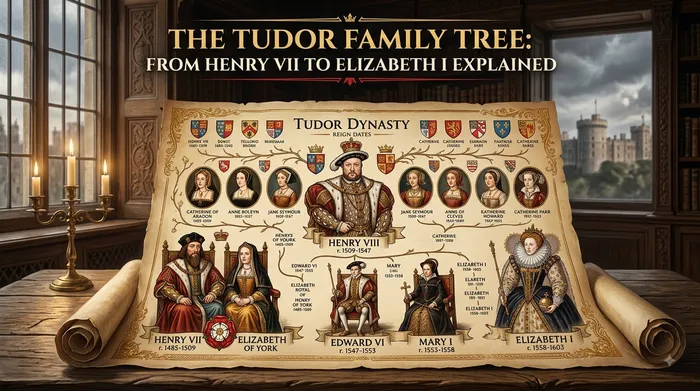
The Tudor Family Tree: From Henry VII to Elizabeth I Explained
From Henry VII's rise at Bosworth Field to Elizabeth I's childless death, trace how one Welsh family became England's most famous royal dynasty.
17 August 2026
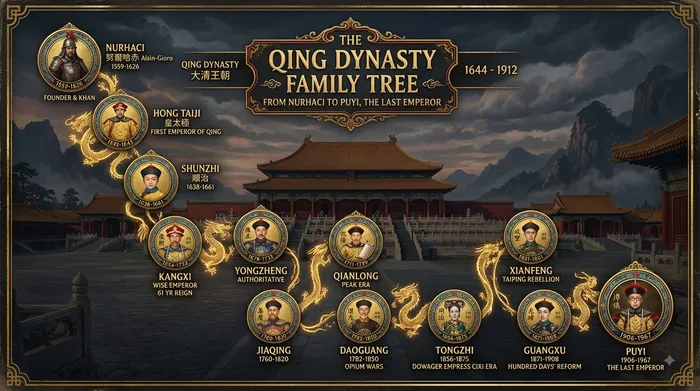
The Qing Dynasty Family Tree: From Nurhaci to Puyi, the Last Emperor
Trace the Qing dynasty's imperial family tree from founder Nurhaci through the High Qing emperors to Puyi, China's last emperor.
16 August 2026
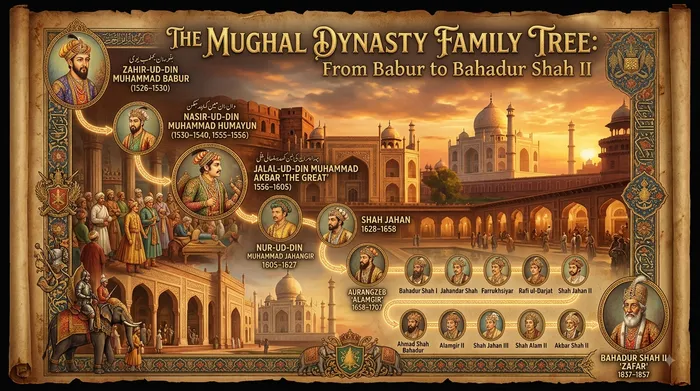
The Mughal Dynasty Family Tree: From Babur to Bahadur Shah II
Trace the Mughal dynasty's family tree across six generations, from founder Babur to the last emperor, Bahadur Shah II, exiled after the 1857 rebellion.
8 August 2026
The Chola Dynasty Family Tree Explained
Explore the Chola Dynasty family tree from Vijayalaya to Rajaraja I, Rajendra I, and the later rulers who built one of South India’s greatest empires.
Create Your Family Tree for Free
Start building your family history in minutes with the My rOoOts Free Family Tree Creator. Add parents, grandparents, children, and relatives, organize generations visually, and create a beautiful family tree that you can save and share.
👉 Create your free family tree: Free Family Tree Creator
No design skills required. Simply enter your family details and generate a clear, easy-to-read family tree online for free.
Check Zodiac Compatibility for Any Two People
Curious about how well two people match based on their date of birth? Try the My rOoOts Zodiac Compatibility Tool to compare zodiac signs, explore relationship compatibility, and get a quick compatibility score for couples, friends, or family members.
👉 Check compatibility now: Zodiac Compatibility Calculator
You can enter two dates of birth and even mention the relationship type to get a more personalized compatibility result.
Download a Free Family Tree Template
Want to draw your family tree yourself? The My rOoOts Family Tree Template provides a free printable blank pedigree chart for documenting your family history across multiple generations.
👉 Download a free family tree template: Family Tree Template
Choose a 3-generation, 4-generation, or 5-generation family tree template and save it as a PDF for printing, writing, and documenting your ancestors.
Discover the Meaning and Origin of Your Surname
Ever wondered where your family name came from? Use the My rOoOts Surname Meaning Lookup to explore surname meanings, origins, history, and etymology from different regions and cultures around the world.
👉 Discover your surname meaning: Surname Meaning Lookup
Learn more about your last name and explore the possible linguistic, geographic, cultural, and historical roots behind your family surname.
Start your family tree free
No account needed to begin. Build it in minutes, then save it whenever you're ready.
Build your family tree