The Mughal Empire ruled most of the Indian subcontinent for over three centuries, and its royal family tree reads like a masterclass in ambition, art, and family rivalry. Understanding how one Central Asian prince's descendants built the Taj Mahal, commissioned the Peacock Throne, and eventually lost an empire is a genuinely useful lens for anyone tracing South Asian family history, since Mughal-era administration, land grants, and titles still show up in family lore and old documents across India, Pakistan, and Bangladesh today.
From Central Asia to Hindustan: How the Mughal Dynasty Began
The founder, Babur, was not originally from India at all. Born in 1483 in the Fergana Valley (in modern Uzbekistan), he was a fifth-generation descendant of Timur (Tamerlane) on his father's side and a descendant of Genghis Khan on his mother's side, which is where the name "Mughal," a Persian-influenced form of "Mongol," comes from. After being pushed out of his ancestral territory, Babur turned south, and in 1526 he defeated the last Delhi Sultanate ruler, Ibrahim Lodi, at the First Battle of Panipat. That victory founded the Mughal dynasty in India.
The Six Great Mughals: A Family Tree Through Six Generations
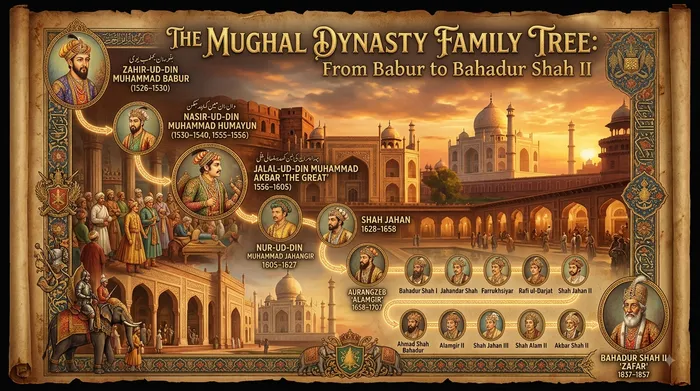
Historians usually count six "Great Mughals" as the dynasty's core line, the emperors who built and held the empire before it began to fracture. Each was the direct son of the last, which makes this one of the more straightforward royal successions to trace on paper, at least until you look at how each transition actually happened.
Babur (r. 1526-1530) - founded the empire after the Battle of Panipat
└── Humayun (r. 1530-1540, 1555-1556) - lost the throne, then won it back
    └── Akbar (r. 1556-1605) - consolidated and expanded the empire
        └── Jahangir (r. 1605-1627)
            └── Shah Jahan (r. 1628-1658) - built the Taj Mahal
                └── Aurangzeb (r. 1658-1707) - empire at its largest extent
                    └── (a long line of weaker successors)
                        └── Bahadur Shah II (r. 1837-1857) - exiled after 1857, dynasty ends
After Aurangzeb, more than a dozen emperors sat on the throne in just 150 years, most controlling little beyond Delhi itself while real power shifted to regional nawabs, the Marathas, and eventually the British East India Company.
Marriages, Rivalries and the Fight for the Throne
Mughal succession had no fixed rule of primogeniture, so almost every transition of power was contested, sometimes violently, between brothers. Shah Jahan himself fought his brothers for the throne after Jahangir's death, and later watched his own sons do the same to him: his third son, Aurangzeb, defeated and imprisoned his elder brother Dara Shikoh, the presumed heir, then confined Shah Jahan to Agra Fort for the last eight years of his life. From that fort, Shah Jahan could only look out at the Taj Mahal, the tomb he had built for his beloved wife, Mumtaz Mahal, who died giving birth to their fourteenth child.
Women in the family were often just as politically important as the emperors, even without holding the throne themselves. Akbar's mother, Hamida Banu Begum, was central to keeping Humayun's cause alive during his years in exile. Jahangir's wife, Nur Jahan, effectively ran the empire's administration during the later years of his reign, issuing coins and official orders in her own name, something almost unheard of for a Mughal empress.
The Slow Decline and the Last Emperor
Aurangzeb's death in 1707 marked the empire's high-water mark and the start of its unraveling. Costly wars in the Deccan, rising Maratha power, the Persian invasion of Delhi under Nadir Shah in 1739, and the steady growth of British East India Company influence all chipped away at Mughal authority. By the early 1800s, the emperor in Delhi was, in practice, a British-pensioned figurehead ruling only the Red Fort.
The dynasty's final chapter came in 1857. Bahadur Shah II, a poet-emperor with little real power, was declared the symbolic leader of the uprising against British rule that year. After the rebellion was crushed, he was tried, exiled to Rangoon (Yangon), and died there in 1862, closing a family line that had run unbroken, father to son, for well over 300 years.
Why the Mughal Family Tree Still Matters for Family Historians
You don't need royal blood for this history to matter to your own family research. Mughal-era mansabdari records, land grants (jagirs), and court titles shaped how many South Asian families organized themselves for generations afterward, and that administrative footprint still surfaces in old family documents, surnames, and oral history today. Mapping your own ancestors against a timeline like Babur-to-Bahadur Shah II is also a useful trick for family historians generally: once you know which Mughal emperor was on the throne during your great-great-grandparents' lifetime, dates and events from that era become much easier to place in context.
Frequently Asked Questions
Who was the first Mughal emperor?
Babur, who founded the dynasty in 1526 after defeating Ibrahim Lodi, the last ruler of the Delhi Sultanate, at the First Battle of Panipat.
Who was the last Mughal emperor?
Bahadur Shah II, who ruled only nominally from 1837 to 1857. He was exiled to Rangoon after the 1857 rebellion and died there in 1862, ending the dynasty.
How is Akbar related to Babur?
Akbar was Babur's grandson, the son of Humayun, who was Babur's son and immediate successor.
Why did Aurangzeb imprison his own father, Shah Jahan?
After defeating his brother Dara Shikoh in the war of succession, Aurangzeb confined Shah Jahan to Agra Fort for the rest of his life to secure his own claim to the throne, since Shah Jahan had favored Dara Shikoh as heir.
Are there living descendants of the Mughal dynasty today?
Yes. Descendants of the Mughal royal family are still alive today, living mostly ordinary lives in India and Pakistan; none hold any political power, and the empire itself has not existed since 1857.
Editor's picks
8 August 2026
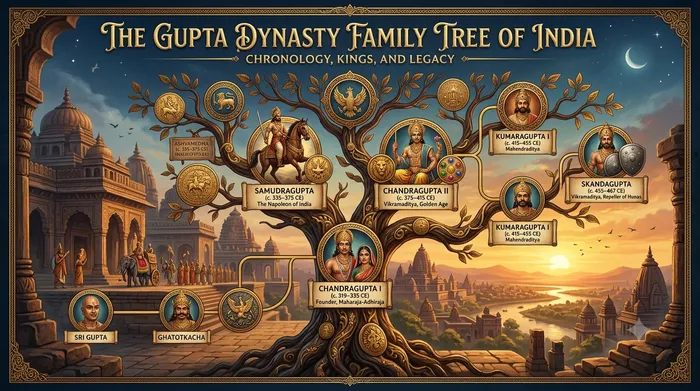
The Gupta Dynasty Family Tree of India
Explore the Gupta Dynasty family tree of India, from Sri Gupta and Chandragupta I to Samudragupta, Chandragupta II Vikramaditya, and the later rulers of India’s Golden Age.
8 August 2026
The Chola Dynasty Family Tree Explained
Explore the Chola Dynasty family tree from Vijayalaya to Rajaraja I, Rajendra I, and the later rulers who built one of South India’s greatest empires.
8 August 2026
The Ottoman Dynasty Family Tree from Osman I Onward
Explore the Ottoman Dynasty family tree from Osman I to the last sultan Mehmed VI, covering the major sultans who ruled one of history’s longest-lasting empires.
Create Your Family Tree for Free
Start building your family history in minutes with the My rOoOts Free Family Tree Creator. Add parents, grandparents, children, and relatives, organize generations visually, and create a beautiful family tree that you can save and share.
👉 Create your free family tree: Free Family Tree Creator
No design skills required. Simply enter your family details and generate a clear, easy-to-read family tree online for free.
Check Zodiac Compatibility for Any Two People
Curious about how well two people match based on their date of birth? Try the My rOoOts Zodiac Compatibility Tool to compare zodiac signs, explore relationship compatibility, and get a quick compatibility score for couples, friends, or family members.
👉 Check compatibility now: Zodiac Compatibility Calculator
You can enter two dates of birth and even mention the relationship type to get a more personalized compatibility result.
Download a Free Family Tree Template
Want to draw your family tree yourself? The My rOoOts Family Tree Template provides a free printable blank pedigree chart for documenting your family history across multiple generations.
👉 Download a free family tree template: Family Tree Template
Choose a 3-generation, 4-generation, or 5-generation family tree template and save it as a PDF for printing, writing, and documenting your ancestors.
Discover the Meaning and Origin of Your Surname
Ever wondered where your family name came from? Use the My rOoOts Surname Meaning Lookup to explore surname meanings, origins, history, and etymology from different regions and cultures around the world.
👉 Discover your surname meaning: Surname Meaning Lookup
Learn more about your last name and explore the possible linguistic, geographic, cultural, and historical roots behind your family surname.
Start your family tree free
No account needed to begin. Build it in minutes, then save it whenever you're ready.
Build your family tree