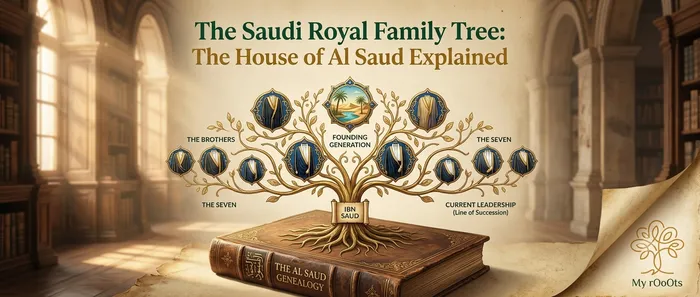
The Saudi Royal Family Tree: The House of Al Saud Explained
The Saudi royal family is almost uniquely large among the world's ruling houses. Thousands of princes trace their descent to a single 20th-century founder, and the kingdom itself is named after the family that rules it. Understanding the House of Al Saud's family tree means understanding a succession system unlike almost any other monarchy still standing today.
From a Desert Alliance to a Kingdom
The Al Saud family's rise began in 1744, in the small town of Diriyah, when local ruler Muhammad bin Saud allied with religious scholar Muhammad ibn Abd al-Wahhab. That alliance, one family providing political and military leadership, the other providing religious legitimacy, shaped Saudi Arabia's identity for the next 280 years and still underpins the kingdom today.
The family's path to modern statehood wasn't a straight line:
- The First Saudi State (1744-1818) was destroyed by Ottoman-Egyptian forces.
- The Second Saudi State (1824-1891) rose and eventually collapsed amid internal family rivalry and regional rivals.
- Abdulaziz ibn Saud (known simply as Ibn Saud) recaptured the family's ancestral capital, Riyadh, in 1902, then spent three decades reuniting the peninsula's territories.
- In 1932, Ibn Saud declared the unified Kingdom of Saudi Arabia, with himself as its first king.
The Family Tree from Ibn Saud Onward
Nearly every Saudi king since 1932 has been a son of Ibn Saud, a succession pattern that's unusual by global standards and central to understanding the modern family tree:
Abdulaziz ibn Saud (r. 1932-1953) - founder of the modern kingdom
├── Saud (r. 1953-1964)
├── Faisal (r. 1964-1975)
├── Khalid (r. 1975-1982)
├── Fahd (r. 1982-2005)
├── Abdullah (r. 2005-2015)
└── Salman (r. 2015-present)
    └── Crown Prince Mohammed bin Salman (grandson of Ibn Saud)
Ibn Saud reportedly had more than 40 sons, and for seven decades the crown passed from brother to brother rather than father to son. Salman is the last of Ibn Saud's sons to have taken the throne; his son, Mohammed bin Salman, represents the first expected transfer to the founder's grandchildren.
Kings of Saudi Arabia at a Glance
| King | Reign | Notable For |
|---|---|---|
| Abdulaziz ibn Saud | 1932-1953 | Unified the kingdom; founded the modern Saudi state |
| Saud | 1953-1964 | First son to succeed; removed by family consensus over financial mismanagement |
| Faisal | 1964-1975 | Modernized the state; assassinated by a nephew in 1975 |
| Khalid | 1975-1982 | Oversaw rapid economic growth from oil wealth |
| Fahd | 1982-2005 | Longest-reigning king until his death; adopted the title "Custodian of the Two Holy Mosques" |
| Abdullah | 2005-2015 | Introduced limited social and economic reforms |
| Salman | 2015-present | Current king; elevated Mohammed bin Salman to crown prince in 2017 |
Why Brothers Inherited the Throne
Unlike most European monarchies, where the crown passes directly from parent to eldest child, Saudi Arabia's succession moved horizontally across Ibn Saud's sons for generations. A few reasons explain why:
- Family cohesion. With dozens of sons from multiple wives, passing power among brothers helped balance influence across the family's many branches rather than concentrating it in one line.
- Practical experience. Brothers who became king were typically older, more experienced, and already held senior government roles before inheriting the throne.
- Formal structure. In 2006, King Abdullah created the Allegiance Council, made up of senior princes, to formalize how future kings and crown princes would be selected, a shift toward more structured succession as the founder's sons aged.
The Royal Family Today
King Salman bin Abdulaziz has ruled since 2015. His son, Crown Prince Mohammed bin Salman (widely known as MBS), was named crown prince in 2017 and now manages most day-to-day governance, including the kingdom's Vision 2030 economic program. His eventual succession will mark the first time the Saudi throne passes to Ibn Saud's grandchildren rather than his sons, a genuinely new chapter for the family tree after nearly a century of brother-to-brother succession.
Beyond the direct royal line, the wider Al Saud family includes thousands of princes descended from Ibn Saud's brothers and other branches, many holding senior government, military, or business positions, a scale of extended family that makes Saudi Arabia's royal genealogy one of the largest in the world.
Frequently Asked Questions
Why have so many Saudi kings been brothers rather than fathers and sons?
Because nearly every king since 1932 has been a son of the kingdom's founder, Abdulaziz ibn Saud. With dozens of sons to choose from, the family passed the crown from brother to brother for decades rather than moving straight to the next generation.
How many sons did Ibn Saud have?
Historical accounts put the number at more than 40 sons from his many marriages, several of whom went on to become king themselves.
Who is next in line for the Saudi throne?
Crown Prince Mohammed bin Salman, a son of the current King Salman and a grandson of founder Ibn Saud, is next in line, and would be the first grandson of the founder to hold the throne.
What is the Allegiance Council?
It's a body of senior Al Saud family members created in 2006 to formalize the process of selecting the king and crown prince, replacing the more informal family consensus that had guided succession in earlier decades.
Is the Saudi royal family related to other Gulf monarchies?
Not directly by blood in most cases, though the ruling families of the Gulf states, including Kuwait's Al Sabah, Bahrain's Al Khalifa, and Qatar's Al Thani, share a similar tribal Arabian heritage and centuries of intermarriage, alliance, and regional history with the Al Saud.
Editor's picks
26 August 2026
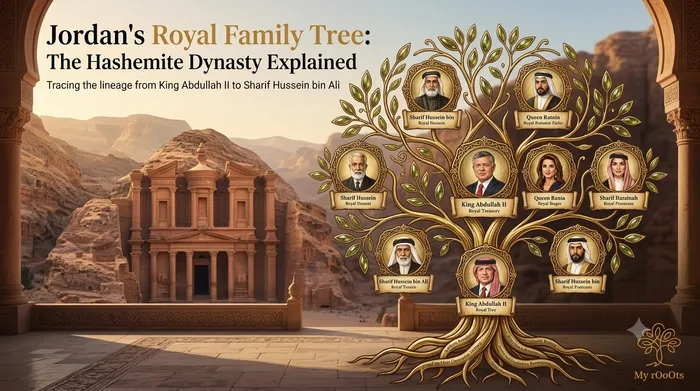
Jordan's Royal Family Tree: The Hashemite Dynasty Explained
How the Hashemite dynasty traces its lineage back to the Prophet Muhammad's family and has ruled Jordan since 1921, from King Abdullah I to King Abdullah II.
25 August 2026
Liechtenstein's Princely Family Tree: The House of Liechtenstein Explained
Liechtenstein is one of Europe's last monarchies where the prince genuinely rules. Here's how the House of Liechtenstein's family tree connects centuries of Austrian nobility to a tiny Alpine nation.

23 August 2026
Luxembourg's Grand Ducal Family Tree: The House of Nassau-Weilburg Explained
How a 19th-century succession crisis split Luxembourg's royal family from the Dutch throne, and how the House of Nassau-Weilburg has ruled the Grand Duchy ever since.

21 August 2026
The Belgian Royal Family Tree: The House of Belgium (Saxe-Coburg) Explained
From Leopold I's founding of modern Belgium in 1831 to King Philippe today, trace how a German-born prince's dynasty became the House of Belgium.
25 August 2026
The Greek Royal Family Tree: The House of Glucksburg and Greece's Lost Monarchy
From a Danish prince crowned King of the Hellenes to a monarchy abolished by referendum, here's how the Greek royal family tree connects to Denmark, Britain, and Russia.
Download a Free Family Tree Template
Want to draw your family tree yourself? The My rOoOts Family Tree Template provides a free printable blank pedigree chart for documenting your family history across multiple generations.
👉 Download a free family tree template: Family Tree Template
Choose a 3-generation, 4-generation, or 5-generation family tree template and save it as a PDF for printing, writing, and documenting your ancestors.
Create Your Family Tree for Free
Start building your family history in minutes with the My rOoOts Free Family Tree Creator. Add parents, grandparents, children, and relatives, organize generations visually, and create a beautiful family tree that you can save and share.
👉 Create your free family tree: Free Family Tree Creator
No design skills required. Simply enter your family details and generate a clear, easy-to-read family tree online for free.
Check Zodiac Compatibility for Any Two People
Curious about how well two people match based on their date of birth? Try the My rOoOts Zodiac Compatibility Tool to compare zodiac signs, explore relationship compatibility, and get a quick compatibility score for couples, friends, or family members.
👉 Check compatibility now: Zodiac Compatibility Calculator
You can enter two dates of birth and even mention the relationship type to get a more personalized compatibility result.
Start your family tree free
No account needed to begin. Build it in minutes, then save it whenever you're ready.
Build your family tree