Of all the royal family trees we've mapped, Greece's might be the most tangled, and the most abruptly ended. The Greek monarchy lasted just over a century, was interrupted twice by republics, and was finally abolished by referendum in 1974. Yet the family behind it, a branch of the House of Glucksburg, ended up quietly woven into nearly every other European royal house still standing today.
If you've read our pieces on the Danish or Norwegian royal families, you already know the Glucksburg name. Greece's royal line started as a younger branch of that same Danish house, exported abroad the way so many minor German and Danish princes were in the 19th century.
A Danish Prince Becomes King of the Hellenes
When Greece won independence from the Ottoman Empire in 1832, the new nation needed a king who wasn't tied to any of the rival Great Powers already circling it. The solution, common in 19th-century Europe, was to import one. In 1863, 17-year-old Prince Vilhelm of Denmark, a younger son of the Glucksburg family, was offered the Greek throne and became King George I of the Hellenes.
George I ruled for nearly 50 years, married Grand Duchess Olga Constantinovna of Russia, and in doing so linked the new Greek dynasty directly to the Romanovs as well as the Danish crown. His descendants would go on to marry into, and shape, several of Europe's remaining royal houses.
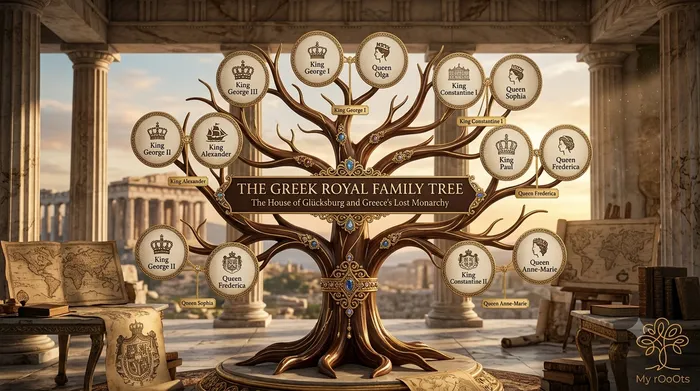
Greek Royal Line (House of Glucksburg)

King George I (r. 1863-1913)
└── King Constantine I (r. 1913-17, 1920-22)
    └── King George II (r. 1922-23, 1935-47)
    └── King Paul (r. 1947-1964)
        └── King Constantine II (r. 1964-1973, monarchy abolished 1974)
            └── Crown Prince Pavlos (current head of the House)
    └── Princess Sophia -> married King Juan Carlos I of Spain
    └── Prince Philip, Duke of Edinburgh -> married Queen Elizabeth II of the UK
The Family That Married Into Everyone
This is the part that surprises most people researching their own family trees: Prince Philip, husband of Queen Elizabeth II, was born Prince Philip of Greece and Denmark, a great-grandson of King George I. He gave up his Greek and Danish royal titles when he married into the British royal family in 1947, but his ancestry ties the House of Windsor directly back to this same Greek-Danish line.
King Constantine I's granddaughter, Princess Sophia, became Queen of Spain when she married Juan Carlos I, meaning the current Spanish royal family also descends from this line. Between Britain, Spain, Denmark, and Norway, the Glucksburg-descended Greek royals arguably did more to shape 20th-century European royalty than any throne they actually held onto.
The End of the Greek Monarchy
Greece's relationship with its monarchy was never settled. The throne was abolished and restored twice before its final end:
- 1924: Monarchy abolished after WWI political upheaval, a republic declared
- 1935: Monarchy restored following a referendum
- 1941-1944: Royal family in exile during the Axis occupation of Greece
- 1967: King Constantine II attempted a counter-coup against the military junta that had seized power and failed, going into exile
- 1973: The junta formally abolished the monarchy
- 1974: A public referendum, held after democracy was restored, confirmed the abolition with nearly 70% voting against restoring the king
Constantine II lived the rest of his life largely in exile in Britain, only regaining Greek citizenship in his final years before his death in 2023. His eldest son, Crown Prince Pavlos, is now head of the House, though the family holds no constitutional role in modern Greece.
Why This Family Tree Still Matters to Genealogists
Even without a throne, tracing this lineage matters for a few reasons:
- It explains hidden Greek and Danish ancestry inside the British, Spanish, and other royal family trees
- It's a clear example of how 19th-century royal houses treated marriage as foreign policy, not romance
- Greek genealogical and church records from this era are increasingly digitized, making it realistic for descendants of Greek emigrants to trace connections back to this period
Frequently Asked Questions
Is the British royal family related to the Greek royal family?
Yes, directly. Prince Philip, Duke of Edinburgh, was born a prince of Greece and Denmark and was a great-grandson of King George I of the Hellenes, making his descendants, including King Charles III, direct descendants of the Greek royal line.
Does Greece still have a royal family?
Greece has had no reigning monarch since the position was abolished by referendum in 1974. The former royal family, headed since 2023 by Crown Prince Pavlos, lives as private citizens without any constitutional role.
Why was a Danish prince made King of Greece?
When Greece became independent in the 19th century, the major European powers preferred a neutral foreign monarch over a Greek noble who might tip the balance of power. Prince Vilhelm of Denmark was chosen in 1863 and became King George I.
How is the Greek royal family connected to Russia's Romanovs?
King George I of Greece married Grand Duchess Olga Constantinovna, a member of the Russian imperial family, directly linking the Greek royal line to the Romanov dynasty by marriage.
What happened to the Greek royal family after the monarchy ended?
King Constantine II and his family went into exile, primarily in Britain, after the 1967 counter-coup attempt failed. He did not return to live in Greece and only regained his Greek citizenship shortly before his death in 2023.
Editor's picks
23 August 2026
The Norwegian Royal Family Tree: The House of Glücksburg Explained
Trace how a Danish prince became King of Norway in 1905, and how today's Harald V, Crown Prince Haakon and Princess Ingrid Alexandra descend from the House of Glücksburg.
20 August 2026
The Danish Royal Family Tree: The House of Glucksburg Explained
How Denmark's House of Glucksburg became Europe's oldest continuous monarchy, and how it quietly supplied royal houses to Greece, Norway, and the UK.
25 August 2026
Liechtenstein's Princely Family Tree: The House of Liechtenstein Explained
Liechtenstein is one of Europe's last monarchies where the prince genuinely rules. Here's how the House of Liechtenstein's family tree connects centuries of Austrian nobility to a tiny Alpine nation.
23 August 2026
Luxembourg's Grand Ducal Family Tree: The House of Nassau-Weilburg Explained
How a 19th-century succession crisis split Luxembourg's royal family from the Dutch throne, and how the House of Nassau-Weilburg has ruled the Grand Duchy ever since.
21 August 2026
The Belgian Royal Family Tree: The House of Belgium (Saxe-Coburg) Explained
From Leopold I's founding of modern Belgium in 1831 to King Philippe today, trace how a German-born prince's dynasty became the House of Belgium.
21 August 2026
The Swedish Royal Family Tree: The House of Bernadotte Explained
A French general with no Swedish blood became King Carl XIV Johan in 1818, and every Swedish monarch since has descended from him. Here's the House of Bernadotte's family tree, from Napoleon's marshal to King Carl XVI Gustaf today.
Download a Free Family Tree Template
Want to draw your family tree yourself? The My rOoOts Family Tree Template provides a free printable blank pedigree chart for documenting your family history across multiple generations.
👉 Download a free family tree template: Family Tree Template
Choose a 3-generation, 4-generation, or 5-generation family tree template and save it as a PDF for printing, writing, and documenting your ancestors.
Create Your Family Tree for Free
Start building your family history in minutes with the My rOoOts Free Family Tree Creator. Add parents, grandparents, children, and relatives, organize generations visually, and create a beautiful family tree that you can save and share.
👉 Create your free family tree: Free Family Tree Creator
No design skills required. Simply enter your family details and generate a clear, easy-to-read family tree online for free.
Check Zodiac Compatibility for Any Two People
Curious about how well two people match based on their date of birth? Try the My rOoOts Zodiac Compatibility Tool to compare zodiac signs, explore relationship compatibility, and get a quick compatibility score for couples, friends, or family members.
👉 Check compatibility now: Zodiac Compatibility Calculator
You can enter two dates of birth and even mention the relationship type to get a more personalized compatibility result.
Start your family tree free
No account needed to begin. Build it in minutes, then save it whenever you're ready.
Build your family tree