Denmark's monarchy claims a title no other European royal house can: the oldest continuous monarchy in Europe, with a line of kings and queens traced back over a thousand years. The current royal house, Glucksburg, has only ruled since 1863, but it did something remarkable in the process - it became a kind of royal export business, quietly supplying monarchs to Greece, Norway, and, through marriage, linking directly into the British royal family.
This guide walks through how the House of Glucksburg came to the Danish throne, its modern lineage down to King Frederik X, and how it connects to royal families well beyond Denmark's borders.
How the Glucksburgs Got the Throne
The House of Glucksburg is a branch of the House of Oldenburg, which had ruled Denmark since 1448. When King Frederik VII died in 1863 without an heir, the Danish throne needed a new line - and it went to Christian of Schleswig-Holstein-Sonderburg-Glucksburg, a distant relative chosen partly because European powers wanted a neutral, uncontroversial candidate for the job.
Christian IX turned out to be an extraordinary genealogical hub. He and his wife, Louise of Hesse-Kassel, had six children, and through strategic marriages, their descendants ended up on thrones across Europe - earning Christian IX the nickname "the father-in-law of Europe."
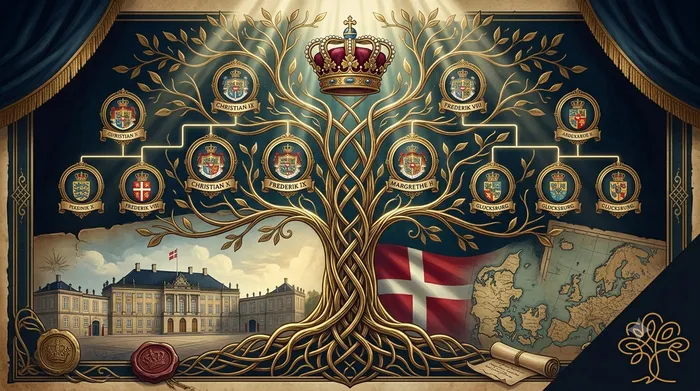
The Lineage from Christian IX to Frederik X
Christian IX (r. 1863-1906)
└── Frederik VIII (r. 1906-1912)
    └── Christian X (r. 1912-1947)
        └── Frederik IX (r. 1947-1972)
            └── Margrethe II (r. 1972-2024)
                └── Frederik X (r. 2024-present)
                    └── Christian, Crown Prince (heir apparent)
Queen Margrethe II's reign, from 1972 to 2024, made her one of the longest-serving monarchs in modern European history before she abdicated in favor of her son. Frederik X now reigns with his wife, Queen Mary (born Mary Donaldson, an Australian who met him at a bar during the 2000 Sydney Olympics), and their eldest son, Prince Christian, is the current heir apparent.
How Denmark's Royal House Spread Across Europe
The most striking thing about the Glucksburg line is how many other royal houses trace back to it:
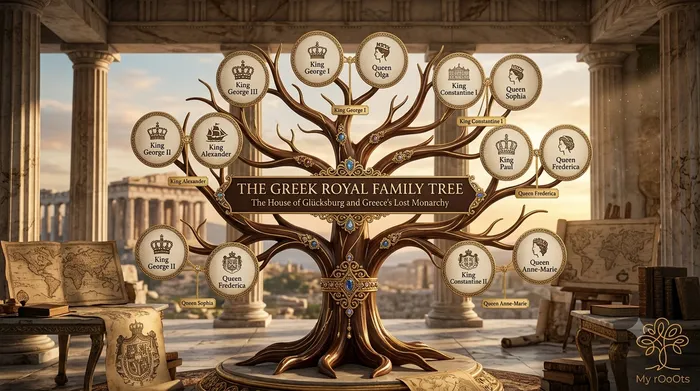
- Greece: Christian IX's second son became King George I of Greece in 1863, founding the Greek royal line (now deposed, but genealogically active - Prince Philip, Duke of Edinburgh, was born into this branch).
- Norway: Christian IX's grandson became King Haakon VII of Norway in 1905 when Norway separated from Sweden and chose a Danish prince as its first modern monarch. Norway's royal family remains part of this line today.
- United Kingdom: Christian IX's daughter Alexandra married the future King Edward VII of Britain, making her queen consort - which is why Prince Philip, himself descended from the Greek branch of the Glucksburgs, married into the British royal family as something closer to a genealogical homecoming than most people realize.
- Russia: Christian IX's daughter Dagmar married Tsar Alexander III of Russia and became Empress Maria Feodorovna, mother of the last Tsar, Nicholas II.
Denmark's Royal Family Today
| Position | Name | Relationship |
|---|---|---|
| King | Frederik X | Reigning monarch since 2024 |
| Queen | Mary | Consort, Australian-born |
| Crown Prince | Christian | Heir apparent, eldest son |
| Princess | Isabella | Second child |
| Prince | Vincent | Third child (twin) |
| Princess | Josephine | Fourth child (twin) |
| Queen Mother | Margrethe II | Abdicated 2024 after 52-year reign |
Why the Danish Monarchy Has Lasted So Long
A few factors explain Denmark's unusually stable royal history:
- Constitutional limits came early. Denmark became a constitutional monarchy in 1849, well before most European royal houses accepted similar limits, which removed much of the political risk that toppled other dynasties.
- Female succession was formalized. A 1953 change to the Act of Succession allowed women to inherit the throne, which is how Margrethe II became queen and kept the Glucksburg line continuous.
- The monarchy adapted its public role. Rather than clinging to political power, Danish royals leaned into a ceremonial, unifying role that kept public support high even as European republics multiplied around them.
Frequently Asked Questions
Is the Danish royal family related to the British royal family?
Yes, closely. Christian IX's daughter Alexandra married King Edward VII of Britain, and Prince Philip, Duke of Edinburgh, was born into the Greek branch of the same Glucksburg family before marrying Queen Elizabeth II - so the connection runs through two separate lines.
Why is the Danish monarchy called the oldest in Europe?
Denmark's line of monarchs is traditionally traced back to Gorm the Old in the 10th century, giving it an unbroken record longer than any other current European royal house, even though the specific ruling family (Glucksburg) has only held the throne since 1863.
How is King Frederik X related to Queen Margrethe II?
Frederik X is Margrethe II's eldest son. She abdicated in January 2024 after a 52-year reign, and he acceded to the throne that same day.
Did the Danish royal family really provide monarchs to other countries?
Yes - Christian IX's children became the monarchs of Greece and, through marriage, connected directly into the royal families of Norway, the United Kingdom, and Russia, which is why he's sometimes called "the father-in-law of Europe."
Can women inherit the Danish throne?
Yes, since a 1953 change to the Act of Succession. Queen Margrethe II became monarch under this rule, and Denmark later moved to full gender-neutral primogeniture in 2009, meaning the eldest child inherits regardless of gender.
Editor's picks
6 August 2026
The British Royal Family Tree Explained Simply
A simple guide to the British Royal Family tree, from Queen Elizabeth II to King Charles III, the Prince of Wales, and the next generation of working royals.
6 August 2026
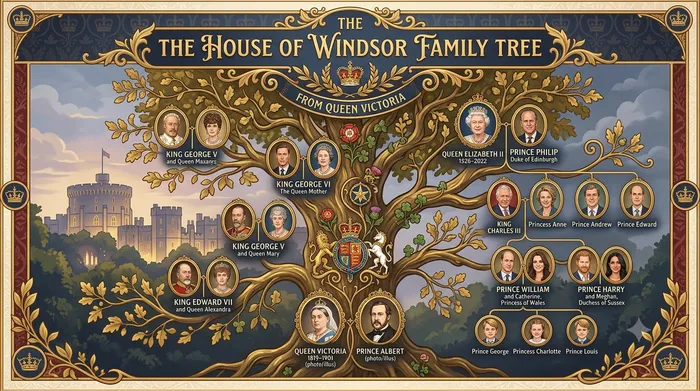
The House of Windsor Family Tree from Queen Victoria to Today
Explore the House of Windsor family tree from Queen Victoria through George V, Elizabeth II, and King Charles III to the present generation of British royals.
8 August 2026
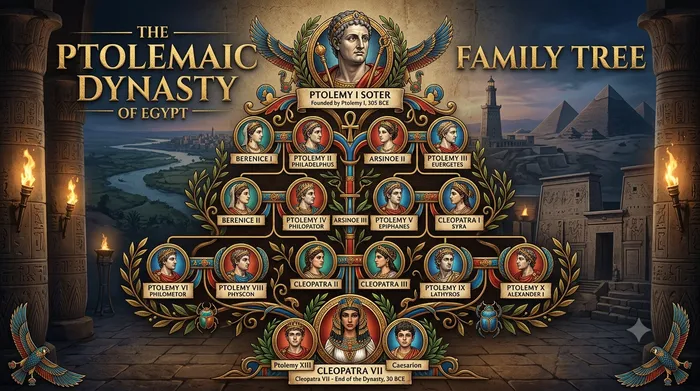
The Ptolemaic Dynasty Family Tree of Egypt
Explore the Ptolemaic Dynasty family tree of Egypt, from Ptolemy I Soter to Cleopatra VII, including the complex royal marriages and the end of pharaonic rule.
19 August 2026
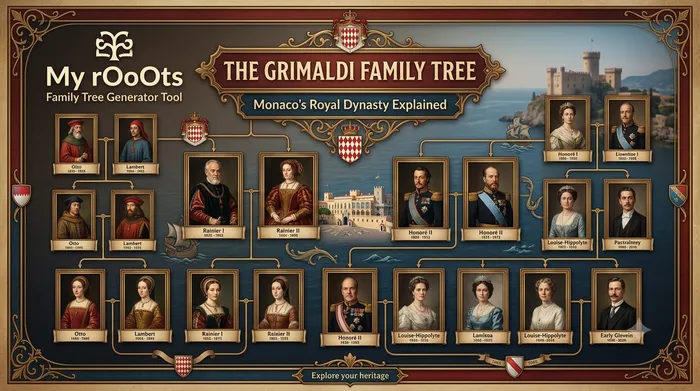
The Grimaldi Family Tree: Monaco's Royal Dynasty Explained
From a disguised monk who seized a fortress in 1297 to Grace Kelly's grandchildren today, the Grimaldi family tree traces the longest-ruling dynasty in Europe. Here's how it all connects.
Create Your Family Tree for Free
Start building your family history in minutes with the My rOoOts Free Family Tree Creator. Add parents, grandparents, children, and relatives, organize generations visually, and create a beautiful family tree that you can save and share.
👉 Create your free family tree: Free Family Tree Creator
No design skills required. Simply enter your family details and generate a clear, easy-to-read family tree online for free.
Check Zodiac Compatibility for Any Two People
Curious about how well two people match based on their date of birth? Try the My rOoOts Zodiac Compatibility Tool to compare zodiac signs, explore relationship compatibility, and get a quick compatibility score for couples, friends, or family members.
👉 Check compatibility now: Zodiac Compatibility Calculator
You can enter two dates of birth and even mention the relationship type to get a more personalized compatibility result.
Download a Free Family Tree Template
Want to draw your family tree yourself? The My rOoOts Family Tree Template provides a free printable blank pedigree chart for documenting your family history across multiple generations.
👉 Download a free family tree template: Family Tree Template
Choose a 3-generation, 4-generation, or 5-generation family tree template and save it as a PDF for printing, writing, and documenting your ancestors.
Discover the Meaning and Origin of Your Surname
Ever wondered where your family name came from? Use the My rOoOts Surname Meaning Lookup to explore surname meanings, origins, history, and etymology from different regions and cultures around the world.
👉 Discover your surname meaning: Surname Meaning Lookup
Learn more about your last name and explore the possible linguistic, geographic, cultural, and historical roots behind your family surname.
Start your family tree free
No account needed to begin. Build it in minutes, then save it whenever you're ready.
Build your family tree