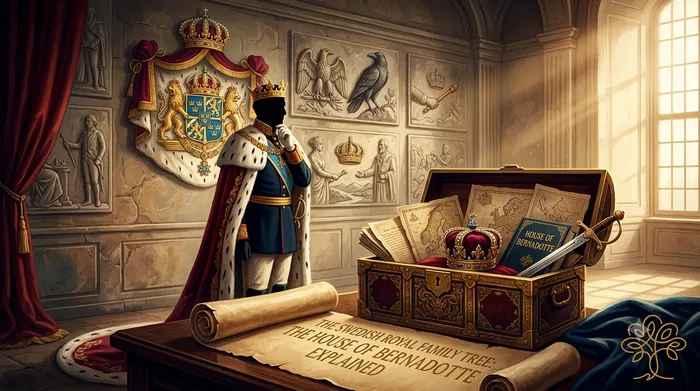
Most European royal houses trace themselves back to medieval nobility. Sweden's does not. The House of Bernadotte, which has ruled Sweden since 1818, begins with a French revolutionary soldier who had never set foot in the country before Swedish nobles adopted him as their crown prince. It's one of the more unusual founding stories in European royal genealogy, and it produced a family tree that's still on the throne two centuries later.
From Napoleon's Marshal to King of Sweden
Jean-Baptiste Bernadotte was born in southern France in 1763 and rose through the ranks during the French Revolution to become one of Napoleon's marshals. In 1810, Sweden's childless King Charles XIII needed an heir, and after a Swedish courtier who had met Bernadotte recommended him, the Swedish parliament elected him crown prince under the name Karl Johan. He effectively ran the country as regent for years before formally becoming King Carl XIV Johan in 1818. Every Swedish monarch since has been his direct descendant.
The Line of Bernadotte Monarchs
- Carl XIV Johan (r. 1818-1844) - the French-born founder
- Oscar I (r. 1844-1859) - his son
- Carl XV (r. 1859-1872) - grandson, left no surviving son
- Oscar II (r. 1872-1907) - Carl XV's younger brother
- Gustaf V (r. 1907-1950) - Oscar II's son, reigned through both World Wars
- Gustaf VI Adolf (r. 1950-1973) - his son, an amateur archaeologist
- Carl XVI Gustaf (r. 1973-present) - Sweden's current king, who inherited the throne at age 27 after his father and older brother had both died
Carl XIV Johan (r. 1818-1844)
└── Oscar I (r. 1844-1859)
    └── Carl XV (r. 1859-1872, no surviving son)
        (crown passes to younger brother)
        Oscar II (r. 1872-1907)
        └── Gustaf V (r. 1907-1950)
            └── Gustaf VI Adolf (r. 1950-1973)
                (son Prince Gustaf Adolf died in 1947, before his father's reign began)
                └── Carl XVI Gustaf (r. 1973-present, succeeded his grandfather directly)
                    └── Crown Princess Victoria (heir apparent)
Why the King Skipped a Generation
One quirk that surprises people tracing this lineage: Carl XVI Gustaf is Gustaf VI Adolf's grandson, not his son. His father, Prince Gustaf Adolf, died in a plane crash in 1947, when the future king was still an infant. Carl XVI Gustaf was raised as heir apparent to his grandfather and took the throne directly from him in 1973, a reminder that royal family trees, like any family tree, sometimes skip a generation when tragedy intervenes.
Titles and Succession Rules Worth Knowing
- Sweden changed its constitution in 1980 to introduce absolute primogeniture, meaning the eldest child inherits regardless of gender. This was applied retroactively, which is why Crown Princess Victoria outranks her younger brother Prince Carl Philip even though he was born male.
- The heir apparent holds the title Crown Princess or Crown Prince of Sweden and, separately, Duchess or Duke of Västergötland-style regional ducal titles are given to all the king's grandchildren.
- Members of the extended family who marry without government and parliamentary approval can lose their royal titles and place in the succession, as happened to two of Carl XVI Gustaf's grandchildren in 2019.
| Monarch | Reign | Relationship to Predecessor |
|---|---|---|
| Carl XIV Johan | 1818-1844 | Founder (elected crown prince) |
| Oscar I | 1844-1859 | Son |
| Carl XV | 1859-1872 | Son |
| Oscar II | 1872-1907 | Brother |
| Gustaf V | 1907-1950 | Son |
| Gustaf VI Adolf | 1950-1973 | Son |
| Carl XVI Gustaf | 1973-present | Grandson |
What This Means If You're Researching Swedish Ancestry
Sweden has some of the best-preserved genealogical records in Europe, thanks to centuries of church-kept parish registers (kyrkobocker) that recorded births, marriages, and deaths in meticulous detail long before civil registration existed elsewhere. If your own family tree includes Swedish ancestors, placing them against the reign of a particular Bernadotte king, and the wars, emigration waves, or industrialization each reign coincided with, can help make sense of why a relative moved, when they might have served in the military, or which parish records to search first.
Frequently Asked Questions
Who is the current King of Sweden?
Carl XVI Gustaf has reigned since 1973. His eldest child, Crown Princess Victoria, is the heir apparent and will become Sweden's first reigning queen since the 18th century.
Was the first Bernadotte king actually Swedish?
No. Carl XIV Johan, born Jean-Baptiste Bernadotte, was French and had served as one of Napoleon's marshals before the Swedish parliament elected him crown prince in 1810 and he took the throne in 1818.
Why does Crown Princess Victoria outrank her older... younger brother?
Sweden adopted absolute primogeniture in 1980, meaning birth order rather than gender determines succession. Because the law was applied retroactively, Victoria, born in 1977, kept her position ahead of her younger brother Carl Philip, born in 1979.
How is the Swedish royal family related to other European monarchies?
Through centuries of intermarriage, the Bernadottes are connected to nearly every other reigning European house, including Britain's Windsors, Denmark's Glücksburgs, and the Netherlands' Orange-Nassaus, even though the dynasty itself began outside the traditional royal bloodlines.
Can members of the Swedish royal family lose their title?
Yes. The king can remove a family member's royal title and, in some cases, their place in the line of succession, most notably when Carl XVI Gustaf stripped five of his grandchildren of their "Royal Highness" styles in 2019 to streamline the working monarchy.
Editor's picks
21 August 2026
The Belgian Royal Family Tree: The House of Belgium (Saxe-Coburg) Explained
From Leopold I's founding of modern Belgium in 1831 to King Philippe today, trace how a German-born prince's dynasty became the House of Belgium.
20 August 2026
The Danish Royal Family Tree: The House of Glucksburg Explained
How Denmark's House of Glucksburg became Europe's oldest continuous monarchy, and how it quietly supplied royal houses to Greece, Norway, and the UK.
20 August 2026
The Dutch Royal Family Tree: The House of Orange-Nassau Explained
How a 16th-century rebel prince became the namesake of the Netherlands' royal house, and how the House of Orange-Nassau's lineage leads to King Willem-Alexander today.
6 August 2026
The British Royal Family Tree Explained Simply
A simple guide to the British Royal Family tree, from Queen Elizabeth II to King Charles III, the Prince of Wales, and the next generation of working royals.
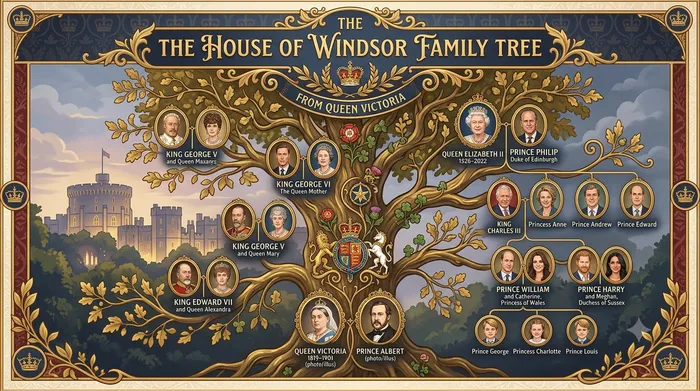
6 August 2026
The House of Windsor Family Tree from Queen Victoria to Today
Explore the House of Windsor family tree from Queen Victoria through George V, Elizabeth II, and King Charles III to the present generation of British royals.
Create Your Family Tree for Free
Start building your family history in minutes with the My rOoOts Free Family Tree Creator. Add parents, grandparents, children, and relatives, organize generations visually, and create a beautiful family tree that you can save and share.
👉 Create your free family tree: Free Family Tree Creator
No design skills required. Simply enter your family details and generate a clear, easy-to-read family tree online for free.
Check Zodiac Compatibility for Any Two People
Curious about how well two people match based on their date of birth? Try the My rOoOts Zodiac Compatibility Tool to compare zodiac signs, explore relationship compatibility, and get a quick compatibility score for couples, friends, or family members.
👉 Check compatibility now: Zodiac Compatibility Calculator
You can enter two dates of birth and even mention the relationship type to get a more personalized compatibility result.
Download a Free Family Tree Template
Want to draw your family tree yourself? The My rOoOts Family Tree Template provides a free printable blank pedigree chart for documenting your family history across multiple generations.
👉 Download a free family tree template: Family Tree Template
Choose a 3-generation, 4-generation, or 5-generation family tree template and save it as a PDF for printing, writing, and documenting your ancestors.
Discover the Meaning and Origin of Your Surname
Ever wondered where your family name came from? Use the My rOoOts Surname Meaning Lookup to explore surname meanings, origins, history, and etymology from different regions and cultures around the world.
👉 Discover your surname meaning: Surname Meaning Lookup
Learn more about your last name and explore the possible linguistic, geographic, cultural, and historical roots behind your family surname.
Start your family tree free
No account needed to begin. Build it in minutes, then save it whenever you're ready.
Build your family tree