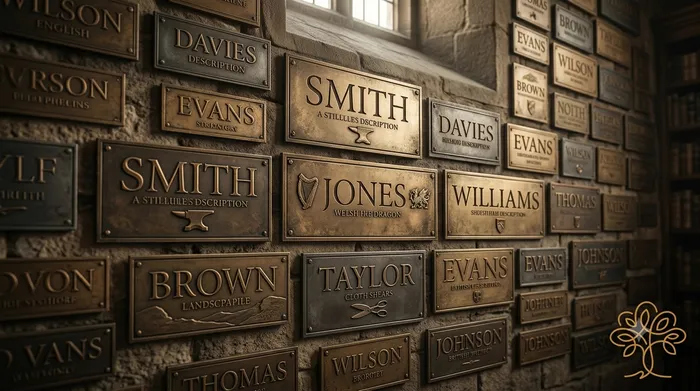
British surnames carry centuries of history. Many originated from occupations, places, personal characteristics, or the names of ancestors. Understanding a surname’s origin can provide valuable clues when researching your family tree and tracing British ancestry.
In this guide, we explore the top 100 British surnames, their meanings, and the historical stories behind them. Whether your family comes from England, Scotland, Wales, or Ireland, these surnames reveal how ordinary people became identifiable families over time.
🌳 Explore and preserve your British family history with My rOoOts: https://myrooots.app/
How British Surnames Developed
Hereditary surnames became common in Britain between the 11th and 15th centuries. Most surnames fall into four main categories:
Occupational Surnames
Derived from a person’s job.
Examples: Smith, Taylor, Baker, Carter.
Locational Surnames
Based on a town, village, or landscape feature.
Examples: Hill, Wood, Green, Brook.
Patronymic Surnames
Meaning “son of” a particular man.
Examples: Johnson, Jackson, Richardson.
Descriptive Surnames
Referring to appearance or character.
Examples: Brown, White, Short, Strong.
Recognizing the category often helps identify the earliest family origins.
The 25 Most Common British Surnames
| Surname | Historical Origin |
|---|---|
| Smith | Blacksmith or metal worker |
| Jones | Son of John (Welsh) |
| Williams | Son of William |
| Brown | Brown-haired or dark-complexioned person |
| Taylor | Tailor or cloth cutter |
| Davies | Son of David (Welsh) |
| Wilson | Son of William |
| Evans | Son of Evan (Welsh form of John) |
| Thomas | Descendant of Thomas |
| Johnson | Son of John |
| Roberts | Son of Robert |
| Walker | Cloth fuller or walker |
| Wright | Craftsman or builder |
| Thompson | Son of Thomas |
| White | Fair-haired or light-complexioned person |
| Edwards | Son of Edward |
| Hughes | Son of Hugh |
| Green | Person living near a village green |
| Hall | Person living near or working at a hall |
| Lewis | Derived from the personal name Louis |
| Harris | Son of Harry |
| Martin | From the personal name Martin |
| Clarke | Clerk, scholar, or church official |
| Patel* | Later immigrant surname, now very common in Britain |
| Turner | Maker of wooden or metal objects on a lathe |
*Included because it is among the most common modern British surnames.
Occupational Surnames (26–50)
These surnames reflect medieval trades.
| Surname | Meaning |
|---|---|
| Baker | Bread maker |
| Carter | Cart driver |
| Cooper | Barrel maker |
| Fletcher | Arrow maker |
| Gardner | Gardener |
| Mason | Stone worker |
| Miller | Grain mill operator |
| Porter | Gatekeeper or carrier |
| Sawyer | Wood cutter |
| Shepherd | Sheep herder |
| Butler | Household steward |
| Carpenter | Woodworker |
| Chandler | Candle maker |
| Cook | Professional cook |
| Farmer | Agricultural worker |
| Fisher | Fisherman |
| Fuller | Cloth cleaner |
| Hunter | Hunter |
| Mercer | Cloth merchant |
| Webster | Weaver (originally female weaver) |
| Brewer | Beer maker |
| Dyer | Cloth dyer |
| Glover | Glove maker |
| Tanner | Leather tanner |
| Wheeler | Wheel maker |
Occupational surnames are especially useful because they may hint at an ancestor’s social status and trade.
Locational Surnames (51–75)
These surnames usually indicate where a family lived.
| Surname | Meaning |
|---|---|
| Hill | Near a hill |
| Wood | Near woodland |
| Woods | Woodland dweller |
| Field | Open field |
| Fields | Multiple fields |
| Brook | Near a stream |
| Brooks | Near streams |
| Marsh | Marshland dweller |
| Stone | Near a notable stone |
| Shaw | Small wood or grove |
| Lane | Person living by a lane |
| Church | Near a church |
| Ford | Near a river crossing |
| Bridge | Near a bridge |
| Cross | Near a crossroads or cross |
| Dean | Valley dweller |
| Dale | Valley dweller |
| Holt | Wooded area |
| Park | Near a park or enclosure |
| Heath | Heathland dweller |
| Berry | Fortified place or hill |
| Atkinson | Originally “Atkin’s son,” often linked to northern England |
| Blackburn | Black stream |
| Thornton | Thorn bush settlement |
| Preston | Priest’s town |
Locational surnames can often be traced to specific counties or villages.
Patronymic Surnames (76–90)
These surnames identify descent from a named ancestor.
| Surname | Meaning |
|---|---|
| Jackson | Son of Jack |
| Richardson | Son of Richard |
| Harrison | Son of Harry |
| Watson | Son of Walter |
| Henderson | Son of Henry |
| Davidson | Son of David |
| Stevenson | Son of Stephen |
| Robertson | Son of Robert |
| Nicholson | Son of Nicholas |
| Adamson | Son of Adam |
| Simpson | Son of Simon |
| Williamson | Son of William |
| Donaldson | Son of Donald |
| Ferguson | Son of Fergus |
| MacDonald | Son of Donald (Scottish Gaelic) |
The prefixes Mac- (Scottish) and O’- (Irish) are classic Celtic patronymic markers.
Descriptive Surnames (91–100)
These surnames began as nicknames.
| Surname | Meaning |
|---|---|
| Black | Dark appearance |
| Gray | Gray-haired person |
| Young | Younger family member |
| Long | Tall person |
| Short | Short person |
| Strong | Strong person |
| Armstrong | Strong-armed person |
| Little | Small person |
| Sharp | Sharp-featured or clever person |
| Goodwin | Good friend or trustworthy person |
Descriptive surnames often originated within local communities where physical appearance distinguished individuals.
English, Scottish, Welsh, and Irish Differences
England
- More occupational surnames.
- Earlier adoption of hereditary surnames.
Scotland
- Frequent use of Mac- names.
- Clan associations are important.
Wales
- Many surnames derived from personal names.
- Jones, Williams, Davies, Evans became extremely common after patronymics became fixed.
Ireland
- Strong use of O’- and Mac- prefixes.
- Anglicized spellings became widespread under English administration.
Understanding the regional pattern can narrow your research dramatically.
What Your Surname Can Reveal
A surname may suggest:
- ancestral occupation,
- geographic origin,
- language background,
- social status,
- or migration history.
For example:
- Smith suggests a blacksmith ancestor.
- Hill suggests residence near a hill.
- MacDonald points toward Scottish Gaelic ancestry.
- Jones strongly suggests Welsh roots.
A surname alone is not proof, but it is an excellent starting clue.
Common Spelling Variations
Before spelling became standardized, clerks wrote names as they heard them.
Examples:
- Smyth → Smith
- Jonson → Johnson
- Macdonald → McDonald
- Clarke → Clark
Always search for multiple spellings when researching British ancestors.
How to Research a British Surname
Start with Family Records
Collect birth, marriage, death, and census documents.
Identify the Earliest Known Ancestor
Focus on the oldest confirmed person in your tree.
Determine the County or Parish
British records are usually organized geographically.
Study Local History
Occupations and naming patterns often vary by region.
Record Every Variant
Keep a list of alternative spellings found in records.
Using Surnames in Genealogy
Surnames are most powerful when combined with:
- dates,
- locations,
- occupations,
- and family relationships.
A surname by itself rarely identifies a unique ancestor, especially with common names such as Smith or Jones.
Build Your British Family Tree
As you discover ancestors connected to these surnames, organize them in a digital family tree.
With My rOoOts, you can:
- add generations,
- upload photographs,
- attach historical records,
- track surname branches,
- and preserve your British heritage for future generations.
👉 Start your family tree today: https://myrooots.app/
Frequently Asked Questions
What is the most common British surname?
Smith is traditionally the most common surname in Britain.
Are all British surnames English?
No. Britain includes English, Scottish, Welsh, and Irish surname traditions.
What does the prefix “Mac” mean?
“Mac” means son of in Scottish Gaelic.
Why are Welsh surnames so repetitive?
Many Welsh surnames originated from a small number of popular personal names such as John, William, David, and Evan.
Can a surname tell me exactly where my family came from?
Not exactly, but it can provide strong clues about region, language, and ancestral occupation.
Final Thoughts
British surnames are living pieces of history. Behind every Smith, Jones, Williams, or MacDonald is a story of work, family, migration, and community stretching back hundreds of years. Understanding your surname’s origin is often the first exciting step toward discovering your British ancestors.
Whether your roots are in England, Scotland, Wales, or Ireland, preserving those discoveries in a family tree ensures that your family’s story continues for generations to come.
🌳 Begin exploring your British ancestry with My rOoOts: https://myrooots.app/
Find Any Family Relationship Instantly
Not sure how someone is related to you? Use the MyRooots Relationship Calculator to instantly identify relationships such as cousin, aunt, uncle, nephew, niece, in-laws, and many more. It is a quick and easy tool for understanding complex family connections.
👉 MyRooots Relationship Calculator
Create a Beautiful Family Tree Online
Turn your family information into a clear and organized family tree within minutes. The MyRooots Family Tree Generator helps you add relatives, connect generations, and create a shareable family tree that can grow over time.
👉 MyRooots Family Tree Generator
Visualize Your Family History Through Time
See your ancestors in chronological order with the My rOoOts Ancestor Timeline Generator. It creates a visual timeline of births, marriages, deaths, and important life events, making it easier to understand your family's history across generations.
Check Zodiac Compatibility for Any Two People
Curious about how well two people match based on their date of birth? Try the My rOoOts Zodiac Compatibility Tool to compare zodiac signs, explore relationship compatibility, and get a quick compatibility score for couples, friends, or family members.
👉 Check compatibility now: Zodiac Compatibility Calculator
You can enter two dates of birth and even mention the relationship type to get a more personalized compatibility result.
Create Your Family Tree for Free
Start building your family history in minutes with the My rOoOts Free Family Tree Creator. Add parents, grandparents, children, and relatives, organize generations visually, and create a beautiful family tree that you can save and share.
👉 Create your free family tree: Free Family Tree Creator
No design skills required. Simply enter your family details and generate a clear, easy-to-read family tree online for free.
Download a Free Family Tree Template
Want to draw your family tree yourself? The My rOoOts Family Tree Template provides a free printable blank pedigree chart for documenting your family history across multiple generations.
👉 Download a free family tree template: Family Tree Template
Choose a 3-generation, 4-generation, or 5-generation family tree template and save it as a PDF for printing, writing, and documenting your ancestors.
Discover the Meaning and Origin of Your Surname
Ever wondered where your family name came from? Use the My rOoOts Surname Meaning Lookup to explore surname meanings, origins, history, and etymology from different regions and cultures around the world.
👉 Discover your surname meaning: Surname Meaning Lookup
Learn more about your last name and explore the possible linguistic, geographic, cultural, and historical roots behind your family surname.
Start your family tree free
No account needed to begin. Build it in minutes, then save it whenever you're ready.
Build your family tree