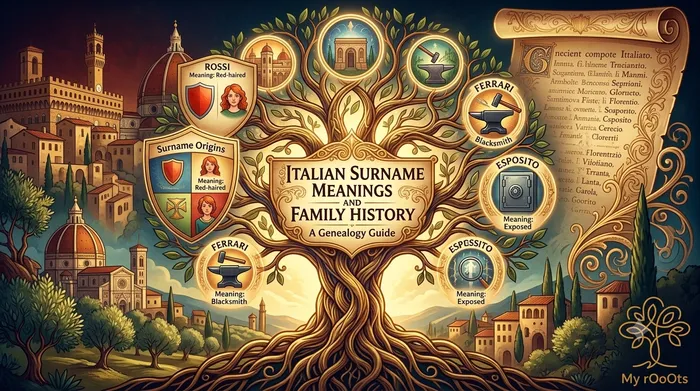
Italian Surname Meanings and Family History: A Genealogy Guide
Italian surnames are some of the most distinctive in the world, full of vowels, regional flavor, and centuries of history packed into a single word. If you're researching Italian ancestors, understanding where your surname comes from can point you toward the region, occupation, or even physical trait that shaped your family's identity long before anyone wrote it down in a record book.
The Five Main Categories of Italian Surnames
Most Italian surnames fall into one of five broad origins:
- Patronymic surnames, built from a father's or ancestor's first name, like Di Giovanni (son of Giovanni) or Antonelli (little Antonio).
- Occupational surnames, describing a family's trade, like Ferrari (blacksmith, from ferro, iron) or Pastore (shepherd).
- Toponymic surnames, taken from a place of origin, like Romano (from Rome) or Milano (from Milan).
- Nickname or descriptive surnames, based on a physical trait or personality, like Rossi (red-haired or ruddy-complexioned) or Piccolo (small).
- Surnames from nature or everyday objects, less common but present, referencing plants, animals, or household items a family may have been associated with.
Regional Patterns Matter More Than in Most Countries
Italy was a patchwork of independent states, kingdoms, and city-republics until unification in 1861, and surnames still reflect that fragmented history:
- Northern Italy (Lombardy, Veneto, Piedmont) surnames often end in a single consonant or short vowel and show German or French influence from centuries of border shifts, like Bianchi, Ferrero, Conti.
- Central Italy (Tuscany, Lazio, Umbria) surnames tend toward the classic patterns most people associate with "Italian" names, like Rossi, Russo, Ferrari.
- Southern Italy and Sicily carry heavier Greek, Arab, Norman, and Spanish influence from the region's long history of foreign rule. Surnames like Greco (Greek), Lo Bianco, or Caruso reflect that layered past.
This regional variation is a genuinely useful research clue: a surname's typical geographic concentration can help narrow down which of Italy's roughly 20 regions your family likely came from, well before you find a single record.
Common Italian Surname Suffixes and What They Mean
Italian surnames often carry a suffix that changes the meaning of the root name, similar to adding "-son" in English surnames:
| Suffix | Meaning | Example |
|---|---|---|
| -ini, -ino | "little" (diminutive) | Bernardini (little Bernard) |
| -etti, -etto | "little" (diminutive) | Rossetti (little Rossi) |
| -one, -oni | "big" (augmentative) | Bruttoni (big, rough) |
| -elli, -ello | "little" (diminutive) | Donatello (little Donato) |
| -acci, -accio | often a negative or coarse connotation | Boccaccio |
Because Italian is a heavily inflected language, the same root name can appear in dozens of variants depending on region, dialect, and era, which is why Giovanni, Di Giovanni, Giovannini, and Giovannoni can all trace back to the same original name.
Ten Common Italian Surnames and Their Meanings
| Surname | Meaning | Type |
|---|---|---|
| Rossi | Red-haired / ruddy complexion | Descriptive |
| Russo | Southern Italian form of Rossi | Descriptive |
| Ferrari | Blacksmith | Occupational |
| Esposito | "Exposed," historically given to abandoned or foundling infants | Descriptive/historical |
| Bianchi | White / fair-skinned | Descriptive |
| Romano | From Rome | Toponymic |
| Colombo | Dove, or from a family associated with doves | Nature-based |
| Ricci | Curly-haired | Descriptive |
| Marino | From the sea, or associated with sailors | Occupational/descriptive |
| Greco | Of Greek origin | Toponymic/ethnic |
Researching Your Italian Family History
Once you know what your surname likely means, the next step is tracing the family it belonged to. A few starting points:
- Civil records (1866 onward), kept by each comune (municipality) after Italian unification, are usually the most complete and accessible starting point.
- Church records, particularly Catholic parish baptism, marriage, and death registers, often extend back well before civil registration began, sometimes into the 1500s in well-preserved parishes.
- Emigration records, since millions of Italians left for the Americas between 1880 and 1920. Ship manifests and Ellis Island records frequently list the exact town of origin, often the single most valuable clue for connecting to records back in Italy.
- Local comune archives, which many Italian municipalities are now digitizing and making searchable online, sometimes free of charge.
Because Italian civil records are organized by comune rather than nationally, knowing your ancestor's specific town, not just the region, is usually essential before you can make real progress.
Frequently Asked Questions
What does my Italian surname most likely mean?
It depends on its ending and root. Names ending in "-etti," "-ini," or "-ello" are usually diminutives of a first name or another surname. Names describing colors (Rossi, Bianchi), places (Romano, Milano), or trades (Ferrari, Pastore) point to descriptive, geographic, or occupational origins respectively.
Why do so many Italian surnames end in a vowel?
Italian is a heavily vowel-based language, and surnames historically followed the same grammatical patterns as regular nouns and adjectives, which almost always end in a vowel in standard Italian.
Does an Italian surname tell you which region a family came from?
Often, yes, at least approximately. Certain surnames and suffixes are far more common in specific regions. Sicilian and southern surnames often carry Greek, Arab, or Norman influence, while northern surnames show more French and German influence from centuries of shifting borders.
What does the surname Esposito mean, and why is it so common in Naples?
Esposito means "exposed" and was historically given to foundling or abandoned infants, often raised in Church-run orphanages. Because it was assigned rather than inherited from a father's line, it became extremely common in and around Naples, where such institutions were widespread for centuries.
Where should I start if I want to trace my Italian ancestors?
Start with what you know: full name, approximate birth year, and any hint of the region or town of origin, often found on immigration records. Then work backward through Italian civil records (from 1866) and church records (often centuries earlier), which are organized by comune rather than nationally.
Editor's picks
25 August 2026
Ashkenazi and Sephardic Jewish Genealogy: How to Trace Your Jewish Family Tree
Jewish genealogy comes with its own record types, naming patterns, and migration history. Here's how to start tracing Ashkenazi, Sephardic, or Mizrahi Jewish ancestry with confidence.
25 August 2026
Scottish Clan Ancestry: How to Trace Your Family to a Highland Clan
A tartan and a surname aren't quite enough to prove clan ancestry. Here's how the Scottish clan system actually worked, and how to genuinely trace your family back to one.
26 August 2026
How to Trace Your Mexican and Latin American Ancestors: A Genealogy Guide
A practical starting guide to Mexican and Latin American family history research, covering Catholic parish records, civil registration, and the naming patterns that make the search easier once you know them.
8 August 2026
Best Family Tree Generators in 2026: Free and Easy Tools for Building Your Family History
Looking for the best family tree generator in 2026? Compare free and paid tools, learn what features matter, and choose the right family tree maker for your family history project.
8 August 2026
The Gupta Dynasty Family Tree of India
Explore the Gupta Dynasty family tree of India, from Sri Gupta and Chandragupta I to Samudragupta, Chandragupta II Vikramaditya, and the later rulers of India’s Golden Age.
26 July 2026
Bua, Tau, Nanad, Mausa Meaning: Indian Family Terms Meaning Explained
A plain-English guide to Indian family relationship names: what bua's husband is called (fufa), what mausa, tau, jija ji and nanad mean, and how Hindi kinship terms map to English relatives like aunt, uncle and in-law.
Download a Free Family Tree Template
Want to draw your family tree yourself? The My rOoOts Family Tree Template provides a free printable blank pedigree chart for documenting your family history across multiple generations.
👉 Download a free family tree template: Family Tree Template
Choose a 3-generation, 4-generation, or 5-generation family tree template and save it as a PDF for printing, writing, and documenting your ancestors.
Create Your Family Tree for Free
Start building your family history in minutes with the My rOoOts Free Family Tree Creator. Add parents, grandparents, children, and relatives, organize generations visually, and create a beautiful family tree that you can save and share.
👉 Create your free family tree: Free Family Tree Creator
No design skills required. Simply enter your family details and generate a clear, easy-to-read family tree online for free.
Check Zodiac Compatibility for Any Two People
Curious about how well two people match based on their date of birth? Try the My rOoOts Zodiac Compatibility Tool to compare zodiac signs, explore relationship compatibility, and get a quick compatibility score for couples, friends, or family members.
👉 Check compatibility now: Zodiac Compatibility Calculator
You can enter two dates of birth and even mention the relationship type to get a more personalized compatibility result.
Start your family tree free
No account needed to begin. Build it in minutes, then save it whenever you're ready.
Build your family tree