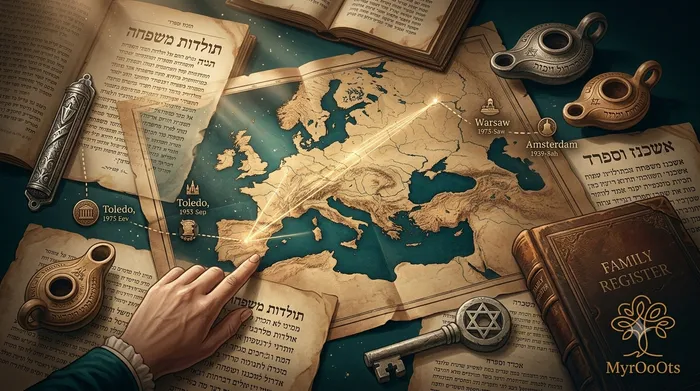
Jewish genealogy is one of the richest, and one of the most disrupted, branches of family history research. Centuries of migration, forced conversions, changing borders, and, in the 20th century, the Holocaust's destruction of entire communities and their records, mean that tracing a Jewish family tree often takes a different set of tools than a typical European genealogy search. The good news: Jewish record-keeping traditions were historically meticulous, and a huge amount of material has survived and been digitized. You just need to know where to look.
Start With the Big Branches: Ashkenazi, Sephardic, and Mizrahi
Before you search a single record, it helps to know roughly which branch of Jewish history your family likely belongs to, since each points to different countries, languages, and record sets.
| Branch | Historical Homeland | Traditional Language | Migration Pattern |
|---|---|---|---|
| Ashkenazi | Germany, then Central and Eastern Europe (Poland, Russia, Ukraine, Lithuania) | Yiddish | Massive emigration to the US and UK, 1880s-1920s |
| Sephardic | Spain and Portugal | Ladino (Judeo-Spanish) | Expelled in 1492, scattered across the Ottoman Empire, North Africa, and the Netherlands |
| Mizrahi | Middle East and North Africa (Iraq, Yemen, Morocco, Iran) | Judeo-Arabic and local languages | Largely emigrated to Israel after 1948 |
Most Jewish Americans and most Jews in Britain today are of Ashkenazi descent, but Sephardic and Mizrahi lines are common in parts of Latin America, France, and Israel, and family names alone often hint at which branch you're researching.
Surnames Are a Genealogical Clue, Not Just a Name
Unlike most of Europe, many Ashkenazi Jewish families didn't have fixed hereditary surnames until governments forced the issue, often in the late 18th or early 19th century, as part of taxation and conscription policy. This means:
- Occupational surnames (Schneider/tailor, Kaufman/merchant) often reflect an actual family trade at the time the name was assigned
- Place-based surnames (Berliner, Warszawski) can point directly to a town or region of origin
- Patronymic surnames (Abramson, Mendelsohn) reveal a father's given name at the moment the surname was fixed
- Acquired surnames were sometimes purchased, assigned arbitrarily, or even given as an insult by local officials, so a surname's literal meaning doesn't always tell a flattering or even accurate story
Sephardic surnames, by contrast, were often stable for centuries before 1492 and can sometimes be traced directly back to a specific town in medieval Spain or Portugal.
Where the Records Actually Are
- JewishGen - the single most important free resource for Jewish genealogy, with searchable databases of records from across Europe, the former Soviet Union, and beyond
- Yad Vashem's Central Database of Shoah Victims' Names - essential, and often heartbreaking, for tracing family lost in the Holocaust
- Synagogue and community (kehilla) records - births, marriages, and deaths were often recorded by the local Jewish community rather than the state, especially in Eastern Europe
- Ship manifests and immigration records - the same Ellis Island records that document millions of European immigrants also cover the huge wave of Ashkenazi emigration from the Russian Empire and Austro-Hungary between 1880 and 1924
- Landsmanshaft society records - mutual aid societies formed by immigrants from the same hometown, often in New York or London, which kept detailed membership and burial records
- DNA testing - especially useful for Jewish genealogy because of a well-documented "founder effect" in Ashkenazi populations, which can make matches unusually precise for confirming shared ancestry within the last few centuries
A Note on Broken Trees
Jewish family history research has to reckon with a hard truth that most other genealogy doesn't: for millions of families, the paper trail simply stops in the early 1940s, not because records weren't kept, but because entire communities, and the people who could have passed down oral history, were destroyed. If you hit a wall around this period, you're not doing anything wrong. Organizations like Yad Vashem and the International Tracing Service exist specifically because so many families share this exact obstacle, and they've helped reconnect surviving relatives with documentation that once seemed permanently lost.
Practical Starting Steps
- Record everything living relatives remember, town names, Yiddish or Ladino nicknames, and approximate dates, before searching any database
- Identify which branch (Ashkenazi, Sephardic, Mizrahi) your family most likely belongs to based on known geography
- Search JewishGen's town-specific databases once you have even an approximate ancestral town
- Cross-check immigration records against ship manifests, which often list the exact town of origin even when later US records don't
- Consider DNA testing alongside paper records, particularly useful given the well-studied Ashkenazi genetic founder population
Frequently Asked Questions
What's the difference between Ashkenazi and Sephardic Jewish ancestry?
Ashkenazi Jews trace their roots to Germany and later Central and Eastern Europe and traditionally spoke Yiddish, while Sephardic Jews trace their roots to Spain and Portugal before the 1492 expulsion and traditionally spoke Ladino. The two branches settled in different regions and left different types of historical records.
Why didn't Jewish families always have fixed surnames?
In much of Eastern and Central Europe, Jewish communities weren't legally required to adopt permanent hereditary surnames until governments mandated it in the late 1700s or early 1800s, usually for taxation and military conscription purposes, which is much later than most European Christian families.
What is JewishGen and is it free to use?
JewishGen is a free, volunteer-driven database and research platform specifically built for Jewish genealogy, with searchable records covering thousands of towns across Europe and beyond. It's widely considered the essential starting point for this kind of research.
How does the Holocaust affect Jewish genealogy research?
The Holocaust destroyed both the communities that kept many Jewish records and, in many cases, the family members who could have passed down oral history, meaning many family trees hit a genuine, unavoidable wall around the early 1940s rather than a research gap that better searching can fix.
Is DNA testing useful for Jewish genealogy specifically?
Yes, often more precisely than for other populations. Ashkenazi Jewish communities experienced a well-documented genetic "founder effect" from a relatively small founding population centuries ago, which tends to produce unusually strong and reliable DNA matches among distant relatives.
Editor's picks
8 August 2026
Best Family Tree Generators in 2026: Free and Easy Tools for Building Your Family History
Looking for the best family tree generator in 2026? Compare free and paid tools, learn what features matter, and choose the right family tree maker for your family history project.
8 August 2026
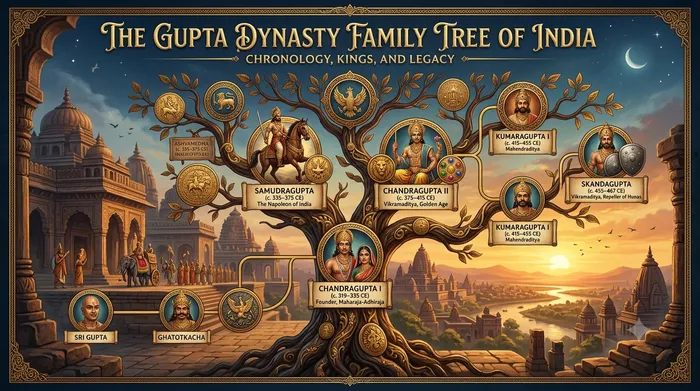
The Gupta Dynasty Family Tree of India
Explore the Gupta Dynasty family tree of India, from Sri Gupta and Chandragupta I to Samudragupta, Chandragupta II Vikramaditya, and the later rulers of India’s Golden Age.
26 July 2026
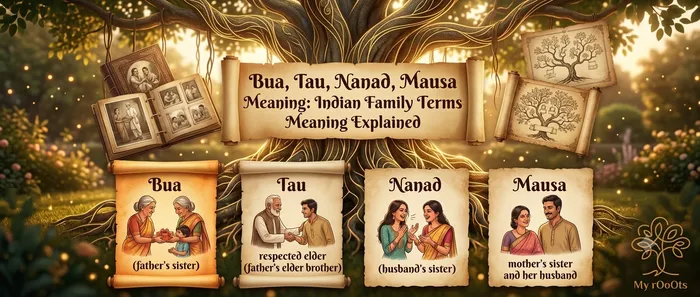
Bua, Tau, Nanad, Mausa Meaning: Indian Family Terms Meaning Explained
A plain-English guide to Indian family relationship names: what bua's husband is called (fufa), what mausa, tau, jija ji and nanad mean, and how Hindi kinship terms map to English relatives like aunt, uncle and in-law.

9 August 2026
Narendra Modi Family History and Tree: Parents, Siblings, and Ancestral Roots
Explore Narendra Modi’s family history, including his parents Damodardas and Heeraben Modi, siblings, early life in Vadnagar, and a clear look at his family tree and roots.
14 August 2026
Trace Your Ancestors Before 1947: A Beginner’s Guide for Indian Families
Learn how to trace Indian ancestors before 1947 using voter lists, land records, temple and church registers, and oral history interviews in this practical beginner’s guide.
8 August 2026
The Chola Dynasty Family Tree Explained
Explore the Chola Dynasty family tree from Vijayalaya to Rajaraja I, Rajendra I, and the later rulers who built one of South India’s greatest empires.
Download a Free Family Tree Template
Want to draw your family tree yourself? The My rOoOts Family Tree Template provides a free printable blank pedigree chart for documenting your family history across multiple generations.
👉 Download a free family tree template: Family Tree Template
Choose a 3-generation, 4-generation, or 5-generation family tree template and save it as a PDF for printing, writing, and documenting your ancestors.
Check Zodiac Compatibility for Any Two People
Curious about how well two people match based on their date of birth? Try the My rOoOts Zodiac Compatibility Tool to compare zodiac signs, explore relationship compatibility, and get a quick compatibility score for couples, friends, or family members.
👉 Check compatibility now: Zodiac Compatibility Calculator
You can enter two dates of birth and even mention the relationship type to get a more personalized compatibility result.
Create Your Family Tree for Free
Start building your family history in minutes with the My rOoOts Free Family Tree Creator. Add parents, grandparents, children, and relatives, organize generations visually, and create a beautiful family tree that you can save and share.
👉 Create your free family tree: Free Family Tree Creator
No design skills required. Simply enter your family details and generate a clear, easy-to-read family tree online for free.
Start your family tree free
No account needed to begin. Build it in minutes, then save it whenever you're ready.
Build your family tree