The Netherlands has one of the more unusual origin stories in European royal history. Its royal house isn't named after a place in the Netherlands at all - it's named after Orange, a small principality in southern France, and its founding figure was a rebel who led a revolt against the King of Spain rather than a conquering monarch. That figure, William of Orange, gave his name to a color, a country's sports jerseys, and, eventually, a royal dynasty that still reigns today.
This guide traces the House of Orange-Nassau from its founding through to King Willem-Alexander and his heir, Princess Catharina-Amalia.
Where the Name Comes From
"Orange-Nassau" is a merger of two family lines. The Nassau family were German nobles who had held territory in what's now the Netherlands and Germany since the Middle Ages. In 1544, a young Nassau prince named William inherited the small, unrelated principality of Orange in southern France, and from then on the family styled itself "Orange-Nassau."
That William - known to history as William the Silent - became the leader of the Dutch Revolt against Spanish Habsburg rule in the late 1500s, effectively founding the independent Netherlands in the process. He's still regarded as the "Father of the Fatherland" in Dutch national memory, and the country's national anthem, the Wilhelmus, is written from his perspective.
From Stadtholders to Kings
For over two centuries after William the Silent, his descendants served as stadtholders - a kind of appointed head of state - rather than hereditary monarchs, since the Dutch Republic was formally not a monarchy. The House of Orange-Nassau only became a true royal dynasty in 1815, when William I was crowned the first King of the Netherlands after the Napoleonic Wars reshaped the map of Europe.
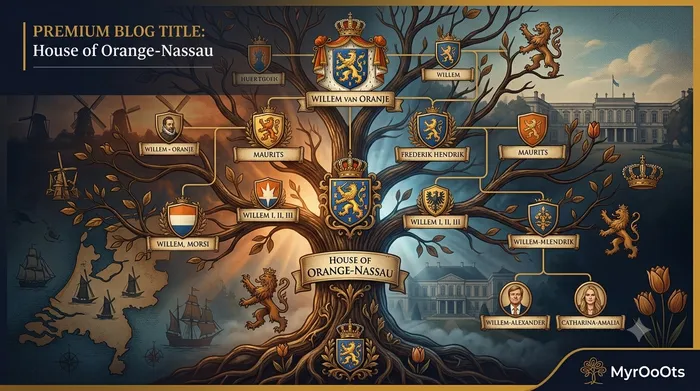
William I (r. 1815-1840), first King of the Netherlands
└── William II (r. 1840-1849)
    └── William III (r. 1849-1890)
        └── Wilhelmina (r. 1890-1948)
            └── Juliana (r. 1948-1980)
                └── Beatrix (r. 1980-2013)
                    └── Willem-Alexander (r. 2013-present)
                        └── Catharina-Amalia, Princess of Orange (heir apparent)
A Family Line Carried by Women
One of the most distinctive features of the modern Dutch monarchy is how often it has passed through female succession. From 1890 to 2013 - more than a century - the Netherlands was ruled by three consecutive queens: Wilhelmina, Juliana, and Beatrix. Each of them voluntarily abdicated in favor of their child rather than reigning until death, a pattern that's now become something of a Dutch royal tradition.
King Willem-Alexander broke that streak of queens when he acceded in 2013, but the pattern of women in the succession continues: his eldest daughter, Catharina-Amalia, became Princess of Orange - the traditional title for the Dutch heir apparent - and is set to become the next queen.
The Dutch Royal Family Today
| Position | Name | Relationship |
|---|---|---|
| King | Willem-Alexander | Reigning monarch since 2013 |
| Queen | Maxima | Consort, born in Argentina |
| Princess of Orange | Catharina-Amalia | Heir apparent, eldest daughter |
| Princess | Alexia | Second daughter |
| Princess | Ariane | Third daughter |
| Princess | Beatrix | Willem-Alexander's mother, abdicated 2013 |
Why "Orange" Matters Beyond the Royal Family
The House of Orange-Nassau's name explains a few things that might otherwise seem like coincidence:
- The Dutch national football team's orange jerseys are a direct tribute to the royal house, not a reference to the fruit or any natural feature of the Netherlands.
- New York's Orange County and the term "Orangemen" in Northern Ireland both trace back to the same royal line, via William III (who was also King of England, Scotland, and Ireland as William of Orange after the 1688 Glorious Revolution).
- South Africa's Orange River and former Orange Free State were named by Dutch settlers in tribute to the House of Orange, showing how far the dynasty's naming influence spread through Dutch colonial history.
Researching Dutch Royal or Noble Ancestry
If you suspect a connection to Dutch nobility or the House of Orange-Nassau itself, a few starting points:
- Start with Dutch civil records, which are unusually well preserved from 1811 onward, when Napoleon's administration introduced standardized birth, marriage, and death registration across the Netherlands.
- Check regional archives (Regionaal Archief) rather than only national ones - much of Dutch genealogical material is organized by province and city rather than centrally.
- Be skeptical of "Orange" surnames alone - many Dutch families carry Oranje- prefixed names or orange-linked surnames with no royal connection at all, since the color and name became broadly popular symbols rather than exclusive royal markers.
Frequently Asked Questions
Why is the Dutch royal family called "Orange" if Orange isn't in the Netherlands?
Orange was a small principality in what's now southern France, inherited by William the Silent's family line in 1544. The name stuck even though the House of Orange-Nassau's power and territory have always been centered in the Netherlands and Germany, not France.
Will Catharina-Amalia become Queen of the Netherlands?
As Princess of Orange, she is the current heir apparent and is expected to become queen when King Willem-Alexander eventually abdicates or dies, continuing the pattern of female monarchs that has defined much of the last 130 years of Dutch royal history.
Why have so many Dutch monarchs abdicated instead of ruling until death?
It's become an informal tradition rather than a legal requirement - Wilhelmina, Juliana, and Beatrix each chose to step aside for their successor rather than reign for life, which is unusual compared to most other European monarchies.
Is the British royal family related to the Dutch House of Orange-Nassau?
Yes, through William III, who was Prince of Orange before becoming King of England, Scotland, and Ireland jointly with his wife Mary II in 1689. That's a separate connection from the modern Dutch royal line, which continued through a different branch of the family.
How far back can you trace the House of Orange-Nassau?
The Nassau side of the family has documented nobility dating to the 12th century, though the House of Orange-Nassau as a distinct name only began with William the Silent's inheritance of Orange in 1544 - so genealogists usually treat that as the practical starting point for the dynasty itself.
Editor's picks
20 August 2026
The Danish Royal Family Tree: The House of Glucksburg Explained
How Denmark's House of Glucksburg became Europe's oldest continuous monarchy, and how it quietly supplied royal houses to Greece, Norway, and the UK.
6 August 2026
The British Royal Family Tree Explained Simply
A simple guide to the British Royal Family tree, from Queen Elizabeth II to King Charles III, the Prince of Wales, and the next generation of working royals.
6 August 2026
The House of Windsor Family Tree from Queen Victoria to Today
Explore the House of Windsor family tree from Queen Victoria through George V, Elizabeth II, and King Charles III to the present generation of British royals.
8 August 2026
The Ptolemaic Dynasty Family Tree of Egypt
Explore the Ptolemaic Dynasty family tree of Egypt, from Ptolemy I Soter to Cleopatra VII, including the complex royal marriages and the end of pharaonic rule.
Create Your Family Tree for Free
Start building your family history in minutes with the My rOoOts Free Family Tree Creator. Add parents, grandparents, children, and relatives, organize generations visually, and create a beautiful family tree that you can save and share.
👉 Create your free family tree: Free Family Tree Creator
No design skills required. Simply enter your family details and generate a clear, easy-to-read family tree online for free.
Check Zodiac Compatibility for Any Two People
Curious about how well two people match based on their date of birth? Try the My rOoOts Zodiac Compatibility Tool to compare zodiac signs, explore relationship compatibility, and get a quick compatibility score for couples, friends, or family members.
👉 Check compatibility now: Zodiac Compatibility Calculator
You can enter two dates of birth and even mention the relationship type to get a more personalized compatibility result.
Download a Free Family Tree Template
Want to draw your family tree yourself? The My rOoOts Family Tree Template provides a free printable blank pedigree chart for documenting your family history across multiple generations.
👉 Download a free family tree template: Family Tree Template
Choose a 3-generation, 4-generation, or 5-generation family tree template and save it as a PDF for printing, writing, and documenting your ancestors.
Discover the Meaning and Origin of Your Surname
Ever wondered where your family name came from? Use the My rOoOts Surname Meaning Lookup to explore surname meanings, origins, history, and etymology from different regions and cultures around the world.
👉 Discover your surname meaning: Surname Meaning Lookup
Learn more about your last name and explore the possible linguistic, geographic, cultural, and historical roots behind your family surname.
Start your family tree free
No account needed to begin. Build it in minutes, then save it whenever you're ready.
Build your family tree