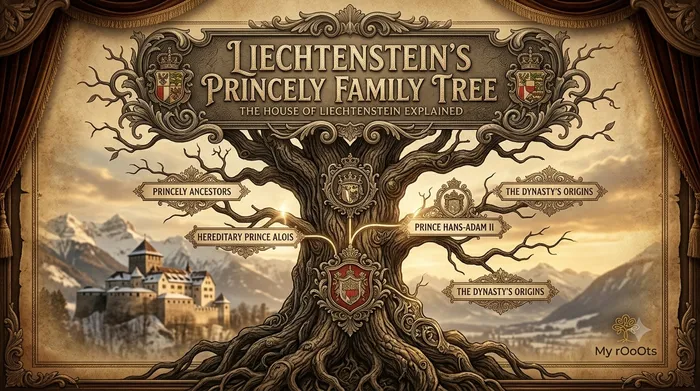
Tucked between Switzerland and Austria, Liechtenstein is one of the last places in Europe where the prince doesn't just wave from a balcony, he actually governs. Understanding the House of Liechtenstein's family tree means understanding a dynasty that owned the name of a country for almost a century before it ever owned the land itself.
If you've been working through our other small-monarchy family trees, from the House of Orange-Nassau in the Netherlands to Luxembourg's House of Nassau-Weilburg, Liechtenstein is the last major piece of that puzzle, and arguably the strangest story of the bunch.
A Dynasty Older Than Its Own Country
The House of Liechtenstein takes its name from Liechtenstein Castle near Vienna, which the family acquired around 1140. For nearly 600 years afterward, the Liechtensteins were wealthy Austrian nobles, close to the Habsburgs, holding vast estates across Moravia, Silesia, and Lower Austria. There was just one problem: none of that land was a sovereign territory, so the family had no seat in the Imperial Diet (the parliament of the Holy Roman Empire).
So, in 1719, Prince Anton Florian bought two small, unrelated territories, the Lordship of Schellenberg and the County of Vaduz, purely so the family would have a piece of land that answered to no one but the Holy Roman Emperor. Emperor Charles VI merged them and named the new principality Liechtenstein, after the family that now owned it.
Here's the part genealogists find fascinating: the family didn't actually move there. For nearly 90 years, the princes ruled Liechtenstein from Vienna without ever setting foot in it. It wasn't until 1806, when Liechtenstein became a fully sovereign state after the collapse of the Holy Roman Empire, that the House of Liechtenstein started paying real attention to the Alpine territory bearing its name.
From Absentee Landlords to Reigning Princes
House of Liechtenstein - Simplified Succession

Prince Johann I (r. 1805-1836)
└── Modernized the principality, kept it neutral through Napoleonic wars
    └── Prince Franz Joseph II (r. 1938-1989)
        └── First prince to actually live full-time in Liechtenstein
            └── Prince Hans-Adam II (r. 1989-present, ceded day-to-day rule 2004)
                └── Prince Alois (Prince Regent since 2004)
                    └── Prince Joseph Wenzel (heir apparent)
Prince Franz Joseph II, who reigned from 1938 to 1989, was the turning point. He was the first head of the house to actually reside in Liechtenstein rather than treating it as a distant possession managed from Vienna, and he steered the country through the difficult neutrality of the Second World War.
His son, Hans-Adam II, has reigned since 1989 and remains the formal head of state, but in 2004 he handed day-to-day governing authority to his son, Alois, who now serves as Prince Regent. This kind of living handover, where the reigning prince stays head of state but passes executive duties to the heir, is unusual among European monarchies and reflects how seriously this family treats succession planning.
How Liechtenstein's Monarchy Actually Works
Unlike Britain's largely ceremonial monarchy, Liechtenstein's prince holds real constitutional power:
- Veto power over any law passed by parliament
- The right to dismiss the government or dissolve parliament
- A personal fortune built on private banking (LGT Group) and art, making the family one of the wealthiest royal houses in the world
- A 2003 referendum, called by Hans-Adam II himself, that expanded these very powers, an almost unheard-of case of a modern monarch successfully asking citizens to give him more authority
The family's wealth and privacy mean far less has been written about their internal family relationships than about, say, the Windsors or the Romanovs, which is part of why their family tree is so rarely mapped out clearly.
Where the Line Stands Today
The current order of succession runs through Prince Alois's four children, with his eldest son, Prince Joseph Wenzel (born 1995), as heir apparent after his father. Because Liechtenstein follows agnatic primogeniture (succession through male descendants), the family tree branches out through Hans-Adam II's siblings and cousins as well, many of whom still hold honorary or ceremonial roles connected to the family's extensive art collection and charitable foundations.
Frequently Asked Questions
Is the Prince of Liechtenstein a real ruling monarch?
Yes. Unlike most European monarchs today, the Prince of Liechtenstein holds genuine constitutional powers, including the ability to veto legislation and dismiss the government, making Liechtenstein one of the few remaining monarchies in Europe with a head of state who rules as well as reigns.
How is the House of Liechtenstein related to Austria?
The family originated as Austrian nobility, and for centuries their vast estates were entirely within Habsburg Austria rather than in the principality that now bears their name. They only became sovereign rulers of Liechtenstein itself in 1806.
Who is next in line to become Prince of Liechtenstein?
Prince Alois, the current Prince Regent, is first in line as the son of reigning Prince Hans-Adam II. After Alois, his eldest son, Prince Joseph Wenzel, is next in the line of succession.
Why did the Liechtenstein family rule from Vienna for so long?
The family bought the territory in 1719 mainly to gain a seat in the Holy Roman Empire's parliament, not out of any personal connection to the land. It took nearly a century, and the collapse of the Holy Roman Empire itself, before a prince made Liechtenstein his actual home.
Is Liechtenstein related to any other European royal families?
Through centuries of intermarriage with Austrian, Bohemian, and other Central European noble houses, the Liechtensteins share ancestry with several historic dynasties, though unlike the Glücksburg-descended royal families of Scandinavia, their intermarriage network centers more on old Austro-Hungarian nobility than on Europe's reigning royal houses.
Editor's picks
23 August 2026
Luxembourg's Grand Ducal Family Tree: The House of Nassau-Weilburg Explained
How a 19th-century succession crisis split Luxembourg's royal family from the Dutch throne, and how the House of Nassau-Weilburg has ruled the Grand Duchy ever since.
21 August 2026
The Belgian Royal Family Tree: The House of Belgium (Saxe-Coburg) Explained
From Leopold I's founding of modern Belgium in 1831 to King Philippe today, trace how a German-born prince's dynasty became the House of Belgium.
23 August 2026
The Norwegian Royal Family Tree: The House of Glücksburg Explained
Trace how a Danish prince became King of Norway in 1905, and how today's Harald V, Crown Prince Haakon and Princess Ingrid Alexandra descend from the House of Glücksburg.
21 August 2026
The Swedish Royal Family Tree: The House of Bernadotte Explained
A French general with no Swedish blood became King Carl XIV Johan in 1818, and every Swedish monarch since has descended from him. Here's the House of Bernadotte's family tree, from Napoleon's marshal to King Carl XVI Gustaf today.
20 August 2026
The Danish Royal Family Tree: The House of Glucksburg Explained
How Denmark's House of Glucksburg became Europe's oldest continuous monarchy, and how it quietly supplied royal houses to Greece, Norway, and the UK.
20 August 2026
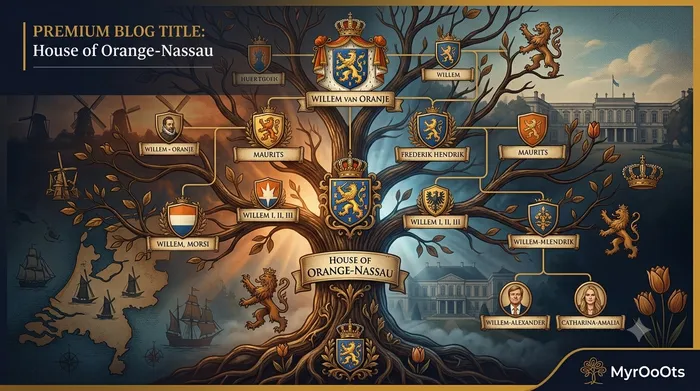
The Dutch Royal Family Tree: The House of Orange-Nassau Explained
How a 16th-century rebel prince became the namesake of the Netherlands' royal house, and how the House of Orange-Nassau's lineage leads to King Willem-Alexander today.
Download a Free Family Tree Template
Want to draw your family tree yourself? The My rOoOts Family Tree Template provides a free printable blank pedigree chart for documenting your family history across multiple generations.
👉 Download a free family tree template: Family Tree Template
Choose a 3-generation, 4-generation, or 5-generation family tree template and save it as a PDF for printing, writing, and documenting your ancestors.
Create Your Family Tree for Free
Start building your family history in minutes with the My rOoOts Free Family Tree Creator. Add parents, grandparents, children, and relatives, organize generations visually, and create a beautiful family tree that you can save and share.
👉 Create your free family tree: Free Family Tree Creator
No design skills required. Simply enter your family details and generate a clear, easy-to-read family tree online for free.
Check Zodiac Compatibility for Any Two People
Curious about how well two people match based on their date of birth? Try the My rOoOts Zodiac Compatibility Tool to compare zodiac signs, explore relationship compatibility, and get a quick compatibility score for couples, friends, or family members.
👉 Check compatibility now: Zodiac Compatibility Calculator
You can enter two dates of birth and even mention the relationship type to get a more personalized compatibility result.
Start your family tree free
No account needed to begin. Build it in minutes, then save it whenever you're ready.
Build your family tree