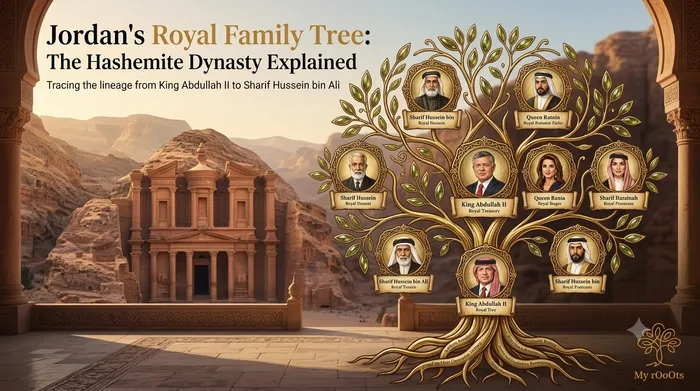
Of all the royal families still reigning today, the Hashemites of Jordan claim one of the longest and most historically significant lineages: a direct line of descent, as tradition holds, from the Prophet Muhammad through his daughter Fatima. That heritage is where the dynasty's name comes from - "Hashemite" refers to the Banu Hashim, the clan of Muhammad's great-grandfather Hashim ibn Abd Manaf. Here's how that ancient lineage connects to the modern kingdom of Jordan.
From Guardians of Mecca to Kings of Jordan
Before they ruled Jordan, the Hashemites were Sharifs of Mecca, the traditional custodians of the holiest sites in Islam, a role the family held for centuries. The modern political story begins with Sharif Hussein bin Ali (1854-1931), who led the Arab Revolt against Ottoman rule during World War I. In the settlement that followed, Hussein's sons were installed as rulers of newly created territories carved out of the former Ottoman Empire:
- His son Faisal became King of Iraq (and briefly King of Syria)
- His son Abdullah became Emir, and later King, of Transjordan - the territory that became modern Jordan
The Jordanian Line, Generation by Generation
Sharif Hussein bin Ali (Sharif of Mecca, led the 1916 Arab Revolt)
└── King Abdullah I (ruled Transjordan/Jordan 1921-1951, assassinated in Jerusalem)
    └── King Talal (ruled 1951-1952, abdicated due to illness)
        └── King Hussein (ruled 1952-1999, Jordan's longest-reigning monarch)
            └── King Abdullah II (ruled 1999-present)
                └── Crown Prince Hussein bin Abdullah (heir apparent, born 1994)
King Abdullah I: The Founder
Abdullah I (1882-1951) became Emir of Transjordan in 1921 under British administration, and King of an independent Jordan in 1946. He was assassinated in 1951 in Jerusalem, at the Al-Aqsa Mosque, by a gunman opposed to his contacts with Israel - his young grandson Hussein was standing beside him at the time and reportedly survived only because a medal on his uniform deflected a bullet.
King Talal: The Brief Reign
Abdullah's son Talal (1909-1972) succeeded him but reigned only about a year before parliament required his abdication due to a diagnosed mental illness. He spent the rest of his life largely out of public view, but his short reign matters for one key reason: it's when Jordan adopted its modern constitution, still the basis of the country's governance today.
King Hussein: The Longest Reign
King Hussein (1935-1999), Talal's son, ruled for nearly half a century and became one of the most recognizable Arab leaders of the 20th century, navigating the 1967 and 1973 wars, the aftermath of Black September, and the eventual 1994 peace treaty with Israel. He married four times; his fourth wife, Queen Noor (born Lisa Halaby, an American), remains a public figure. His successor, however, came from his first marriage.
King Abdullah II: The Current Monarch
King Abdullah II (born 1962) is King Hussein's eldest son, from his second wife, Princess Muna (born Antoinette Gardiner, a British-born former actress). Abdullah II ascended the throne in 1999, just weeks before his father's death from cancer, after King Hussein made a late change naming Abdullah rather than his own brother Hassan as heir. Abdullah II married Queen Rania, born in Kuwait to a Palestinian family, and the couple has four children.
The Next Generation
Abdullah II and Rania's eldest son, Crown Prince Hussein bin Abdullah (born 1994), was formally named heir apparent in 2009 and has taken on an increasingly public role in recent years, including representing Jordan at international summits. His siblings - Princess Iman, Princess Salma, and Prince Hashem - round out the current generation of the family.
Why the Hashemite Lineage Carries Extra Weight
Unlike most European royal houses, whose legitimacy rests on inheritance, conquest, or parliamentary settlement, the Hashemites' claim rests additionally on sharifian descent - lineage traced back through many generations to the Prophet Muhammad's family. This is a distinct kind of genealogical claim, verified historically through the same kind of oral and written lineage-keeping (nasab) that Arab tribal genealogy has used for over a thousand years, predating and separate from the more recent 20th-century political story of the kingdom itself.
Frequently Asked Questions
What does "Hashemite" mean?
Hashemite refers to the Banu Hashim, the clan within the Quraysh tribe of Mecca to which the Prophet Muhammad's family belonged. The Jordanian royal family takes its name from this ancestral clan.
Is King Abdullah II a direct descendant of the Prophet Muhammad?
According to the traditional Hashemite genealogy (nasab), yes - the family traces an unbroken line of descent from Muhammad through his daughter Fatima and her husband Ali, extending down through the Sharifs of Mecca to the present king.
Why did the Hashemites end up ruling Jordan instead of a larger territory?
After World War I, the Hashemite family briefly held influence across Arabia, Syria, and Iraq, but shifting colonial arrangements and regional politics narrowed their lasting rule to Transjordan (Jordan) and, separately, the Kingdom of Iraq (which itself was overthrown in 1958). Jordan is the only Hashemite monarchy that has survived to the present day.
Who is next in line to the Jordanian throne after King Abdullah II?
Crown Prince Hussein bin Abdullah, King Abdullah II's eldest son, is the designated heir apparent.
How is Queen Noor related to the current king?
Queen Noor was King Hussein's fourth wife and is King Abdullah II's stepmother, not his biological mother. Abdullah II's mother is Princess Muna, King Hussein's second wife.
Editor's picks
25 August 2026
Liechtenstein's Princely Family Tree: The House of Liechtenstein Explained
Liechtenstein is one of Europe's last monarchies where the prince genuinely rules. Here's how the House of Liechtenstein's family tree connects centuries of Austrian nobility to a tiny Alpine nation.

23 August 2026
Luxembourg's Grand Ducal Family Tree: The House of Nassau-Weilburg Explained
How a 19th-century succession crisis split Luxembourg's royal family from the Dutch throne, and how the House of Nassau-Weilburg has ruled the Grand Duchy ever since.

21 August 2026
The Belgian Royal Family Tree: The House of Belgium (Saxe-Coburg) Explained
From Leopold I's founding of modern Belgium in 1831 to King Philippe today, trace how a German-born prince's dynasty became the House of Belgium.
25 August 2026
The Greek Royal Family Tree: The House of Glucksburg and Greece's Lost Monarchy
From a Danish prince crowned King of the Hellenes to a monarchy abolished by referendum, here's how the Greek royal family tree connects to Denmark, Britain, and Russia.

23 August 2026
The Norwegian Royal Family Tree: The House of Glücksburg Explained
Trace how a Danish prince became King of Norway in 1905, and how today's Harald V, Crown Prince Haakon and Princess Ingrid Alexandra descend from the House of Glücksburg.

21 August 2026
The Swedish Royal Family Tree: The House of Bernadotte Explained
A French general with no Swedish blood became King Carl XIV Johan in 1818, and every Swedish monarch since has descended from him. Here's the House of Bernadotte's family tree, from Napoleon's marshal to King Carl XVI Gustaf today.
Download a Free Family Tree Template
Want to draw your family tree yourself? The My rOoOts Family Tree Template provides a free printable blank pedigree chart for documenting your family history across multiple generations.
👉 Download a free family tree template: Family Tree Template
Choose a 3-generation, 4-generation, or 5-generation family tree template and save it as a PDF for printing, writing, and documenting your ancestors.
Create Your Family Tree for Free
Start building your family history in minutes with the My rOoOts Free Family Tree Creator. Add parents, grandparents, children, and relatives, organize generations visually, and create a beautiful family tree that you can save and share.
👉 Create your free family tree: Free Family Tree Creator
No design skills required. Simply enter your family details and generate a clear, easy-to-read family tree online for free.
Check Zodiac Compatibility for Any Two People
Curious about how well two people match based on their date of birth? Try the My rOoOts Zodiac Compatibility Tool to compare zodiac signs, explore relationship compatibility, and get a quick compatibility score for couples, friends, or family members.
👉 Check compatibility now: Zodiac Compatibility Calculator
You can enter two dates of birth and even mention the relationship type to get a more personalized compatibility result.
Start your family tree free
No account needed to begin. Build it in minutes, then save it whenever you're ready.
Build your family tree