Interactive family tree
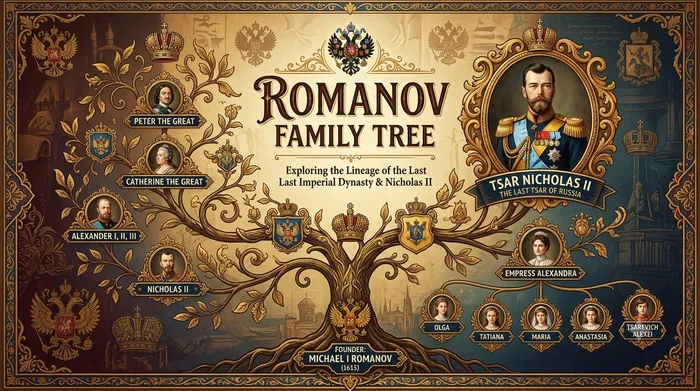
Romanov Family Tree - Tsar Nicholas II and the Last Imperial House of Russia Family Tree
17 people documented: explore the full interactive family tree
The Romanov Family Tree and the Last Tsar of Russia
The House of Romanov ruled Russia for more than three centuries, from 1613 until the revolution of 1917. Its final chapter belongs to Tsar Nicholas II, his wife Alexandra, and their five children. Their story is one of imperial splendour, political crisis, and tragic ending. This guide explains the Romanov family tree with a clear focus on the last imperial family.
Brief Background of the Dynasty
The Romanov dynasty began in 1613 when Michael Romanov was elected Tsar after the Time of Troubles. Over the following centuries the family transformed Russia into a major European empire. By the late nineteenth century the dynasty stood at the height of its formal power, yet it faced growing social and political pressures.
The last Tsar, Nicholas II, was the eldest son of Alexander III. He came to the throne in 1894 and reigned until his forced abdication in March 1917.
The Immediate Family of Nicholas II
The core of the final Romanov family tree is compact and well documented:
Alexander III (1845–1894)
m. Maria Feodorovna (Dagmar of Denmark)
└── Nicholas II (1868–1918)   ← Last Tsar of Russia
m. Alexandra Feodorovna (Alix of Hesse) (1872–1918)
├── Grand Duchess Olga Nikolaevna (1895–1918)
├── Grand Duchess Tatiana Nikolaevna (1897–1918)
├── Grand Duchess Maria Nikolaevna (1899–1918)
├── Grand Duchess Anastasia Nikolaevna (1901–1918)
└── Tsarevich Alexei Nikolaevich (1904–1918)
Nicholas and Alexandra had four daughters before the long-awaited male heir, Alexei, was born in 1904. Alexei suffered from haemophilia, a condition inherited through Alexandra’s side of the family (she was a granddaughter of Queen Victoria).
Key Members Explained
Nicholas II
Born in 1868, he became Emperor in 1894. His reign saw economic growth, military defeat in the Russo-Japanese War, the 1905 Revolution, the creation of the Duma, and ultimately Russia’s involvement in the First World War. He abdicated in 1917 in favour of his brother Michael, who declined the throne the next day.
Alexandra Feodorovna
A German-born princess and favourite granddaughter of Queen Victoria, she married Nicholas in 1894. She was deeply devoted to her husband and children and became increasingly unpopular with the Russian public, partly because of her reliance on the mystic Grigori Rasputin in the hope of helping her son.
The Five Children
Olga, Tatiana, Maria, and Anastasia were often known collectively as OTMA. They lived relatively secluded lives within the imperial household. Alexei, as Tsarevich, was the heir and the focus of intense parental anxiety because of his illness.
The End of the Imperial Family
After the abdication, the family was held under house arrest, first at Tsarskoye Selo, then in Tobolsk, and finally in the Ipatiev House in Yekaterinburg. In the early hours of 17 July 1918, Nicholas, Alexandra, their five children, and several loyal attendants were executed by Bolshevik forces.
For many years rumours claimed that one or more of the children had survived. Extensive investigation and DNA testing in the 1990s and 2000s confirmed that all seven members of the immediate family had died together. Their remains were later given state funerals and were interred in the Peter and Paul Cathedral in St Petersburg.
Wider Romanov Branches
Nicholas II had several siblings and many cousins. After 1917 some Romanov relatives escaped abroad and established lives in exile. Various branches of the wider family continue to this day, and questions of dynastic headship are still discussed among Romanov descendants and monarchist circles. The direct line of Nicholas II, however, ended in 1918.
Why the Romanov Tree Still Matters
The Romanov family tree illustrates both the splendour and the vulnerability of dynastic rule. It shows how marriage alliances linked the Russian imperial house to other European royal families, how a genetic condition could affect an entire succession, and how political revolution can end a centuries-old lineage in a single night.
For students of history and genealogy, the Romanovs also demonstrate the value of careful documentation. Letters, diaries, photographs, and official records have allowed the final generation to be reconstructed in remarkable detail.
Preserving Family Stories of Your Own
Most families do not live in palaces, yet every family has names, relationships, and stories worth recording. A clear digital family tree can hold the people, dates, and memories that matter most so they are not lost with time.
You can begin building a private family record for free, with no sign-up required, at the My rOoOts create-tree page. The family tree generator offers a simple way to start. An ancestor timeline generator helps place generations against historical events. When relatives contribute information, a relationship calculator can clarify connections across generations.
Conclusion
The Romanov family tree reaches its final chapter with Tsar Nicholas II, Empress Alexandra, and their five children — Olga, Tatiana, Maria, Anastasia, and Alexei. Their lives ended together in 1918, closing three hundred years of Romanov rule in Russia. The wider dynasty continues through collateral branches, but the imperial line of the last Tsar concluded in Yekaterinburg.
Studying this family tree offers a powerful reminder of how history, politics, and personal fate intersect. It also shows the lasting value of recording names and relationships carefully — a practice that belongs not only to emperors, but to every family.
Editor's picks
6 August 2026
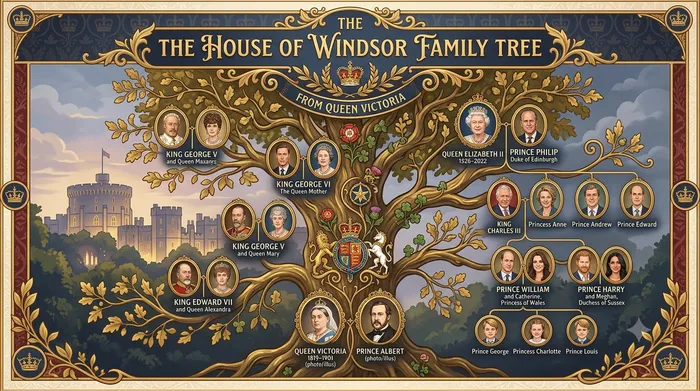
The House of Windsor Family Tree from Queen Victoria to Today
Explore the House of Windsor family tree from Queen Victoria through George V, Elizabeth II, and King Charles III to the present generation of British royals.
6 August 2026
The British Royal Family Tree Explained Simply
A simple guide to the British Royal Family tree, from Queen Elizabeth II to King Charles III, the Prince of Wales, and the next generation of working royals.
6 August 2026
The Tuareg: Desert Nomads and Their Clan-Based Genealogy
Explore the Tuareg people of the Sahara, their nomadic heritage, clan-based social structure, and how genealogy shapes identity, status, and family history across the desert.
Create Your Family Tree for Free
Start building your family history in minutes with the My rOoOts Free Family Tree Creator. Add parents, grandparents, children, and relatives, organize generations visually, and create a beautiful family tree that you can save and share.
👉 Create your free family tree: Free Family Tree Creator
No design skills required. Simply enter your family details and generate a clear, easy-to-read family tree online for free.
Check Zodiac Compatibility for Any Two People
Curious about how well two people match based on their date of birth? Try the My rOoOts Zodiac Compatibility Tool to compare zodiac signs, explore relationship compatibility, and get a quick compatibility score for couples, friends, or family members.
👉 Check compatibility now: Zodiac Compatibility Calculator
You can enter two dates of birth and even mention the relationship type to get a more personalized compatibility result.
Download a Free Family Tree Template
Want to draw your family tree yourself? The My rOoOts Family Tree Template provides a free printable blank pedigree chart for documenting your family history across multiple generations.
👉 Download a free family tree template: Family Tree Template
Choose a 3-generation, 4-generation, or 5-generation family tree template and save it as a PDF for printing, writing, and documenting your ancestors.
Discover the Meaning and Origin of Your Surname
Ever wondered where your family name came from? Use the My rOoOts Surname Meaning Lookup to explore surname meanings, origins, history, and etymology from different regions and cultures around the world.
👉 Discover your surname meaning: Surname Meaning Lookup
Learn more about your last name and explore the possible linguistic, geographic, cultural, and historical roots behind your family surname.
Start your family tree free
No account needed to begin. Build it in minutes, then save it whenever you're ready.
Build your family tree