The Bourbon Family Tree Across France and Spain
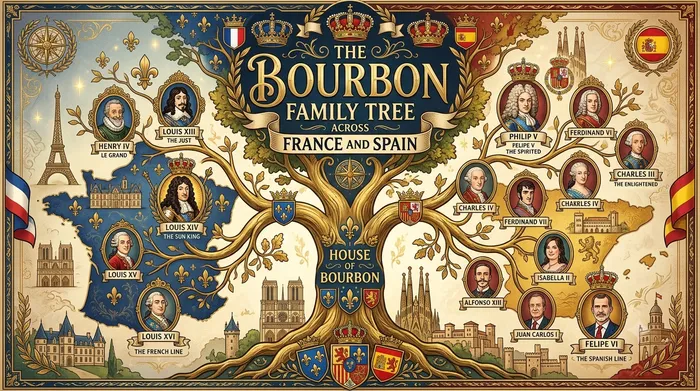
The House of Bourbon is one of Europe’s most enduring royal dynasties. It rose to power in France in the late sixteenth century and later established a lasting branch on the Spanish throne. Today the Spanish Bourbons remain the reigning royal family of Spain. This guide explains the main lines of the Bourbon family tree across both countries in clear, simple terms.
Origins of the Bourbons
The Bourbons began as a junior branch of the Capetian dynasty, the long-ruling royal house of France. Their name comes from the lordship of Bourbon in central France. Through careful marriages and royal favour they rose in importance until, in 1589, Henry of Navarre became King Henry IV of France — the first Bourbon king.
Henry IV’s accession ended the Valois line and began more than two centuries of Bourbon rule in France.
Simplified Main Family Tree
The following diagram shows the core French line and the point at which the Spanish branch was created:
Henry IV of France (1553–1610)
└── Louis XIII (1601–1643)
└── Louis XIV, the Sun King (1638–1715)
├── Louis, Grand Dauphin (1661–1711)
│   ├── Louis, Duke of Burgundy (1682–1712)
│   │   └── Louis XV of France (1710–1774)
│   │       └── Louis XVI of France (1754–1793)
│   │           (French Revolution – monarchy abolished)
│   └── Philip V of Spain (1683–1746)   ← Founder of Spanish Bourbons
│       └── Spanish line continues
│           └── ... → King Felipe VI of Spain (b. 1968)
└── (other children)
This outline highlights the direct connection between the great French kings and the Spanish royal house that still exists today.
The French Bourbons
The French Bourbon kings include some of the most famous rulers in European history:
| King | Reign | Significance |
|---|---|---|
| Henry IV | 1589–1610 | First Bourbon king; restored stability |
| Louis XIII | 1610–1643 | Strengthened royal authority |
| Louis XIV | 1643–1715 | Peak of absolute monarchy; built Versailles |
| Louis XV | 1715–1774 | Long reign; growing financial and political problems |
| Louis XVI | 1774–1792 | Reign ended by the French Revolution |
After the Revolution the monarchy was restored for a time. Louis XVIII and Charles X (brothers of Louis XVI) returned to the throne. In 1830 the elder Bourbon line was replaced by the Orléans branch under Louis-Philippe. The French monarchy finally ended in 1848.
The Spanish Bourbons
The Spanish branch began with the War of the Spanish Succession (1701–1714). Charles II of Spain, the last Spanish Habsburg, died childless. He left his throne to Philip, Duke of Anjou — a grandson of Louis XIV. Philip became Philip V of Spain, the first Bourbon king of Spain.
Despite wars and political upheavals, the Spanish Bourbons have remained on the throne for most of the period since 1700. The present king, Felipe VI, is a direct descendant of Philip V.
Key points about the Spanish line:
- Founded by Philip V (grandson of Louis XIV)
- Survived the Napoleonic period, republics, and civil war
- Restored after the death of Franco
- Continues today under King Felipe VI and Queen Letizia
Other Bourbon Branches
In addition to France and Spain, Bourbon lines once ruled in Naples and Sicily (the Two Sicilies) and in the Duchy of Parma. These branches are now non-reigning but still exist as noble families. The main historical importance of the dynasty, however, lies in the French and Spanish thrones.
Why the Bourbon Tree Matters
The Bourbon family tree shows how a single dynasty could rule two major European kingdoms and influence the continent for centuries. It also illustrates the power of dynastic marriage and inheritance: a French prince became the founder of Spain’s current royal house.
For anyone interested in genealogy, the Bourbons offer a clear example of how carefully recorded names, marriages, and successions allow a complex family story to remain understandable across hundreds of years.
Recording Your Own Family History
Royal trees are unusually well documented, yet the basic principles apply to every family. Recording names, relationships, and key dates helps preserve history that would otherwise fade.
You can begin building a private family tree for free, with no sign-up required, at the My rOoOts create-tree page. The family tree generator offers an easy starting point. An ancestor timeline generator can place generations against historical events. When relatives add information, a relationship calculator helps clarify connections.
Conclusion
The Bourbon family tree links the glamorous court of Louis XIV’s France with the modern Spanish monarchy. From Henry IV’s accession in 1589 to the reign of Felipe VI today, the dynasty has survived revolution, war, and political change. The French line lost its throne in the nineteenth century, but the Spanish branch continues to reign.
Studying this tree reveals both the reach of European dynastic politics and the lasting value of clear genealogical records — a practice that serves royal houses and ordinary families alike.
Editor's picks
6 August 2026
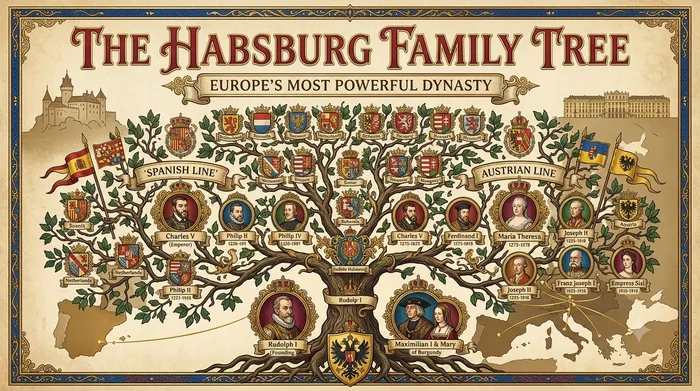
The Habsburg Family Tree: Europe’s Most Powerful Dynasty
Explore the Habsburg family tree, from their Swiss origins to the Spanish and Austrian branches that dominated European politics for centuries through marriage and empire.
6 August 2026
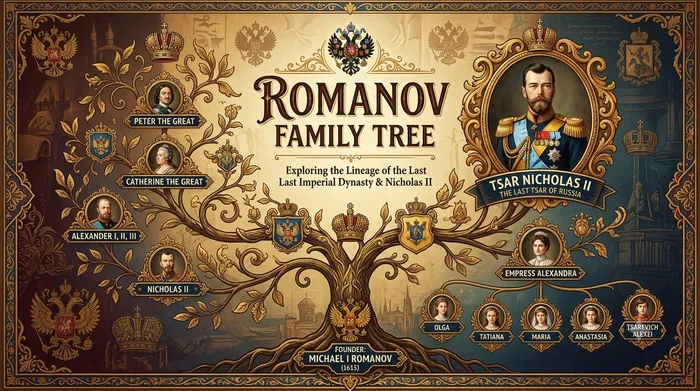
The Romanov Family Tree and the Last Tsar of Russia
Explore the Romanov family tree, focusing on Tsar Nicholas II, the last Emperor of Russia, his wife Alexandra, their five children, and the end of the dynasty in 1918.
6 August 2026
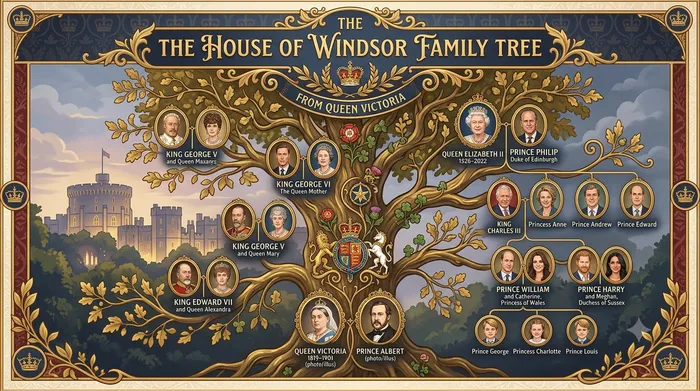
The House of Windsor Family Tree from Queen Victoria to Today
Explore the House of Windsor family tree from Queen Victoria through George V, Elizabeth II, and King Charles III to the present generation of British royals.
6 August 2026
The British Royal Family Tree Explained Simply
A simple guide to the British Royal Family tree, from Queen Elizabeth II to King Charles III, the Prince of Wales, and the next generation of working royals.
6 August 2026
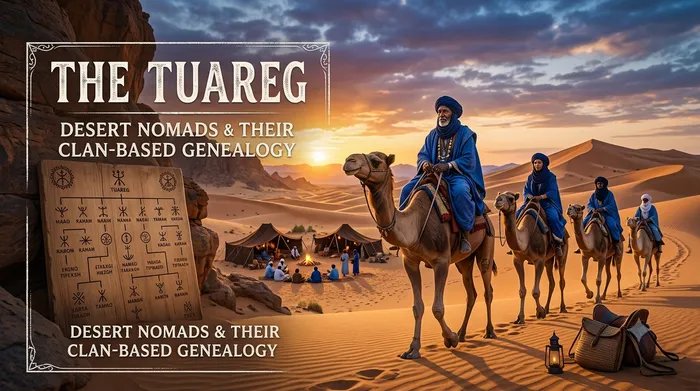
The Tuareg: Desert Nomads and Their Clan-Based Genealogy
Explore the Tuareg people of the Sahara, their nomadic heritage, clan-based social structure, and how genealogy shapes identity, status, and family history across the desert.
6 August 2026
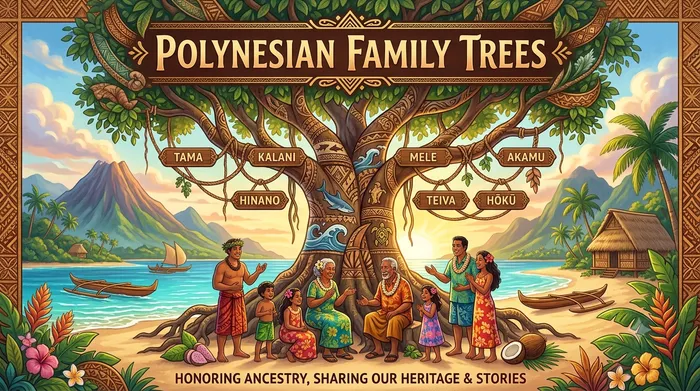
Polynesian Family Trees: How Oral Genealogy Preserved Ancestors for Centuries
Discover how Polynesian societies used oral genealogy to preserve family trees for centuries, linking people to ancestors, land, and identity across the Pacific.
Create Your Family Tree for Free
Start building your family history in minutes with the My rOoOts Free Family Tree Creator. Add parents, grandparents, children, and relatives, organize generations visually, and create a beautiful family tree that you can save and share.
👉 Create your free family tree: Free Family Tree Creator
No design skills required. Simply enter your family details and generate a clear, easy-to-read family tree online for free.
Check Zodiac Compatibility for Any Two People
Curious about how well two people match based on their date of birth? Try the My rOoOts Zodiac Compatibility Tool to compare zodiac signs, explore relationship compatibility, and get a quick compatibility score for couples, friends, or family members.
👉 Check compatibility now: Zodiac Compatibility Calculator
You can enter two dates of birth and even mention the relationship type to get a more personalized compatibility result.
Download a Free Family Tree Template
Want to draw your family tree yourself? The My rOoOts Family Tree Template provides a free printable blank pedigree chart for documenting your family history across multiple generations.
👉 Download a free family tree template: Family Tree Template
Choose a 3-generation, 4-generation, or 5-generation family tree template and save it as a PDF for printing, writing, and documenting your ancestors.
Discover the Meaning and Origin of Your Surname
Ever wondered where your family name came from? Use the My rOoOts Surname Meaning Lookup to explore surname meanings, origins, history, and etymology from different regions and cultures around the world.
👉 Discover your surname meaning: Surname Meaning Lookup
Learn more about your last name and explore the possible linguistic, geographic, cultural, and historical roots behind your family surname.
Start your family tree free
No account needed to begin. Build it in minutes, then save it whenever you're ready.
Build your family tree