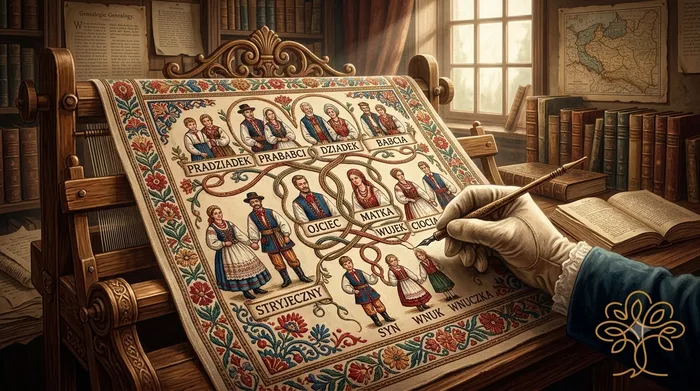
Polish is one of the more genealogically rewarding languages to learn family vocabulary in, because it draws sharper lines than English does - separate words for a maternal uncle versus a paternal uncle, and for in-laws depending on which side of the marriage they're on. If you have Polish ancestry, or you're working through Polish parish and civil records, this guide covers the core terms in English to Polish.
Immediate Family
| English | Polish |
|---|---|
| Father | ojciec (informal: tata) |
| Mother | matka (informal: mama) |
| Son | syn |
| Daughter | córka |
| Brother | brat |
| Sister | siostra |
| Husband | mąż |
| Wife | żona |
| Parents | rodzice |
| Siblings | rodzeństwo |
Rodzeństwo is worth learning early: it's a single collective noun for "siblings" that doesn't specify gender or number, which is genuinely convenient compared to English needing "brothers and sisters."
Grandparents
- dziadek - grandfather, babcia - grandmother
- pradziadek / prababcia - great-grandfather / great-grandmother
- wnuk / wnuczka - grandson / granddaughter
Uncles and Aunts: The Maternal-Paternal Split
This is the feature that most surprises English speakers. Traditional Polish distinguishes which side of the family an uncle or aunt is on:
- wuj (or the more modern, increasingly common wujek) - a maternal uncle, your mother's brother
- stryj - a paternal uncle, your father's brother (this word is falling out of everyday use, with wujek increasingly used for both sides in casual speech)
- ciotka (informal: ciocia) - aunt, used for either side, though older usage sometimes distinguished stryjenka (paternal uncle's wife) from wujenka (maternal uncle's wife)
If you're reading older Polish parish records or letters, seeing stryj rather than wuj is actually a useful clue about which branch of the family a document is describing.
Cousins, Nieces, and Nephews
- kuzyn / kuzynka - male / female cousin
- siostrzeniec / siostrzenica - nephew / niece through a sister
- bratanek / bratanica - nephew / niece through a brother
Just like with aunts and uncles, Polish tracks nieces and nephews by which sibling they descend from - a nephew through your sister has a different word than a nephew through your brother. This level of specificity is genuinely useful for genealogy, since it tells you the family line at a glance without extra context.
In-Laws
Polish in-law terms are also side-specific and among the most detailed of any European language:
- teść / teściowa - father-in-law / mother-in-law
- zięć - son-in-law
- synowa - daughter-in-law
- szwagier / szwagierka - brother-in-law / sister-in-law
- swat / swatowa - the parents of your child's spouse, relative to each other (a relationship English has no single word for at all)
That last one, swat, is a good example of how Polish family vocabulary sometimes covers relationships English speakers don't typically name directly - your child's spouse's parents, from your point of view.
Step-Family Terms
- ojczym - stepfather
- macocha - stepmother
- pasierb / pasierbica - stepson / stepdaughter
- przyrodni brat / przyrodnia siostra - half-brother / half-sister
Why the Detail Matters for Genealogy
Polish genealogical research, especially through Catholic parish books and Austrian, Prussian, or Russian partition-era civil records, often uses these precise relationship terms rather than generic ones. Knowing that stryj means specifically a paternal uncle, not just "an uncle," can help you correctly place a name on the right branch of a family tree instead of guessing. It's a small vocabulary difference that can save real time once you're working through handwritten 19th-century records.
Frequently Asked Questions
What is the Polish word for grandmother?
Babcia is the everyday word for grandmother, widely used both formally and affectionately. The more formal term is babka, though babcia is by far the more common in modern usage.
Does Polish have different words for a mother's brother and a father's brother?
Traditionally yes: wuj is a maternal uncle and stryj is a paternal uncle, though in modern casual Polish, wujek is increasingly used for both.
What does "rodzeństwo" mean?
It's a collective noun meaning "siblings," referring to a person's brothers and sisters together without needing to specify gender or count them individually.
What is a "swat" in Polish family terms?
Swat describes the relationship between two sets of parents whose children have married each other - a relationship that English has no direct single word for.
Is Polish family vocabulary the same across Poland and Polish diaspora communities?
The core terms are the same, but diaspora communities, particularly in the US and UK, sometimes simplify side-specific terms like stryj and wuj into the more general wujek for both, mirroring how English doesn't distinguish maternal and paternal uncles.
Editor's picks
23 August 2026
Portuguese Family Relationship Names Explained (English to Portuguese Guide)
A clear guide to Portuguese family and kinship terms in English, covering immediate family, in-laws, and the differences between Brazilian and European Portuguese.
9 August 2026
French Family Relationship Names Explained (English to French Guide)
A complete English-to-French guide to family relationship names, covering parents, siblings, grandparents, in-laws, cousins, step-family, and more with clear tables and examples.
17 August 2026
Chinese Family Relationship Names Explained (English to Chinese Guide)
A clear guide to Chinese family relationship names in Mandarin, covering grandparents, aunts, uncles, and cousins on both the paternal and maternal sides.
20 August 2026
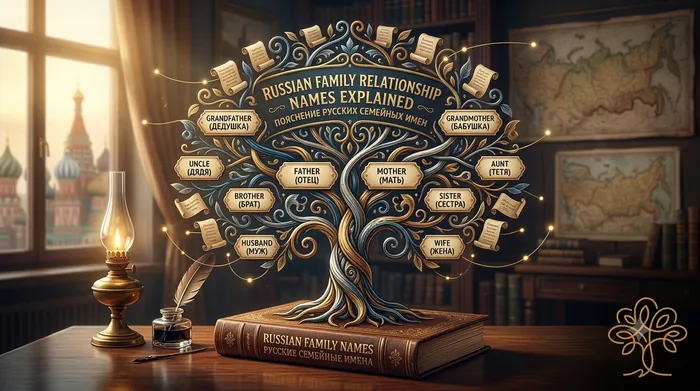
Russian Family Relationship Names Explained (English to Russian Guide)
An English-to-Russian guide to family relationship names, including the distinct in-law terms Russian uses depending on which side of the family you married into.
20 August 2026
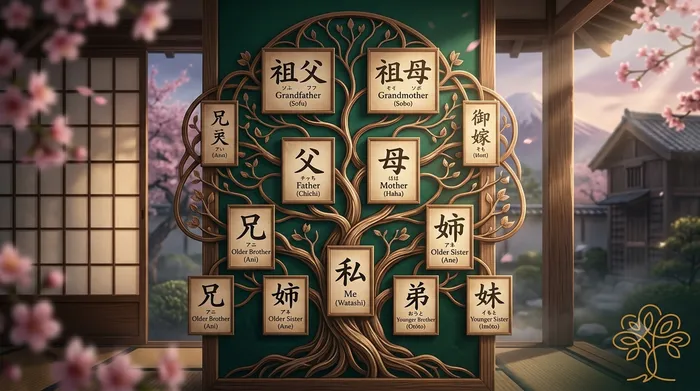
Japanese Family Relationship Names Explained (English to Japanese Guide)
A clear English-to-Japanese guide to family relationship names, including the age-ranked sibling terms and the own-family-vs-other-family rule that trips up most learners.
21 August 2026
Arabic Family Relationship Names Explained (English to Arabic Guide)
A clear, practical guide to Arabic kinship terms, from immediate family words like ab and umm to the maternal-versus-paternal aunt and uncle distinctions that don't exist in English.
Create Your Family Tree for Free
Start building your family history in minutes with the My rOoOts Free Family Tree Creator. Add parents, grandparents, children, and relatives, organize generations visually, and create a beautiful family tree that you can save and share.
👉 Create your free family tree: Free Family Tree Creator
No design skills required. Simply enter your family details and generate a clear, easy-to-read family tree online for free.
Check Zodiac Compatibility for Any Two People
Curious about how well two people match based on their date of birth? Try the My rOoOts Zodiac Compatibility Tool to compare zodiac signs, explore relationship compatibility, and get a quick compatibility score for couples, friends, or family members.
👉 Check compatibility now: Zodiac Compatibility Calculator
You can enter two dates of birth and even mention the relationship type to get a more personalized compatibility result.
Download a Free Family Tree Template
Want to draw your family tree yourself? The My rOoOts Family Tree Template provides a free printable blank pedigree chart for documenting your family history across multiple generations.
👉 Download a free family tree template: Family Tree Template
Choose a 3-generation, 4-generation, or 5-generation family tree template and save it as a PDF for printing, writing, and documenting your ancestors.
Discover the Meaning and Origin of Your Surname
Ever wondered where your family name came from? Use the My rOoOts Surname Meaning Lookup to explore surname meanings, origins, history, and etymology from different regions and cultures around the world.
👉 Discover your surname meaning: Surname Meaning Lookup
Learn more about your last name and explore the possible linguistic, geographic, cultural, and historical roots behind your family surname.
Start your family tree free
No account needed to begin. Build it in minutes, then save it whenever you're ready.
Build your family tree