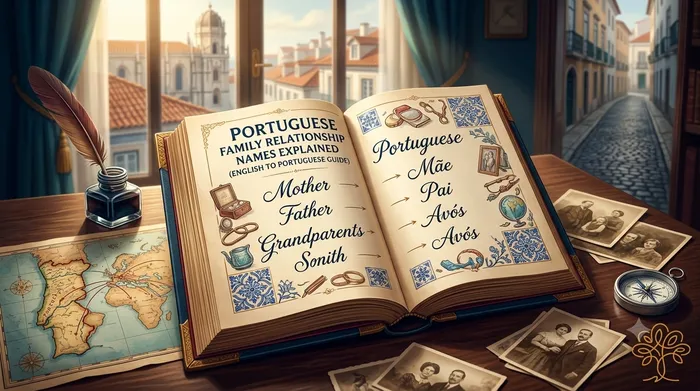
If you've got Portuguese-speaking branches in your family tree - whether from Portugal itself, Brazil, or the wider Lusophone world across Africa and Asia - you'll quickly notice that Portuguese family vocabulary is warm, specific, and a little different depending on where it's spoken. This guide walks through the core Portuguese family relationship names in English, with notes on where Brazilian and European Portuguese diverge.
Immediate Family Terms
| English | Portuguese (masculine) | Portuguese (feminine) |
|---|---|---|
| Father | pai | - |
| Mother | - | mãe |
| Son | filho | - |
| Daughter | - | filha |
| Brother | irmão | - |
| Sister | - | irmã |
| Husband | marido | - |
| Wife | - | esposa (also: mulher) |
Portuguese pluralizes mixed-gender groups using the masculine plural form, so "parents" is pais (literally the plural of "pai"), and "siblings" is irmãos, even if the group includes both brothers and sisters. This trips up a lot of beginners, so it's worth memorizing early.
Grandparents and Extended Family
- avô / avó - grandfather / grandmother, avós - grandparents
- bisavô / bisavó - great-grandfather / great-grandmother
- tio / tia - uncle / aunt (Portuguese does not distinguish maternal from paternal uncles and aunts the way some Asian languages do)
- primo / prima - cousin
- sobrinho / sobrinha - nephew / niece
- neto / neta - grandson / granddaughter
In-Laws
- sogro / sogra - father-in-law / mother-in-law
- genro - son-in-law
- nora - daughter-in-law
- cunhado / cunhada - brother-in-law / sister-in-law
Step-Family Terms
- padrasto - stepfather
- madrasta - stepmother
- enteado / enteada - stepson / stepdaughter
- meio-irmão / meia-irmã - half-brother / half-sister
Affectionate and Everyday Terms
Portuguese-speaking families lean heavily on diminutives to soften and warm up family words, especially in Brazil. Adding -inho or -inha to a word makes it more affectionate: mãezinha (little mother, i.e. "mom" or "mommy"). Vovô and vovó are the informal, child-friendly versions of avô and avó, closer to "grandpa" and "grandma" than the formal terms, and you'll also hear paizinho for "daddy."
Brazilian vs. European Portuguese: A Few Differences
Most core kinship terms are identical across Brazil and Portugal, but a few everyday words differ:
- "Wife" is more commonly mulher in everyday Brazilian speech, while esposa is used more formally in both variants and preferred in written European Portuguese.
- Brazilians are more likely to use vovô / vovó in daily conversation with children, while European Portuguese families often still use avô / avó even informally.
- Address terms for parents vary regionally within both countries - some families use "mãe" and "pai," others "mamãe" and "papai," largely by personal or regional habit rather than a national rule.
Why This Matters for Family Tree Research
If you're documenting a Portuguese, Brazilian, Cape Verdean, Angolan, or Goan branch of your family, church and civil records often record relationships using these exact terms - "filho de" (son of) and "filha de" (daughter of) are especially common in older baptismal and marriage records, and knowing them will help you read original documents rather than relying only on translations. Building this branch into a shared family tree that other relatives can add to is often the easiest way to keep the terms and spellings consistent as more names get added over time.
Frequently Asked Questions
What is "grandma" in Portuguese?
The formal term is avó, while the affectionate, everyday version used with children is vovó. Both are correct; the choice usually comes down to family habit and how formal the household is.
Does Portuguese have separate words for maternal and paternal uncles?
No. Unlike some languages, Portuguese uses the same word, tio (uncle) or tia (aunt), regardless of whether the relative is on the mother's or father's side of the family.
What does "meio-irmão" mean?
It means "half-brother." Meio means "half," so meio-irmão and meia-irmã describe siblings who share only one parent.
Is Brazilian Portuguese family vocabulary different from European Portuguese?
The core words are the same, but Brazilian Portuguese uses diminutive and informal forms like vovô, vovó, mamãe, and papai more often in daily speech than European Portuguese typically does.
How do you say "in-laws" collectively in Portuguese?
There isn't a single catch-all word used the way English uses "in-laws" - Portuguese speakers use specific terms like sogros (parents-in-law) and cunhados (siblings-in-law), depending on exactly who they mean.
Editor's picks
9 August 2026
French Family Relationship Names Explained (English to French Guide)
A complete English-to-French guide to family relationship names, covering parents, siblings, grandparents, in-laws, cousins, step-family, and more with clear tables and examples.
17 August 2026
Chinese Family Relationship Names Explained (English to Chinese Guide)
A clear guide to Chinese family relationship names in Mandarin, covering grandparents, aunts, uncles, and cousins on both the paternal and maternal sides.
20 August 2026
Russian Family Relationship Names Explained (English to Russian Guide)
An English-to-Russian guide to family relationship names, including the distinct in-law terms Russian uses depending on which side of the family you married into.
20 August 2026
Japanese Family Relationship Names Explained (English to Japanese Guide)
A clear English-to-Japanese guide to family relationship names, including the age-ranked sibling terms and the own-family-vs-other-family rule that trips up most learners.
21 August 2026
Arabic Family Relationship Names Explained (English to Arabic Guide)
A clear, practical guide to Arabic kinship terms, from immediate family words like ab and umm to the maternal-versus-paternal aunt and uncle distinctions that don't exist in English.
21 August 2026
Turkish Family Relationship Names Explained (English to Turkish Guide)
A clear guide to Turkish kinship terms, including the maternal-versus-paternal aunt and uncle words, and the age-based sibling terms that don't have a direct English equivalent.
Create Your Family Tree for Free
Start building your family history in minutes with the My rOoOts Free Family Tree Creator. Add parents, grandparents, children, and relatives, organize generations visually, and create a beautiful family tree that you can save and share.
👉 Create your free family tree: Free Family Tree Creator
No design skills required. Simply enter your family details and generate a clear, easy-to-read family tree online for free.
Check Zodiac Compatibility for Any Two People
Curious about how well two people match based on their date of birth? Try the My rOoOts Zodiac Compatibility Tool to compare zodiac signs, explore relationship compatibility, and get a quick compatibility score for couples, friends, or family members.
👉 Check compatibility now: Zodiac Compatibility Calculator
You can enter two dates of birth and even mention the relationship type to get a more personalized compatibility result.
Download a Free Family Tree Template
Want to draw your family tree yourself? The My rOoOts Family Tree Template provides a free printable blank pedigree chart for documenting your family history across multiple generations.
👉 Download a free family tree template: Family Tree Template
Choose a 3-generation, 4-generation, or 5-generation family tree template and save it as a PDF for printing, writing, and documenting your ancestors.
Discover the Meaning and Origin of Your Surname
Ever wondered where your family name came from? Use the My rOoOts Surname Meaning Lookup to explore surname meanings, origins, history, and etymology from different regions and cultures around the world.
👉 Discover your surname meaning: Surname Meaning Lookup
Learn more about your last name and explore the possible linguistic, geographic, cultural, and historical roots behind your family surname.
Start your family tree free
No account needed to begin. Build it in minutes, then save it whenever you're ready.
Build your family tree