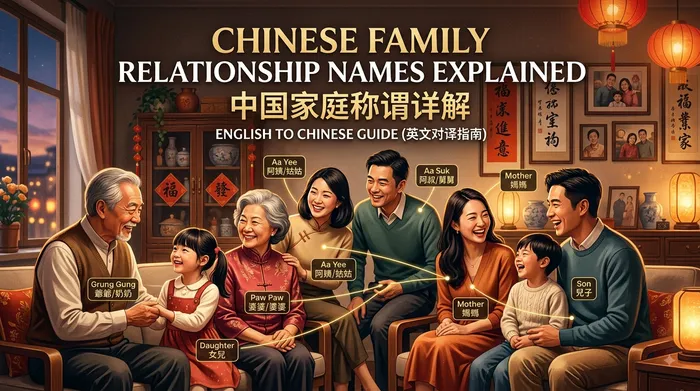
Learning how to talk about family in Chinese is one of the most rewarding (and occasionally confusing) parts of connecting with Chinese heritage. Unlike English, where "aunt," "uncle," and "cousin" cover almost every relative on both sides of the family, Chinese kinship terms are built around three questions: is this person older or younger than you, are they on your father's side or your mother's side, and are they related by blood or by marriage. Once you understand that logic, the whole system starts to make sense, and it becomes a genuinely useful tool for building out your family tree.
This guide walks through the core Chinese family relationship names (in Mandarin, with pinyin) so you can label grandparents, aunts, uncles, cousins, and in-laws correctly, and understand why Chinese speakers almost never just say "uncle" the way English speakers do.
Immediate Family
- Father: 爸爸 (bàba)
- Mother: 妈妈 (māma)
- Older brother: 哥哥 (gēge)
- Younger brother: 弟弟 (dìdi)
- Older sister: 姐姐 (jiějie)
- Younger sister: 妹妹 (mèimei)
- Son: 儿子 (érzi)
- Daughter: 女儿 (nǚ'ér)
Notice there's no single word for "sibling" the way English has one; you always specify older or younger. That distinction carries through the entire family tree and shapes birthday etiquette, inheritance customs, and even how relatives address each other at family gatherings.
Grandparents: Paternal vs Maternal
This is where Chinese really diverges from English. Your father's parents and your mother's parents get entirely different names; there's no shared word like "grandma" that works for both.
- Paternal grandfather: 爷爷 (yéye)
- Paternal grandmother: 奶奶 (nǎinai)
- Maternal grandfather: 外公 (wàigōng), also 姥爷 (lǎoye) in northern China
- Maternal grandmother: 外婆 (wàipó), also 姥姥 (lǎolao) in northern China
The character 外 (wài) literally means "outside," reflecting a traditional view of the mother's side of the family as the "outer" family, since a married-in wife historically joined her husband's household. It's a good example of how kinship vocabulary can preserve older family structures long after they've stopped shaping everyday life.
Aunts, Uncles, and Their Spouses
Chinese doesn't have one word for "uncle" or "aunt": it has, at minimum, six, depending on which side of the family and, for father's brothers, whether they're older or younger than your father.
- Father's older brother: 伯伯 (bóbo); his wife: 伯母 (bómǔ)
- Father's younger brother: 叔叔 (shūshu); his wife: 婶婶 (shěnshen)
- Father's sister: 姑姑 (gūgu); her husband: 姑父 (gūfu)
- Mother's brother: 舅舅 (jiùjiu); his wife: 舅妈 (jiùmā)
- Mother's sister: 阿姨 (āyí); her husband: 姨父 (yífu)
If you've ever wondered why a Chinese family tree chart looks more detailed than a Western one even at just two generations back, this is why: each box needs a more specific label.
Cousins: The 堂 and 表 Divide
Cousins follow the same paternal/maternal logic as grandparents. Children of your father's brothers are considered close enough to use a near-sibling prefix, 堂 (táng), while everyone else, your father's sisters' kids and all your mother's siblings' kids, use 表 (biǎo).
- Paternal-uncle's-side cousin, older male: 堂哥 (tánggē)
- Paternal-uncle's-side cousin, younger male: 堂弟 (tángdì)
- Paternal-uncle's-side cousin, older female: 堂姐 (tángjiě)
- Paternal-uncle's-side cousin, younger female: 堂妹 (tángmèi)
- All other cousins (father's sisters', mother's siblings'): 表哥/表弟/表姐/表妹 (biǎogē / biǎodì / biǎojiě / biǎomèi)
Historically, 堂 cousins often grew up sharing a family name, a household, or even a family business, which is part of why they're grouped separately from every other cousin.
In-Laws
- Husband: 老公 (lǎogōng) informally, 丈夫 (zhàngfu) formally
- Wife: 老婆 (lǎopó) informally, 妻子 (qīzi) formally
- Husband's father / mother: 公公 (gōnggong) / 婆婆 (pópo)
- Wife's father / mother: 岳父 (yuèfù) / 岳母 (yuèmǔ)
Why This Matters for Your Family Tree
If you're building out a Chinese branch of your family tree, these distinctions aren't just vocabulary trivia; they're information. Knowing whether a relative was called 姑姑 or 阿姨 tells you immediately which side of the family they belonged to, which can be a genuinely useful clue when older relatives describe family members by relationship term rather than name, which is extremely common in Chinese families. A tool like myrOoOts lets you record both the English relationship and the original Chinese term side by side, so that context isn't lost as the tree gets passed down to family members who may not speak Chinese themselves.
Frequently Asked Questions
What do you call your grandparents in Chinese?
Paternal grandparents are 爷爷 (yéye) for grandfather and 奶奶 (nǎinai) for grandmother. Maternal grandparents are 外公 (wàigōng) or 姥爷 (lǎoye) for grandfather and 外婆 (wàipó) or 姥姥 (lǎolao) for grandmother. The terms are never interchangeable between the two sides.
Why does Chinese have so many words for "uncle"?
Because traditional Chinese kinship terms encode both which side of the family someone belongs to and, for a father's brothers, their birth order relative to your father. This made inheritance, seating order, and family obligations clear without needing to ask.
Is there a single word for "cousin" in Chinese?
Not one that covers everyone. Cousins on your father's brothers' side use the 堂 (táng) prefix, while cousins from your father's sisters and your mother's siblings all use the 表 (biǎo) prefix, combined with older/younger and male/female markers.
Do younger generations in China still use all these terms?
Many young, urban Chinese families use simplified versions or default to 阿姨/叔叔 (auntie/uncle) more loosely for any older relative or family friend, similar to how English speakers sometimes call a close family friend "auntie." The fuller traditional system is still very much alive in more rural areas and in formal or written contexts.
How should I record Chinese relationship terms in a family tree?
Record the specific term used by your family, not just "uncle" or "aunt" in English, alongside the person's name and generation. That detail often reveals which side of the family they belonged to and can help later generations reconstruct relationships that would otherwise be lost in translation.
Editor's picks
9 August 2026
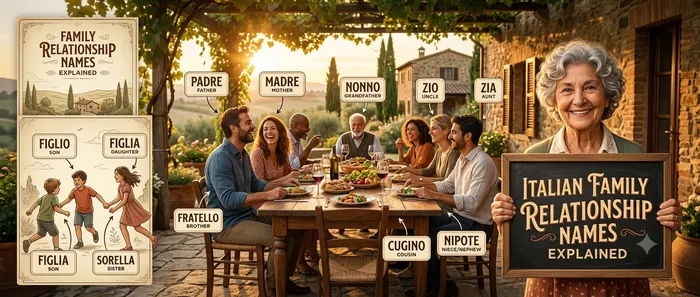
Italian Family Relationship Names Explained
A complete English-to-Italian guide to family relationship names, covering parents, siblings, grandparents, cousins, in-laws, step-family and more with clear tables.
9 August 2026
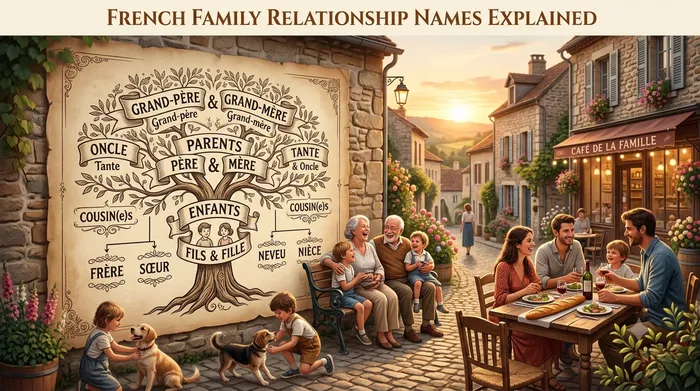
French Family Relationship Names Explained (English to French Guide)
A complete English-to-French guide to family relationship names, covering parents, siblings, grandparents, in-laws, cousins, step-family, and more with clear tables and examples.
15 August 2026
Spanish Family Relationship Names Explained (English to Spanish Guide)
A clear guide to Spanish family relationship names, from parents and grandparents to in-laws, step-family, and the uniquely Latin American compadre/comadre bond, with regional terms useful for family history research.
16 August 2026
Bengali Family Relationship Names Explained (English to Bengali Guide)
A clear guide to Bengali family relationship names, from baba and ma to mama, pishi, jamaibabu and shoshur, and why Bengali kinship terms are so precise about generation and side of the family.
9 August 2026
German Family Tree Terms: Parents, Grandparents, Cousins and In-Laws
A clear English-to-German guide to family tree terms, including parents, grandparents, siblings, cousins, uncles, aunts, in-laws, and step-relations with easy tables.
8 August 2026
Best Family Tree Generators in 2026: Free and Easy Tools for Building Your Family History
Looking for the best family tree generator in 2026? Compare free and paid tools, learn what features matter, and choose the right family tree maker for your family history project.
Create Your Family Tree for Free
Start building your family history in minutes with the My rOoOts Free Family Tree Creator. Add parents, grandparents, children, and relatives, organize generations visually, and create a beautiful family tree that you can save and share.
👉 Create your free family tree: Free Family Tree Creator
No design skills required. Simply enter your family details and generate a clear, easy-to-read family tree online for free.
Check Zodiac Compatibility for Any Two People
Curious about how well two people match based on their date of birth? Try the My rOoOts Zodiac Compatibility Tool to compare zodiac signs, explore relationship compatibility, and get a quick compatibility score for couples, friends, or family members.
👉 Check compatibility now: Zodiac Compatibility Calculator
You can enter two dates of birth and even mention the relationship type to get a more personalized compatibility result.
Download a Free Family Tree Template
Want to draw your family tree yourself? The My rOoOts Family Tree Template provides a free printable blank pedigree chart for documenting your family history across multiple generations.
👉 Download a free family tree template: Family Tree Template
Choose a 3-generation, 4-generation, or 5-generation family tree template and save it as a PDF for printing, writing, and documenting your ancestors.
Discover the Meaning and Origin of Your Surname
Ever wondered where your family name came from? Use the My rOoOts Surname Meaning Lookup to explore surname meanings, origins, history, and etymology from different regions and cultures around the world.
👉 Discover your surname meaning: Surname Meaning Lookup
Learn more about your last name and explore the possible linguistic, geographic, cultural, and historical roots behind your family surname.
Start your family tree free
No account needed to begin. Build it in minutes, then save it whenever you're ready.
Build your family tree