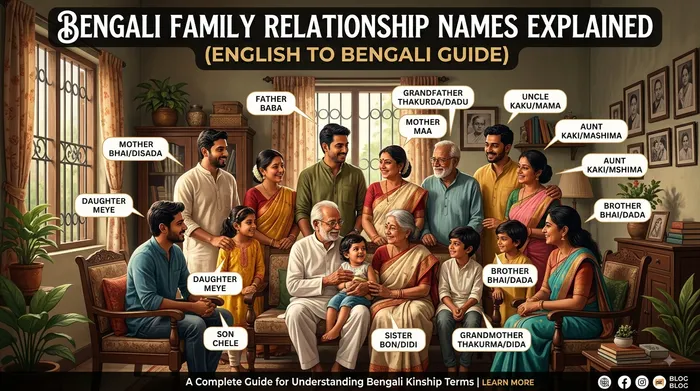
If you've ever sat through a Bengali family gathering and heard someone rattle off "Mejo Pishi" or "Notun Mama" and wondered exactly who that was, you're not alone. Bengali kinship terms are famously specific. Where English gets by with just "uncle," "aunt," and "cousin" for almost everyone outside the immediate family, Bengali has a separate word for nearly every relationship, depending on whether the relative is on your mother's side or your father's, older or younger than your parent, and connected to you by blood or by marriage.
That precision is a gift if you're building a family tree. It tells you, just from the word someone uses, exactly how a relative fits into the family structure, generation and all. This guide walks through the most common Bengali family relationship names in plain English, so you can label relatives correctly, follow along at a family function, or make sense of names an elder used when telling you a story about your ancestors.
Immediate Family
The innermost circle is simple, but already has one twist worth knowing:
- Baba - father
- Ma - mother
- Dada - elder brother
- Bhai - younger brother (also used generically for "brother")
- Didi - elder sister
- Bon - younger sister (also used generically for "sister")
- Chele - son
- Meye - daughter
That twist: in Bengali, "Dada" means elder brother, not grandfather as it does in Hindi and several other Indian languages. If you grew up around both Bengali and Hindi-speaking relatives, this mix-up is extremely common at family gatherings, and it's worth clarifying early when you're recording family history so names don't get attached to the wrong generation on your tree.
Grandparents
Grandparent terms vary a little between West Bengal and Bangladesh, and even from family to family, but the most widely used forms are:
- Dadu or Thakurdada - paternal grandfather
- Thakuma - paternal grandmother
- Dadu or Dadamoshai - maternal grandfather (many families use "Dadu" for both grandfathers and rely on context)
- Didima or Dida - maternal grandmother
Because "Dadu" is sometimes used for either grandfather, it's worth noting which side of the family a "Dadu" belonged to when you're recording oral history. Future generations reading your notes won't have the context you have right now.
Aunts, Uncles, and Their Bengali Names
This is where Bengali kinship really shows its precision. Every aunt and uncle has a distinct name depending on which parent they're related to, and whether they're older or younger than that parent:
- Jyathamoshai - father's elder brother; his wife is Jethima
- Kaka - father's younger brother; his wife is Kakima
- Pishi (or Pishima) - father's sister; her husband is Pishemoshai
- Mama - mother's brother; his wife is Mami
- Mashi (or Maashi) - mother's sister; her husband is Mesho (or Meshomoshai)
Notice the pattern: a relative's title tells you their side of the family (Kaka and Jyathamoshai are always paternal; Mama and Mashi are always maternal), and often their relative age too (Jyathamoshai is older than your father, Kaka is younger). When you're interviewing an elder relative about the family tree, asking "was that your Kaka or your Jyathamoshai?" can pin down someone's exact position in the family faster than any amount of guessing.
Many families also add "Boro" (eldest), "Mejo" (middle), "Notun" or "Choto" (youngest) in front of these titles when there are several siblings of the same type, for example "Boro Mama" for the eldest maternal uncle or "Choto Pishi" for the youngest paternal aunt.
In-Laws and Marriage Relations
Bengali is just as precise once marriage enters the picture:
- Shoshur - father-in-law
- Shashuri - mother-in-law
- Jamai (or Jamaibabu for an elder sister's husband) - son-in-law, or a sister's husband
- Bouma or Bou - daughter-in-law, or one's wife
- Boudi - elder brother's wife
- Bhasur - husband's elder brother
- Debor - husband's younger brother
- Nanad - husband's sister
- Shala - wife's brother
- Shali - wife's sister
As with the aunts and uncles, these terms encode both the relationship and its direction, so a Bengali family tree, once labeled correctly, actually tells a small story about how the family expanded through marriage over generations.
Why This Matters for Your Family Tree
When you're documenting a Bengali family's history, English labels like "uncle" or "cousin" flatten information that the original Bengali terms preserved. If an elder relative described someone as their "Mejo Kaka's chele," that single phrase already tells you the generation, the side of the family, and the birth order, information that's easy to lose once it's translated into English and separated from the person who remembers it. Recording the original Bengali term alongside the English translation, even just in a note on that person's profile, keeps that context intact for whoever looks at the tree next, whether that's your children or a cousin researching the same family decades from now.
Frequently Asked Questions
What do you call your father's younger brother in Bengali?
He's your Kaka, and his wife is your Kakima. Your father's elder brother is a separate term, Jyathamoshai, with his wife called Jethima.
Is "Dada" used for brother or grandfather in Bengali?
In Bengali, "Dada" means elder brother. This is different from Hindi and Urdu, where a similar-sounding word can refer to a paternal grandfather, so it's a common point of confusion in mixed-language families.
What is the Bengali word for mother-in-law and father-in-law?
Mother-in-law is Shashuri and father-in-law is Shoshur. These terms are used by both a son's wife and a daughter's husband to refer to their spouse's parents.
Do Bengali family terms differ between West Bengal and Bangladesh?
The core terms are shared, since they come from the same language, but pronunciation and a few specific words (especially for grandparents) can vary by region and by individual family custom. When in doubt, ask the family what term they actually used.
Why do Bengali families use different words for elder and younger siblings?
Bengali culture traditionally places importance on birth order within a family, and the language reflects that directly: "Dada" and "Didi" for elder siblings, "Bhai" and "Bon" for younger ones, with the same elder/younger distinction carried through to aunts, uncles, and their spouses.
Editor's picks
15 August 2026
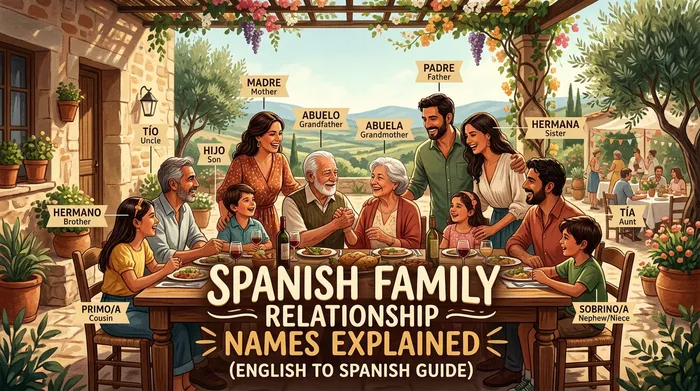
Spanish Family Relationship Names Explained (English to Spanish Guide)
A clear guide to Spanish family relationship names, from parents and grandparents to in-laws, step-family, and the uniquely Latin American compadre/comadre bond, with regional terms useful for family history research.
9 August 2026
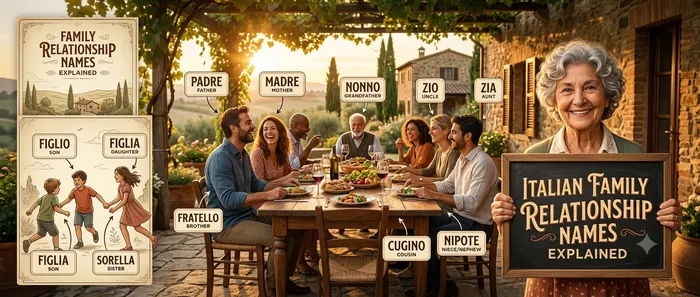
Italian Family Relationship Names Explained
A complete English-to-Italian guide to family relationship names, covering parents, siblings, grandparents, cousins, in-laws, step-family and more with clear tables.
9 August 2026
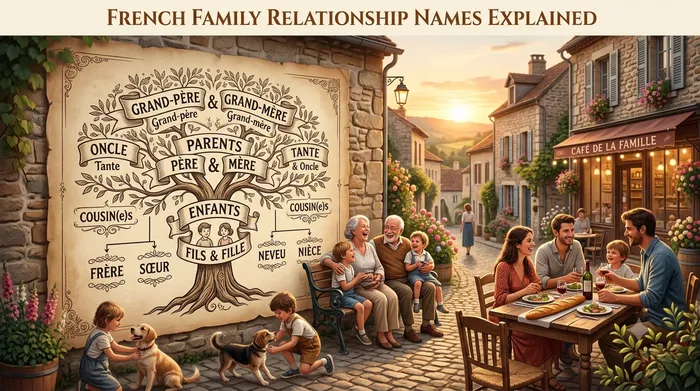
French Family Relationship Names Explained (English to French Guide)
A complete English-to-French guide to family relationship names, covering parents, siblings, grandparents, in-laws, cousins, step-family, and more with clear tables and examples.
9 August 2026
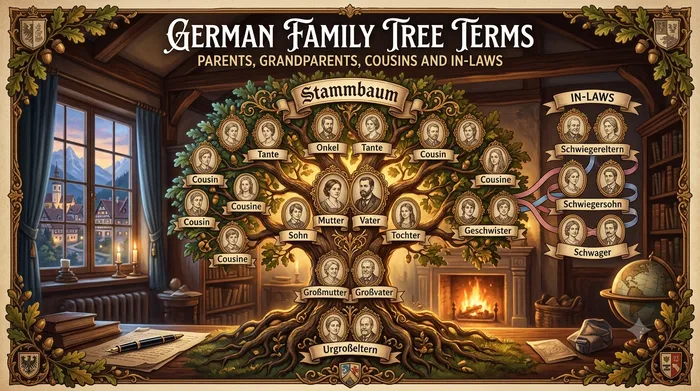
German Family Tree Terms: Parents, Grandparents, Cousins and In-Laws
A clear English-to-German guide to family tree terms, including parents, grandparents, siblings, cousins, uncles, aunts, in-laws, and step-relations with easy tables.
8 August 2026
Best Family Tree Generators in 2026: Free and Easy Tools for Building Your Family History
Looking for the best family tree generator in 2026? Compare free and paid tools, learn what features matter, and choose the right family tree maker for your family history project.
26 July 2026
Bua, Tau, Nanad, Mausa Meaning: Indian Family Terms Meaning Explained
A plain-English guide to Indian family relationship names: what bua's husband is called (fufa), what mausa, tau, jija ji and nanad mean, and how Hindi kinship terms map to English relatives like aunt, uncle and in-law.
Create Your Family Tree for Free
Start building your family history in minutes with the My rOoOts Free Family Tree Creator. Add parents, grandparents, children, and relatives, organize generations visually, and create a beautiful family tree that you can save and share.
👉 Create your free family tree: Free Family Tree Creator
No design skills required. Simply enter your family details and generate a clear, easy-to-read family tree online for free.
Check Zodiac Compatibility for Any Two People
Curious about how well two people match based on their date of birth? Try the My rOoOts Zodiac Compatibility Tool to compare zodiac signs, explore relationship compatibility, and get a quick compatibility score for couples, friends, or family members.
👉 Check compatibility now: Zodiac Compatibility Calculator
You can enter two dates of birth and even mention the relationship type to get a more personalized compatibility result.
Download a Free Family Tree Template
Want to draw your family tree yourself? The My rOoOts Family Tree Template provides a free printable blank pedigree chart for documenting your family history across multiple generations.
👉 Download a free family tree template: Family Tree Template
Choose a 3-generation, 4-generation, or 5-generation family tree template and save it as a PDF for printing, writing, and documenting your ancestors.
Discover the Meaning and Origin of Your Surname
Ever wondered where your family name came from? Use the My rOoOts Surname Meaning Lookup to explore surname meanings, origins, history, and etymology from different regions and cultures around the world.
👉 Discover your surname meaning: Surname Meaning Lookup
Learn more about your last name and explore the possible linguistic, geographic, cultural, and historical roots behind your family surname.
Start your family tree free
No account needed to begin. Build it in minutes, then save it whenever you're ready.
Build your family tree