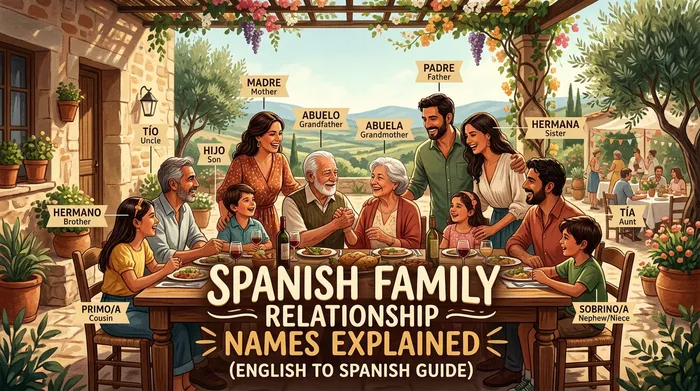
If you're building out a family tree that touches Spain, Mexico, or anywhere across Latin America, you'll quickly run into a vocabulary that's richer than English kinship terms in some places and looser in others. Spanish family relationship names carry gender, affection, and sometimes region baked right into the word itself, so a single English label like "grandmother" can map to several different Spanish words depending on who's speaking and where they're from. This guide walks through the everyday Spanish words for family members, the quirks that trip up learners and researchers alike, and a few regional variations worth knowing before you start labeling branches on your own family tree.
Immediate Family
- Father - padre (informal: papá)
- Mother - madre (informal: mamá)
- Son - hijo
- Daughter - hija
- Brother - hermano
- Sister - hermana
- Husband - esposo / marido
- Wife - esposa / mujer
One habit worth knowing early: when Spanish groups a mixed set of sons and daughters, it defaults to the masculine plural, "hijos." That single word covering "children" regardless of gender shows up constantly in old civil and church records, so don't assume a document listing someone's "hijos" is only counting sons.
Grandparents and Grandchildren
- Grandfather - abuelo
- Grandmother - abuela
- Grandson - nieto
- Granddaughter - nieta
- Great-grandparent - bisabuelo / bisabuela
- Great-great-grandparent - tatarabuelo / tatarabuela
Affectionate versions show up constantly in everyday speech, and sometimes even in family letters and records: abuelito, abuelita, papi, mami. They're not a separate relationship, just a warmer way of saying the same word, similar to how English speakers say "grandma" instead of "grandmother."
Aunts, Uncles, Cousins, and Nieces/Nephews
- Uncle - tío
- Aunt - tía
- Cousin - primo (male) / prima (female)
- Nephew - sobrino
- Niece - sobrina
Spanish generally doesn't distinguish "cousin" by degree the way English sometimes does. A second cousin and a first cousin are both commonly just "primo" or "prima" in casual conversation, with primo segundo (second cousin) or primo lejano (distant cousin) only used when someone wants to be precise. If you're piecing together a family tree from oral history, ask follow-up questions when a relative mentions a "primo" - the actual degree of relation can be looser than the word implies.
In-Laws
- Father-in-law - suegro
- Mother-in-law - suegra
- Brother-in-law - cuñado
- Sister-in-law - cuñada
- Son-in-law - yerno
- Daughter-in-law - nuera
Step and Half Family
- Stepfather - padrastro
- Stepmother - madrastra
- Stepson - hijastro
- Stepdaughter - hijastra
- Stepbrother / stepsister - hermanastro / hermanastra
- Half-brother / half-sister - medio hermano / media hermana
The Compadrazgo System: Godparents as Family
This is where Spanish kinship vocabulary does something English doesn't really have a word for. When a couple becomes padrino (godfather) and madrina (godmother) to a child, the child's parents and the godparents start calling each other compadre and comadre. It's not a blood relationship, but across Spain and much of Latin America it's treated with real closeness, almost a formal extension of the family itself.
This matters for genealogy research specifically because church baptismal records from Spanish-speaking countries almost always list the padrinos alongside the parents. If you're transcribing an old baptismal register and see a name you don't recognize sitting right next to the parents, it's worth checking whether that person is a godparent rather than a blood relative before you connect them to the wrong branch of your tree.
Regional Variations Worth Knowing
Spanish is spoken across dozens of countries, so a handful of family words shift depending on where your ancestors were from:
- In Mexico and parts of Central America, "amá" and "apá" are common casual versions of mom and dad, alongside mamá and papá.
- In Spain, "yaya" and "yayo" are affectionate regional alternatives to abuela and abuelo in some areas.
- In the Caribbean and parts of South America, "viejo" and "vieja" (literally "old man" and "old woman") are an affectionate way adult children refer to their own parents, not a term for someone actually elderly.
- "Hermanito" and "hermanita" (little brother, little sister) are used as terms of endearment regardless of the actual age gap between siblings.
None of these change the underlying relationship, but they're useful to recognize if they show up in a letter, an old interview transcript, or something a relative says when you're trying to record family history.
Why This Matters for Your Family Tree
When you're transcribing an old baptismal, marriage, or civil registry from a Spanish-speaking country, precise kinship terms are often the only clue connecting one generation to the next. A phrase like "hija legítima de..." (legitimate daughter of...) or "nieto de..." carved on a headstone can be the exact thread that links two branches you thought were unrelated. Getting comfortable with these words before you dig through records saves you from misreading a cuñado as a hermano, or missing that a "primo" mentioned in a letter could be a cousin of any degree, not necessarily a first cousin.
If you're mapping a Spanish-speaking branch of your family on myrooots, using the correct term for each relationship from the start keeps the tree readable and accurate for relatives on both sides of the language, whether they think in English, Spanish, or switch between both.
Frequently Asked Questions
What is the Spanish word for cousin?
"Primo" for a male cousin and "prima" for a female cousin. Spanish typically doesn't distinguish first cousins from more distant cousins in everyday speech the way English sometimes does - primo segundo (second cousin) is used only when someone wants to be specific.
What do you call your spouse's parents in Spanish?
Suegro is father-in-law and suegra is mother-in-law. Your spouse's siblings are cuñado (brother-in-law) and cuñada (sister-in-law).
Is there a Spanish word for stepmother and stepfather?
Yes. Padrastro means stepfather and madrastra means stepmother. Step-siblings are hermanastro or hermanastra, and a stepchild is hijastro or hijastra.
What does "compadre" mean?
Compadre and comadre describe the relationship between a child's parents and that child's godparents. It isn't a blood relationship, but it's treated with the same closeness as family across much of the Spanish-speaking world, and it often appears in old church baptismal records.
How do you say grandparents in Spanish?
"Abuelos" covers grandparents as a group. Individually, abuelo is grandfather and abuela is grandmother. Great-grandparents are bisabuelos, and great-great-grandparents are tatarabuelos.
Editor's picks
9 August 2026
Italian Family Relationship Names Explained
A complete English-to-Italian guide to family relationship names, covering parents, siblings, grandparents, cousins, in-laws, step-family and more with clear tables.
9 August 2026
French Family Relationship Names Explained (English to French Guide)
A complete English-to-French guide to family relationship names, covering parents, siblings, grandparents, in-laws, cousins, step-family, and more with clear tables and examples.
9 August 2026
German Family Tree Terms: Parents, Grandparents, Cousins and In-Laws
A clear English-to-German guide to family tree terms, including parents, grandparents, siblings, cousins, uncles, aunts, in-laws, and step-relations with easy tables.
8 August 2026
Best Family Tree Generators in 2026: Free and Easy Tools for Building Your Family History
Looking for the best family tree generator in 2026? Compare free and paid tools, learn what features matter, and choose the right family tree maker for your family history project.
26 July 2026
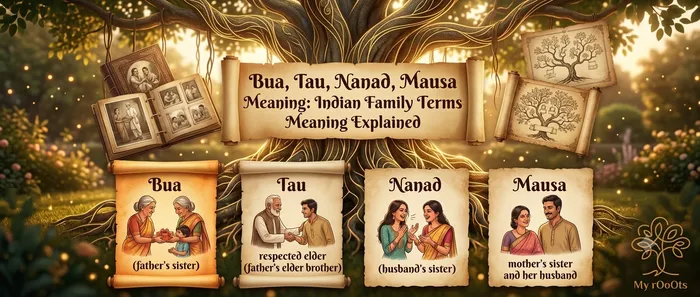
Bua, Tau, Nanad, Mausa Meaning: Indian Family Terms Meaning Explained
A plain-English guide to Indian family relationship names: what bua's husband is called (fufa), what mausa, tau, jija ji and nanad mean, and how Hindi kinship terms map to English relatives like aunt, uncle and in-law.
15 August 2026
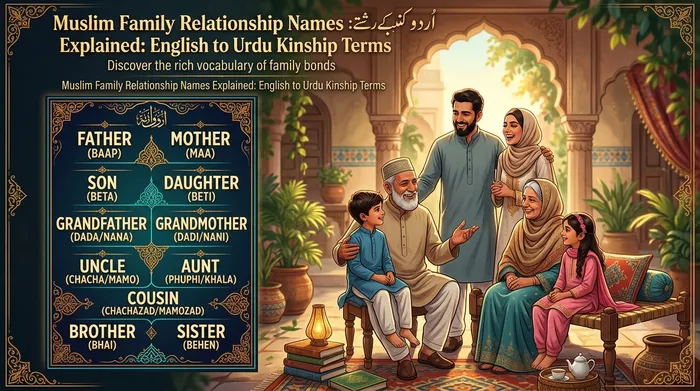
Muslim Family Relationship Names Explained: English to Urdu Kinship Terms
A clear guide to Muslim and Urdu family relationship names, from chacha and taya to phuppo and mamu, so you can label every branch of your family tree correctly.
Create Your Family Tree for Free
Start building your family history in minutes with the My rOoOts Free Family Tree Creator. Add parents, grandparents, children, and relatives, organize generations visually, and create a beautiful family tree that you can save and share.
👉 Create your free family tree: Free Family Tree Creator
No design skills required. Simply enter your family details and generate a clear, easy-to-read family tree online for free.
Check Zodiac Compatibility for Any Two People
Curious about how well two people match based on their date of birth? Try the My rOoOts Zodiac Compatibility Tool to compare zodiac signs, explore relationship compatibility, and get a quick compatibility score for couples, friends, or family members.
👉 Check compatibility now: Zodiac Compatibility Calculator
You can enter two dates of birth and even mention the relationship type to get a more personalized compatibility result.
Download a Free Family Tree Template
Want to draw your family tree yourself? The My rOoOts Family Tree Template provides a free printable blank pedigree chart for documenting your family history across multiple generations.
👉 Download a free family tree template: Family Tree Template
Choose a 3-generation, 4-generation, or 5-generation family tree template and save it as a PDF for printing, writing, and documenting your ancestors.
Discover the Meaning and Origin of Your Surname
Ever wondered where your family name came from? Use the My rOoOts Surname Meaning Lookup to explore surname meanings, origins, history, and etymology from different regions and cultures around the world.
👉 Discover your surname meaning: Surname Meaning Lookup
Learn more about your last name and explore the possible linguistic, geographic, cultural, and historical roots behind your family surname.
Start your family tree free
No account needed to begin. Build it in minutes, then save it whenever you're ready.
Build your family tree