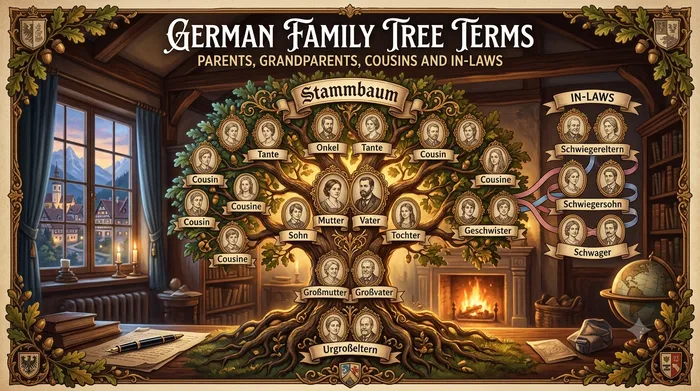
German Family Tree Terms: Parents, Grandparents, Cousins and In-Laws
German family relationship terms are precise and useful for genealogy, bilingual family trees, and conversations with German-speaking relatives. Unlike English, German almost always marks gender and often distinguishes between maternal and paternal sides. This guide explains the most important terms clearly.
Immediate Family
| English | German (Male) | German (Female) | Notes |
|---|---|---|---|
| Father | Vater | — | |
| Mother | — | Mutter | |
| Parents | Eltern | Eltern | |
| Son | Sohn | — | |
| Daughter | — | Tochter | |
| Children | Kinder | Kinder | |
| Brother | Bruder | — | |
| Sister | — | Schwester | |
| Siblings | Geschwister | Geschwister | Neutral plural |
| Husband | Ehemann / Mann | — | |
| Wife | — | Ehefrau / Frau | |
| Spouse | Ehepartner | Ehepartnerin | Formal/neutral |
Grandparents and Great-Grandparents
| English | German (Male) | German (Female) |
|---|---|---|
| Grandfather | Großvater / Opa | — |
| Grandmother | — | Großmutter / Oma |
| Grandparents | Großeltern | Großeltern |
| Great-grandfather | Urgroßvater | — |
| Great-grandmother | — | Urgroßmutter |
| Great-grandparents | Urgroßeltern | Urgroßeltern |
| Great-great-grandfather | Ururgroßvater | — |
| Great-great-grandmother | — | Ururgroßmutter |
In everyday speech, Opa and Oma are very common and affectionate forms.
Grandchildren
| English | German (Male) | German (Female) |
|---|---|---|
| Grandson | Enkel / Enkelsohn | — |
| Granddaughter | — | Enkelin |
| Grandchildren | Enkelkinder | Enkelkinder |
| Great-grandson | Urenkel | — |
| Great-granddaughter | — | Urenkelin |
Uncles, Aunts, Nephews and Nieces
| English | German (Male) | German (Female) | Notes |
|---|---|---|---|
| Uncle | Onkel | — | |
| Aunt | — | Tante | |
| Maternal uncle | Onkel mütterlicherseits | — | Brother of the mother |
| Paternal uncle | Onkel väterlicherseits | — | Brother of the father |
| Nephew | Neffe | — | |
| Niece | — | Nichte | |
| Great-uncle | Großonkel | — | |
| Great-aunt | — | Großtante |
Cousins
German distinguishes gender clearly and has specific terms for degree of cousinship:
| English | German (Male) | German (Female) |
|---|---|---|
| Cousin | Cousin / Vetter | Cousine / Base |
| First cousin | Cousin ersten Grades | Cousine ersten Grades |
| Second cousin | Cousin zweiten Grades | Cousine zweiten Grades |
| Distant cousin | entfernter Cousin | entfernte Cousine |
In modern German, Cousin and Cousine are very common. Traditional regional words such as Vetter (male) and Base (female) are still understood, especially among older speakers.
In-Laws
| English | German (Male) | German (Female) |
|---|---|---|
| Father-in-law | Schwiegervater | — |
| Mother-in-law | — | Schwiegermutter |
| Son-in-law | Schwiegersohn | — |
| Daughter-in-law | — | Schwiegertochter |
| Brother-in-law | Schwager | — |
| Sister-in-law | — | Schwägerin |
| Parents-in-law | Schwiegereltern | Schwiegereltern |
Step-Family and Half-Relations
| English | German (Male) | German (Female) |
|---|---|---|
| Stepfather | Stiefvater | — |
| Stepmother | — | Stiefmutter |
| Stepson | Stiefsohn | — |
| Stepdaughter | — | Stieftochter |
| Stepbrother | Stiefbruder | — |
| Stepsister | — | Stiefschwester |
| Half-brother | Halbbruder | — |
| Half-sister | — | Halbschwester |
Simple German Family Tree Example
Großvater ────── Großmutter
        │
Vater ────── Mutter
    │
┌───┴───┐
Sohn   Tochter
You can expand the tree with Onkel, Tante, Cousin, Cousine, Neffe, Nichte, and the corresponding Schwieger- and Stief- forms.
Useful Tips for German Family Terms
- German almost always marks gender. Always choose the correct masculine or feminine form.
- To specify the side of the family, use mütterlicherseits (maternal) or väterlicherseits (paternal).
- In genealogy, more precise expressions such as Cousin ersten Grades are preferred.
- Affectionate everyday forms (Opa, Oma, Mama, Papa) are very common in spoken German but less suitable for formal family trees.
Building a German or Bilingual Family Tree
Many families today have German-speaking and English-speaking members. Recording the correct relationship terms helps everyone understand the connections clearly.
You can create a private family tree and label relationships in German or English at the My rOoOts create-tree page.
Helpful tools include:
These make it easy to organise names, dates, and precise family links across generations.
Conclusion
German family tree terms are logical and gender-specific. From basic words such as Vater, Mutter, Sohn and Tochter to more precise terms like Schwiegervater, Cousin ersten Grades and Urgroßmutter, the language offers clear ways to describe every common relationship. Using the correct vocabulary improves communication and supports accurate genealogy work.
Whether you are researching German ancestry, speaking with relatives, or building a bilingual family tree, this guide provides a practical reference for parents, grandparents, cousins, in-laws, and more.
Frequently Asked Questions About German Family Tree Terms
What is the German word for cousin?
A male cousin is Cousin (or traditionally Vetter) and a female cousin is Cousine (or traditionally Base). A first cousin is called Cousin ersten Grades or Cousine ersten Grades.
How do you say mother-in-law and father-in-law in German?
Mother-in-law is Schwiegermutter and father-in-law is Schwiegervater. Parents-in-law together are Schwiegereltern.
What is the difference between “Bruder” and “Halbbruder”?
Bruder means a full brother. Halbbruder means half-brother (a brother with whom you share only one parent). Stiefbruder means stepbrother.
How do you say grandparents in German?
Grandparents are Großeltern. Grandfather is Großvater (informally Opa) and grandmother is Großmutter (informally Oma).
What is the German term for great-grandfather?
Great-grandfather is Urgroßvater and great-grandmother is Urgroßmutter. Great-grandparents are Urgroßeltern.
How do you say nephew and niece in German?
Nephew is Neffe and niece is Nichte.
What is the German word for siblings?
Siblings are called Geschwister (a gender-neutral plural term).
How do you distinguish maternal and paternal relatives in German?
Add mütterlicherseits for the mother’s side and väterlicherseits for the father’s side.
Examples: Onkel mütterlicherseits (maternal uncle), Tante väterlicherseits (paternal aunt).
What does “Schwager” mean in German?
Schwager means brother-in-law. The female form Schwägerin means sister-in-law.
How do you say son-in-law and daughter-in-law in German?
Son-in-law is Schwiegersohn and daughter-in-law is Schwiegertochter.
What is the German word for grandchildren?
Grandchildren are Enkelkinder. Grandson is Enkel or Enkelsohn and granddaughter is Enkelin.
Is there a difference between “Frau” and “Ehefrau”?
Both can mean wife. Ehefrau is more precise and formal, while Frau is commonly used in everyday speech. Similarly, Mann and Ehemann both refer to husband.
How do you say step-parents in German?
Stepfather is Stiefvater and stepmother is Stiefmutter. Step-parents can be referred to as Stiefeltern.
What is the German term for ancestors?
Ancestors are Vorfahren or Ahnen. In genealogy, Ahnentafel refers to an ancestor chart.
How can I use these German family terms in a family tree?
You can label each person with the correct German relationship term (for example, Großvater väterlicherseits or Cousine ersten Grades) when building a German or bilingual family tree. Tools such as My rOoOts allow you to record names and relationships clearly in any language.
Editor's picks
9 August 2026
French Family Relationship Names Explained (English to French Guide)
A complete English-to-French guide to family relationship names, covering parents, siblings, grandparents, in-laws, cousins, step-family, and more with clear tables and examples.
8 August 2026
The Julio-Claudian Family Tree of Ancient Rome
Explore the Julio-Claudian family tree of ancient Rome, from Augustus to Nero, including the complex ties of blood, adoption, and marriage that shaped the first imperial dynasty.
8 August 2026
The Ottoman Dynasty Family Tree from Osman I Onward
Explore the Ottoman Dynasty family tree from Osman I to the last sultan Mehmed VI, covering the major sultans who ruled one of history’s longest-lasting empires.
6 August 2026
The British Royal Family Tree Explained Simply
A simple guide to the British Royal Family tree, from Queen Elizabeth II to King Charles III, the Prince of Wales, and the next generation of working royals.
Create Your Family Tree for Free
Start building your family history in minutes with the My rOoOts Free Family Tree Creator. Add parents, grandparents, children, and relatives, organize generations visually, and create a beautiful family tree that you can save and share.
👉 Create your free family tree: Free Family Tree Creator
No design skills required. Simply enter your family details and generate a clear, easy-to-read family tree online for free.
Check Zodiac Compatibility for Any Two People
Curious about how well two people match based on their date of birth? Try the My rOoOts Zodiac Compatibility Tool to compare zodiac signs, explore relationship compatibility, and get a quick compatibility score for couples, friends, or family members.
👉 Check compatibility now: Zodiac Compatibility Calculator
You can enter two dates of birth and even mention the relationship type to get a more personalized compatibility result.
Download a Free Family Tree Template
Want to draw your family tree yourself? The My rOoOts Family Tree Template provides a free printable blank pedigree chart for documenting your family history across multiple generations.
👉 Download a free family tree template: Family Tree Template
Choose a 3-generation, 4-generation, or 5-generation family tree template and save it as a PDF for printing, writing, and documenting your ancestors.
Discover the Meaning and Origin of Your Surname
Ever wondered where your family name came from? Use the My rOoOts Surname Meaning Lookup to explore surname meanings, origins, history, and etymology from different regions and cultures around the world.
👉 Discover your surname meaning: Surname Meaning Lookup
Learn more about your last name and explore the possible linguistic, geographic, cultural, and historical roots behind your family surname.
Start your family tree free
No account needed to begin. Build it in minutes, then save it whenever you're ready.
Build your family tree