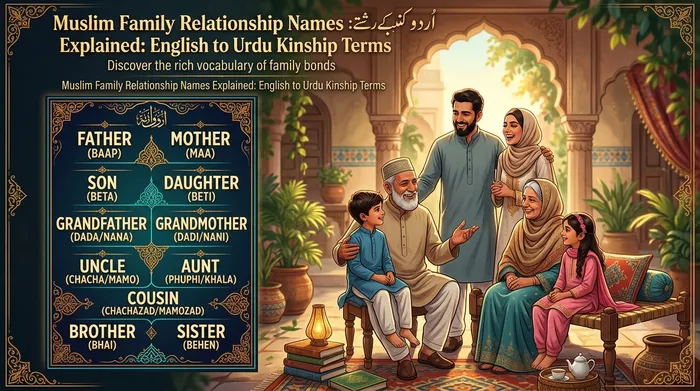
If you grew up in a Muslim household anywhere from Lahore to Lucknow to Dhaka, you already know that "uncle" and "aunt" don't really cut it. Your father's brother isn't the same word as your mother's brother, your father's sister isn't the same word as your mother's sister, and even your cousins get a completely different name depending on which side of the family they come from. English kinship terms flatten all of that into a handful of generic words. Urdu, the language most widely used across Muslim families in Pakistan, North India, and Bangladesh, keeps every one of those relationships distinct, and once you know the pattern, it makes building an accurate family tree much easier.
This guide walks through the everyday Muslim family relationship names you'll hear at home, at weddings, and in family stories passed down from grandparents, and shows you how to place each one correctly on a family tree.
Immediate Family
Start with the closest relationships, since these are the words most families use every single day.
- Abbu / Abba / Waalid - Father. "Waalid" is the more formal, Arabic-rooted word used in writing.
- Ammi / Waalida - Mother, with "Waalida" as the formal equivalent.
- Bhai / Bhaijaan - Brother, often said with "jaan" added as a term of affection for an older brother.
- Baji / Aapa - Older sister. Younger siblings are usually just called by name, but it's considered respectful to never call an older sibling by their first name alone.
- Beta / Beti - Son and daughter, also used affectionately toward any younger person in the family, related or not.
Grandparents: Dada-Dadi and Nana-Nani
As with many South Asian families, Muslim households distinguish which side of the family a grandparent belongs to rather than using one word for "grandfather" and one for "grandmother."
- Dada - Paternal grandfather (father's father)
- Dadi - Paternal grandmother (father's mother)
- Nana - Maternal grandfather (mother's father)
- Nani - Maternal grandmother (mother's mother)
A child's "dada's house" and "nana's house" are treated as two genuinely separate households in family conversation, which is worth keeping in mind when you're organizing photos or records by branch.
Father's Side: Chacha, Taya and Phuppo
This is where Muslim family relationship names really diverge from English, because the words change depending on whether the relative is older or younger than your father.
- Chacha / Chachu - Father's younger brother
- Taya / Tayaji - Father's older brother
- Chachi - Chacha's wife
- Tayi - Taya's wife
- Phuppo / Phuppi - Father's sister, of any age
- Phuppa - Phuppo's husband
Notice that the birth-order distinction (chacha vs. taya) only applies to brothers, not sisters. All of your father's sisters are phuppo, regardless of whether they were born before or after him.
Mother's Side: Mamu and Khala
The mother's side uses its own separate set of names, and unlike the father's side, there's no birth-order split here.
- Mamu / Mamoo - Mother's brother, any age
- Mumani / Mami - Mamu's wife
- Khala - Mother's sister, any age
- Khalu - Khala's husband
So where English collapses six different relatives into just "uncle" and "aunt," Muslim family naming gives you six distinct, unambiguous words: chacha, taya, phuppo, mamu, khala, and their respective spouses. For anyone doing family history research, this actually makes old letters, oral histories, and family stories easier to map onto a tree once you know the vocabulary, because the word itself tells you exactly which relative is being discussed.
Cousins: Why "Chachazad" Beats "Cousin"
English has one word, "cousin," for every child of every aunt or uncle. Urdu-speaking Muslim families go a step further and name cousins according to exactly which relative is their parent, by adding "-zad" (meaning "born of") to the relevant title:
- Chachazad bhai/behen - Cousin through your chacha (father's younger brother)
- Tayazad bhai/behen - Cousin through your taya (father's older brother)
- Phuppizad bhai/behen - Cousin through your phuppo (father's sister)
- Mamuzad bhai/behen - Cousin through your mamu (mother's brother)
- Khalazad bhai/behen - Cousin through your khala (mother's sister)
In everyday speech, most people simply say "cousin brother" or "cousin sister," but the -zad terms show up often enough in family conversation, and especially in older relatives' storytelling, that it's worth recognizing them. If a grandparent mentions their "phuppizad bhai," you now know exactly where that person sits on the tree: a first cousin through a paternal aunt.
In-Laws After Marriage
Marriage brings in another full set of relationship names, which matters a great deal for tracing a family tree past the first generation.
- Susar / Sasur - Father-in-law
- Saas - Mother-in-law
- Sala - Wife's brother
- Sali - Wife's sister
- Nanad - Husband's sister
- Devar - Husband's younger brother
- Jeth - Husband's older brother
- Damad - Son-in-law
- Bahu - Daughter-in-law
These in-law terms are shared across many North Indian, Pakistani, and Bangladeshi households regardless of religion, since they come from the shared linguistic history of Urdu and Hindi rather than from religious vocabulary specifically.
Why These Words Matter for Your Family Tree
When you're documenting a Muslim family's history, using the correct relationship name rather than a generic "uncle" or "cousin" label does two things. First, it preserves information: "chacha" tells you the paternal side and younger-than-father in a single word, which a generic label loses. Second, it respects how the family actually talks about itself. If your grandmother always referred to someone as her phuppo, labeling that same person "aunt" in a family tree app strips away a piece of the family's own language and, often, a piece of the story of how that relationship was lived day to day.
As you build out your tree, it helps to jot down the original Urdu term alongside the English relationship label for each family member. That way, a grandchild researching the tree years from now can see both what the relationship was and what it was actually called at home.
Frequently Asked Questions
What is the difference between chacha and taya?
Both mean "father's brother," but chacha specifically refers to a younger brother of your father, while taya refers to an older brother. The distinction only applies to father's brothers; father's sisters are all called phuppo regardless of age.
Is phuppo the same as khala?
No. Phuppo is your father's sister, while khala is your mother's sister. They come from different sides of the family and are never used interchangeably, even though English would call both of them simply "aunt."
What do Muslim families call cousins?
Most people say "cousin brother" or "cousin sister" in everyday conversation, but the more traditional terms add "-zad" to the relevant relative's title, such as chachazad (through a chacha), mamuzad (through a mamu), or khalazad (through a khala), to show exactly which side of the family the cousin comes from.
Are these terms used only by Muslims, or by all Urdu speakers?
Most of these words, including chacha, mamu, khala, and phuppo, are used broadly across Urdu and Hindi-speaking households in India, Pakistan, and Bangladesh, regardless of religion. A few formal terms, like waalid and waalida for parents, are more specifically associated with Muslim and Arabic-influenced usage.
Why doesn't English have separate words for chacha and mamu?
English kinship terms developed around a smaller, more nuclear idea of family, so one word, "uncle," covers any uncle. Urdu kinship developed around large joint families where knowing exactly which side of the family, and often the birth order, mattered for social roles like inheritance and household authority, so the language kept that information built into the words themselves.
Editor's picks

26 July 2026
Family Tree App with Photos: Why Pictures Matter as Much as Names
A family tree of names and dates tells you who existed. A family tree with photos tells you who they were. Here's why photos change everything.

14 August 2026
Independence Day Family Tree Project Ideas for Students (2026)
Creative Independence Day family tree project ideas for students in 2026, including chart designs, freedom-fighter examples, printable templates, and free online tools.
4 August 2026
Human Race Genealogy in Europe: Origins, DNA, Migration, and Family History
Discover the genealogy of the human race in Europe through ancient migrations, DNA research, surnames, and family records, and learn how to preserve your ancestry.
2 August 2026
Indian Regional Castes and Family Histories: A Genealogy Guide for Every State
Explore the rich diversity of Indian regional castes, surnames, clans, and family traditions across every state. Learn how communities preserve ancestry records and discover how to build your digital family tree with MyRooots.
1 August 2026
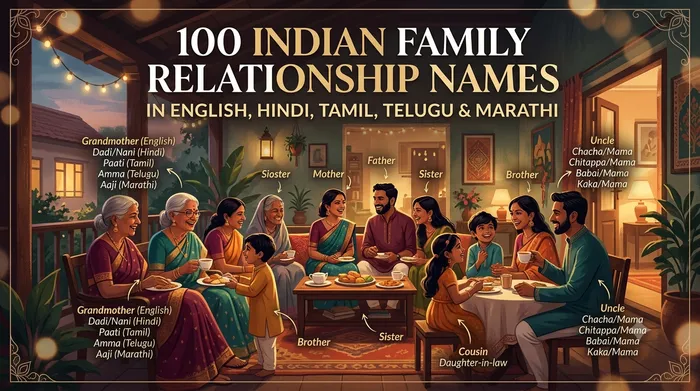
100 Indian Family Relationship Names in English, Hindi, Tamil, Telugu & Marathi
Explore 100 Indian family relationship names in English, Hindi, Tamil, Telugu, and Marathi. Learn common family terms and preserve your family heritage with My rOoOts.
Create Your Family Tree for Free
Start building your family history in minutes with the My rOoOts Free Family Tree Creator. Add parents, grandparents, children, and relatives, organize generations visually, and create a beautiful family tree that you can save and share.
👉 Create your free family tree: Free Family Tree Creator
No design skills required. Simply enter your family details and generate a clear, easy-to-read family tree online for free.
Check Zodiac Compatibility for Any Two People
Curious about how well two people match based on their date of birth? Try the My rOoOts Zodiac Compatibility Tool to compare zodiac signs, explore relationship compatibility, and get a quick compatibility score for couples, friends, or family members.
👉 Check compatibility now: Zodiac Compatibility Calculator
You can enter two dates of birth and even mention the relationship type to get a more personalized compatibility result.
Download a Free Family Tree Template
Want to draw your family tree yourself? The My rOoOts Family Tree Template provides a free printable blank pedigree chart for documenting your family history across multiple generations.
👉 Download a free family tree template: Family Tree Template
Choose a 3-generation, 4-generation, or 5-generation family tree template and save it as a PDF for printing, writing, and documenting your ancestors.
Discover the Meaning and Origin of Your Surname
Ever wondered where your family name came from? Use the My rOoOts Surname Meaning Lookup to explore surname meanings, origins, history, and etymology from different regions and cultures around the world.
👉 Discover your surname meaning: Surname Meaning Lookup
Learn more about your last name and explore the possible linguistic, geographic, cultural, and historical roots behind your family surname.
Start your family tree free
No account needed to begin. Build it in minutes, then save it whenever you're ready.
Build your family tree