If you've ever tried to translate a Turkish family tree into English, you've probably noticed the vocabulary doesn't line up cleanly. Turkish family words carry information that English words don't: which side of the family someone belongs to, and often, whether they're older or younger than you. Once you know the pattern, though, Turkish kinship terms are logical and genuinely useful for keeping a large extended family straight.
Here's a practical breakdown for anyone building a family tree with Turkish relatives, learning the language, or trying to make sense of terms an older relative used growing up.
Immediate Family
- Baba - father
- Anne - mother
- Oğul - son
- Kız - daughter (the same word also means "girl")
- Kardeş - sibling (a gender-neutral term for brother or sister)
- Erkek kardeş - brother, specifically
- Kız kardeş - sister, specifically
- Koca / Eş - husband
- Karı / Eş - wife
Notice that "eş" works as a gender-neutral word for spouse, while "koca" and "karı" specify husband and wife.
Grandparents
- Dede - grandfather
- Büyükanne / Nine - grandmother
"Büyükanne" literally means "big mother," and "nine" is a warmer, more informal alternative used especially in rural or older-generation speech.
Aunts and Uncles: Turkish Splits Them by Side of the Family
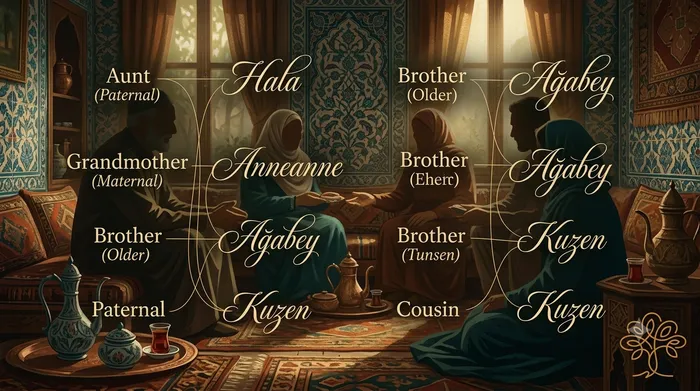
Like several other language families, Turkish doesn't use one word for "aunt" or "uncle." It specifies exactly which parent's sibling you mean:
| English | Turkish | Side of the Family |
|---|---|---|
| Paternal uncle (father's brother) | Amca | Father's side |
| Paternal aunt (father's sister) | Hala | Father's side |
| Maternal uncle (mother's brother) | Dayı | Mother's side |
| Maternal aunt (mother's sister) | Teyze | Mother's side |
This distinction is used constantly in everyday Turkish, not just in formal genealogy. Turkish speakers will introduce a relative as their "dayı" or "hala" rather than a generic "uncle" or "aunt," so knowing these four words instantly tells you which branch of a family tree someone belongs to.
Cousins
Modern spoken Turkish generally uses one umbrella term for cousin regardless of side:
- Kuzen - cousin (a more modern, gender-neutral loanword, commonly used in cities)
- Amca/Hala/Dayı/Teyze çocuğu - literally "child of my paternal uncle/paternal aunt/maternal uncle/maternal aunt," the traditional and still very common way older generations specify exactly which cousin they mean
Unlike the aunt/uncle terms, the cousin distinction has weakened somewhat in casual modern usage, but many families, especially outside major cities, still specify the exact relationship rather than defaulting to "kuzen."
Turkish Sibling Terms Also Mark Birth Order
One feature Turkish has that English lacks entirely: separate words for older and younger siblings.
- Abi / Ağabey - older brother
- Abla - older sister
- Kardeş - younger sibling (or a general term for any sibling)
These terms are used so often in daily life that "abi" and "abla" have become general terms of respect for any older man or woman, even someone unrelated, similar to how some cultures use "uncle" or "auntie" as a polite address for a family friend.
In-Laws
- Kayınvalide / Kaynana - mother-in-law
- Kayınpeder / Kayınbaba - father-in-law
- Damat - son-in-law
- Gelin - daughter-in-law (also the general word for "bride")
- Görümce - husband's sister
- Baldız - wife's sister
- Elti - the wife of your husband's brother (sister-in-law through a shared in-marriage)
Turkish has notably specific words for in-law relationships that many languages, including English, collapse into one general "sister-in-law" or "brother-in-law."
Step and Half-Family Terms
- Üvey baba - stepfather
- Üvey anne - stepmother
- Üvey kardeş - stepsibling or half-sibling
Why This Matters for Building a Family Tree
When you're mapping out a large Turkish family across generations, the built-in side-of-the-family and birth-order information in these terms can actually make the tree easier to reconstruct. If an older relative refers to someone as their "dayı," you immediately know that person descends from the maternal line, no extra research needed. That kind of built-in structure is worth preserving even when you write the family tree down in English, since translating "uncle" alone loses information the original Turkish term carried.
Frequently Asked Questions
What is the Turkish word for aunt?
There isn't one single word. "Hala" is your father's sister, and "teyze" is your mother's sister. Turkish keeps the two sides of the family separate rather than using one general term.
What is the Turkish word for uncle?
Again, it depends on the side of the family: "amca" is your father's brother, and "dayı" is your mother's brother.
Why do Turkish speakers use different words for older and younger siblings?
Turkish traditionally places importance on birth order and respect within the family, so "abi" (older brother) and "abla" (older sister) exist as separate, respectful terms, while "kardeş" covers a younger sibling or siblings in general.
Is there one Turkish word for cousin?
"Kuzen" is a modern, commonly used general term, but many families, particularly older generations, still specify the relationship precisely, such as "dayı çocuğu" for the child of a maternal uncle.
Are "abi" and "abla" only used for actual siblings?
No. Because they signal respect toward an older person, Turkish speakers commonly use "abi" and "abla" to address older friends, neighbors, or even shopkeepers, not just biological older brothers and sisters.
Editor's picks
21 August 2026
Arabic Family Relationship Names Explained (English to Arabic Guide)
A clear, practical guide to Arabic kinship terms, from immediate family words like ab and umm to the maternal-versus-paternal aunt and uncle distinctions that don't exist in English.
20 August 2026
Japanese Family Relationship Names Explained (English to Japanese Guide)
A clear English-to-Japanese guide to family relationship names, including the age-ranked sibling terms and the own-family-vs-other-family rule that trips up most learners.
20 August 2026
Russian Family Relationship Names Explained (English to Russian Guide)
An English-to-Russian guide to family relationship names, including the distinct in-law terms Russian uses depending on which side of the family you married into.
20 August 2026
Vietnamese Family Relationship Names Explained (English to Vietnamese Guide)
An English-to-Vietnamese guide to family relationship names, including the paternal-versus-maternal grandparent terms and age-ranked sibling words that make Vietnamese kinship vocabulary so precise.

17 August 2026
Chinese Family Relationship Names Explained (English to Chinese Guide)
A clear guide to Chinese family relationship names in Mandarin, covering grandparents, aunts, uncles, and cousins on both the paternal and maternal sides.
9 August 2026
Italian Family Relationship Names Explained
A complete English-to-Italian guide to family relationship names, covering parents, siblings, grandparents, cousins, in-laws, step-family and more with clear tables.
Create Your Family Tree for Free
Start building your family history in minutes with the My rOoOts Free Family Tree Creator. Add parents, grandparents, children, and relatives, organize generations visually, and create a beautiful family tree that you can save and share.
👉 Create your free family tree: Free Family Tree Creator
No design skills required. Simply enter your family details and generate a clear, easy-to-read family tree online for free.
Check Zodiac Compatibility for Any Two People
Curious about how well two people match based on their date of birth? Try the My rOoOts Zodiac Compatibility Tool to compare zodiac signs, explore relationship compatibility, and get a quick compatibility score for couples, friends, or family members.
👉 Check compatibility now: Zodiac Compatibility Calculator
You can enter two dates of birth and even mention the relationship type to get a more personalized compatibility result.
Download a Free Family Tree Template
Want to draw your family tree yourself? The My rOoOts Family Tree Template provides a free printable blank pedigree chart for documenting your family history across multiple generations.
👉 Download a free family tree template: Family Tree Template
Choose a 3-generation, 4-generation, or 5-generation family tree template and save it as a PDF for printing, writing, and documenting your ancestors.
Discover the Meaning and Origin of Your Surname
Ever wondered where your family name came from? Use the My rOoOts Surname Meaning Lookup to explore surname meanings, origins, history, and etymology from different regions and cultures around the world.
👉 Discover your surname meaning: Surname Meaning Lookup
Learn more about your last name and explore the possible linguistic, geographic, cultural, and historical roots behind your family surname.
Start your family tree free
No account needed to begin. Build it in minutes, then save it whenever you're ready.
Build your family tree