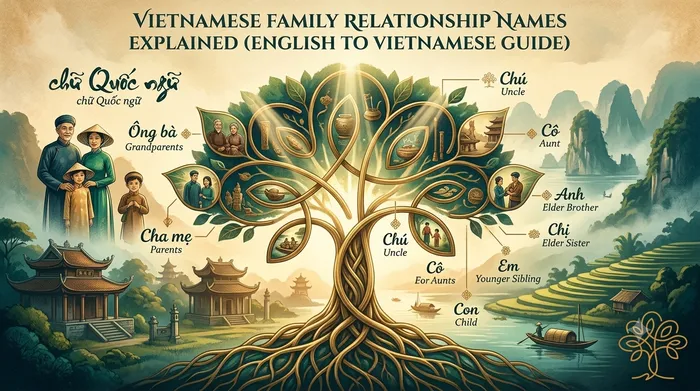
Vietnamese kinship terms do something most English speakers have never had to think about: they tell you exactly where in the family someone sits before you even finish the sentence. Say "ong noi" and a Vietnamese speaker instantly knows you mean your paternal grandfather, not your maternal one. Say "anh" and they know you're talking about an older brother, never a younger one. If you're documenting a Vietnamese branch of your family tree, understanding this precision will save you from a lot of ambiguous labels later.
This guide walks through the core Vietnamese family relationship names, organized around the two rules that shape almost all of them: which side of the family, and relative age.
Rule One: Paternal Side vs. Maternal Side
Vietnamese draws a sharp line between your father's relatives and your mother's relatives, most clearly with grandparents:
| Relationship | Vietnamese | Side |
|---|---|---|
| Paternal grandfather | ong noi | Father's side |
| Paternal grandmother | ba noi | Father's side |
| Maternal grandfather | ong ngoai | Mother's side |
| Maternal grandmother | ba ngoai | Mother's side |
"Noi" roughly means "inside" and refers to the father's line, while "ngoai" means "outside" and refers to the mother's line - a naming pattern that reflects a traditionally patrilineal family structure, where a father's relatives were considered part of the household and a mother's relatives were considered, linguistically at least, more like outside connections.
The same noi/ngoai split extends to aunts and uncles, though it also layers in age relative to the parent:
- Bac: father's older brother (or his wife)
- Chu: father's younger brother
- Co: father's sister (of any age)
- Cau: mother's brother (of any age)
- Di: mother's sister (of any age)
- Mo / Thim: wife of chu or bac, depending on which uncle
Notice that the paternal side gets more granular distinctions (bac vs. chu split by whether the uncle is older or younger than the father) while the maternal side uses one word each (cau, di) regardless of age - another artifact of the traditional emphasis placed on the father's line.
Rule Two: Older or Younger, Always
Like several other Southeast and East Asian languages, Vietnamese has no neutral word for "brother" or "sister." Every sibling term specifies relative age:
- Anh: older brother
- Chi: older sister
- Em trai: younger brother
- Em gai: younger sister
This isn't just a family-tree quirk - anh and chi are also used broadly in everyday Vietnamese as polite terms of address for anyone slightly older than you, even outside the family, which shows how deeply the age-based system runs through the language as a whole.
Parents, Spouse, and Children
- Father: bo / ba / cha (regional variation - bo is common in the north, ba in the south)
- Mother: me / ma
- Husband: chong
- Wife: vo
- Son: con trai
- Daughter: con gai
Vietnamese doesn't have separate words for "son" and "daughter" the way most languages do - "con" means "child," and trai (male) or gai (female) is added to specify gender. The same con root appears in other terms, like chau (grandchild or niece/nephew, depending on context).
Cousins and Extended Family
Vietnamese doesn't have a single word equivalent to "cousin." Instead, cousins are described using the same sibling terms (anh, chi, em) combined with "con" of the relevant aunt or uncle - so a cousin is functionally described as "the child of my bac/chu/co/cau/di," and then referred to day-to-day as anh, chi, or em based on their age relative to you, exactly like a sibling would be.
You
├── Anh / Chi (older sibling or older cousin, by age not by blood distance)
└── Em (younger sibling or younger cousin, by age not by blood distance)
This is a genuinely useful thing to know if you're building a family tree with Vietnamese relatives: two people the tree shows as first cousins might refer to each other, and be referred to by the whole family, using the exact same words used for siblings - the vocabulary doesn't distinguish "close" family from "extended" family the way English implicitly does.
Building a Vietnamese Branch of Your Family Tree
A few practical tips if you're adding Vietnamese relatives to your tree:
- Record whether a grandparent, aunt, or uncle is on the paternal or maternal side - the Vietnamese terms already encode it, so capturing it in your English notes keeps the tree consistent for readers in either language.
- Note relative age for siblings and cousins alike, since Vietnamese kinship terms are built around it and it's easy to lose track of once a tree grows beyond a couple of generations.
- Expect regional vocabulary differences - Northern, Central, and Southern Vietnamese dialects use different words for "father" and a few other core terms, so ask which region a family originates from before assuming one is a mistake.
My rOoOts lets you attach relationship labels to each person in a tree, which is especially useful for a system like Vietnamese's, where the same English word ("uncle," "cousin") can map to several different, non-interchangeable Vietnamese terms depending on side of the family and age.
Frequently Asked Questions
Why does Vietnamese have different words for paternal and maternal grandparents?
The distinction (noi for the father's side, ngoai for the mother's side) reflects a traditionally patrilineal family structure where the father's relatives were considered part of the immediate household and the mother's relatives were linguistically marked as connected but separate.
Is there a single Vietnamese word for "cousin"?
No. Vietnamese describes cousins by relationship to the connecting aunt or uncle, then refers to them day-to-day using the same age-based sibling terms (anh, chi, em) used for actual siblings.
Why do Vietnamese people call people who aren't relatives "anh" or "chi"?
Because the sibling terms function as general polite terms of address based on relative age, not just literal family words - calling a slightly older stranger "anh" or "chi" is a normal, respectful way to address them in everyday Vietnamese.
Do all regions of Vietnam use the same words for "father" and "mother"?
No - there's real regional variation. "Bo" is more common in the north, while "ba" is more common in the south, along with several other regional vocabulary differences that are worth confirming with family before assuming a term is unusual or wrong.
How does Vietnamese distinguish "son" from "daughter"?
Both start from "con" (child) and add a gender word - "con trai" for son (trai meaning male) and "con gai" for daughter (gai meaning female) - rather than using two entirely separate root words the way English does.
Editor's picks
20 August 2026
Russian Family Relationship Names Explained (English to Russian Guide)
An English-to-Russian guide to family relationship names, including the distinct in-law terms Russian uses depending on which side of the family you married into.
20 August 2026
Japanese Family Relationship Names Explained (English to Japanese Guide)
A clear English-to-Japanese guide to family relationship names, including the age-ranked sibling terms and the own-family-vs-other-family rule that trips up most learners.
17 August 2026
Chinese Family Relationship Names Explained (English to Chinese Guide)
A clear guide to Chinese family relationship names in Mandarin, covering grandparents, aunts, uncles, and cousins on both the paternal and maternal sides.
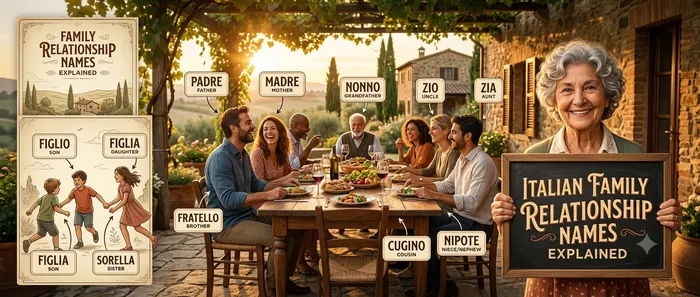
9 August 2026
Italian Family Relationship Names Explained
A complete English-to-Italian guide to family relationship names, covering parents, siblings, grandparents, cousins, in-laws, step-family and more with clear tables.
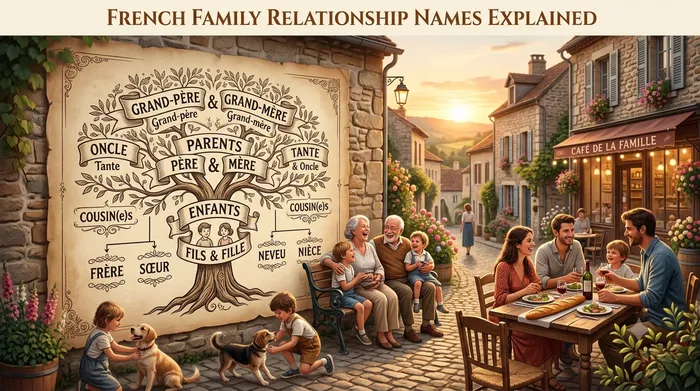
9 August 2026
French Family Relationship Names Explained (English to French Guide)
A complete English-to-French guide to family relationship names, covering parents, siblings, grandparents, in-laws, cousins, step-family, and more with clear tables and examples.
19 August 2026
Marathi Family Relationship Names Explained (English to Marathi Guide)
A complete English-to-Marathi guide to family relationship names, from parents and grandparents to in-laws and cousins, rooted in Maharashtra's family traditions.
Create Your Family Tree for Free
Start building your family history in minutes with the My rOoOts Free Family Tree Creator. Add parents, grandparents, children, and relatives, organize generations visually, and create a beautiful family tree that you can save and share.
👉 Create your free family tree: Free Family Tree Creator
No design skills required. Simply enter your family details and generate a clear, easy-to-read family tree online for free.
Check Zodiac Compatibility for Any Two People
Curious about how well two people match based on their date of birth? Try the My rOoOts Zodiac Compatibility Tool to compare zodiac signs, explore relationship compatibility, and get a quick compatibility score for couples, friends, or family members.
👉 Check compatibility now: Zodiac Compatibility Calculator
You can enter two dates of birth and even mention the relationship type to get a more personalized compatibility result.
Download a Free Family Tree Template
Want to draw your family tree yourself? The My rOoOts Family Tree Template provides a free printable blank pedigree chart for documenting your family history across multiple generations.
👉 Download a free family tree template: Family Tree Template
Choose a 3-generation, 4-generation, or 5-generation family tree template and save it as a PDF for printing, writing, and documenting your ancestors.
Discover the Meaning and Origin of Your Surname
Ever wondered where your family name came from? Use the My rOoOts Surname Meaning Lookup to explore surname meanings, origins, history, and etymology from different regions and cultures around the world.
👉 Discover your surname meaning: Surname Meaning Lookup
Learn more about your last name and explore the possible linguistic, geographic, cultural, and historical roots behind your family surname.
Start your family tree free
No account needed to begin. Build it in minutes, then save it whenever you're ready.
Build your family tree