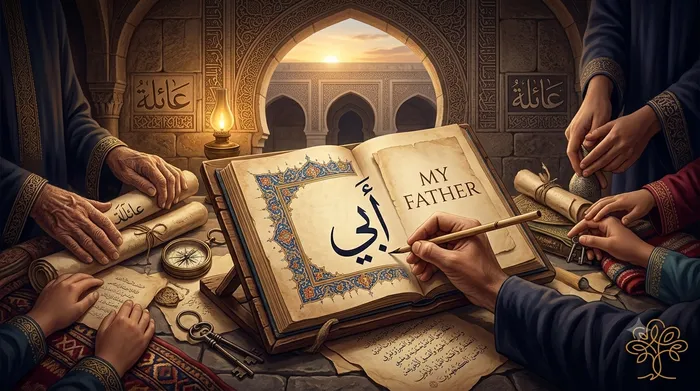
English gets by with a fairly small set of family words. "Aunt" covers your mother's sister and your father's sister equally, and "cousin" covers dozens of different relatives without distinction. Arabic doesn't work that way. Its kinship vocabulary is precise about which side of the family someone belongs to, and that precision carries real cultural weight, it tells you something about lineage, inheritance, and closeness that English simply leaves out.
If you're building out a family tree with Arabic-speaking relatives, learning a language with family, or just curious why your Arabic-speaking friend has four different words for what you'd call "uncle," here's a clear breakdown.
Immediate Family
- Ab (أب) - father
- Umm (أم) - mother
- Ibn (ابن) - son
- Ibna / Bint (ابنة / بنت) - daughter
- Akh (أخ) - brother
- Ukht (أخت) - sister
- Zawj (زوج) - husband
- Zawja (زوجة) - wife
Grandparents
- Jadd (جد) - grandfather
- Jadda (جدة) - grandmother
Many Arabic-speaking families add a side to clarify, such as jadd min jihat al-ab (paternal grandfather, literally "grandfather from the father's side") versus jadd min jihat al-umm (maternal grandfather), especially in families with a lot of relatives to keep straight across a large family tree.
Why Arabic Splits "Aunt" and "Uncle" by Side of the Family
This is the single biggest difference from English, and it's where a lot of learners get tripped up:
| English | Arabic | Literal Meaning |
|---|---|---|
| Paternal uncle (father's brother) | Amm (عم) | father's brother |
| Paternal aunt (father's sister) | Amma (عمة) | father's sister |
| Maternal uncle (mother's brother) | Khal (خال) | mother's brother |
| Maternal aunt (mother's sister) | Khala (خالة) | mother's sister |
The distinction matters beyond vocabulary. In many Arab cultures, a paternal uncle (amm) traditionally carries more weight in family decisions and inheritance than a maternal uncle (khal), because lineage has historically been traced through the father's line. Knowing which word applies to which relative can tell you a lot about how a family tree is structured, not just what to call someone at a family gathering.
Cousins
Arabic also distinguishes cousins by which aunt or uncle they descend from, rather than lumping them all into one word:
- Ibn al-amm / Bint al-amm - son/daughter of the paternal uncle (paternal male-line cousin)
- Ibn al-amma / Bint al-amma - son/daughter of the paternal aunt
- Ibn al-khal / Bint al-khal - son/daughter of the maternal uncle
- Ibn al-khala / Bint al-khala - son/daughter of the maternal aunt
In traditional Arab tribal and family structures, the paternal-uncle's-child relationship (ibn al-amm/bint al-amm) has particular cultural significance, historically linked to marriage customs within the extended paternal family and to inheritance and lineage claims.
In-Laws
- Hama (حماة) - mother-in-law
- Ham (حم) - father-in-law
- Sihr (صهر) - son-in-law, or more broadly a male in-law
- Kanna (كنة) - daughter-in-law
Extended and Step-Family Terms
- Akh min al-ab - half-brother (same father)
- Akh min al-umm - half-brother (same mother)
- Zawj al-umm - stepfather (literally "mother's husband")
- Zawjat al-ab - stepmother (literally "father's wife")
- Hafid / Hafida - grandson / granddaughter
Regional Variation Is Common
Standard Arabic (Fusha) provides the vocabulary above, but everyday spoken Arabic varies by region, and family terms are some of the words that shift the most. Egyptian, Levantine, Gulf, and Maghrebi dialects can all pronounce or even substitute different everyday words for the same relative, especially in affectionate or informal address. If you're documenting a family tree with roots in a specific Arab country, it's worth asking older relatives which dialect terms they actually grew up using, since those are often the words tied most closely to family memory.
Why This Matters for Building a Family Tree
When you're mapping out relationships across generations, especially in a large extended family, knowing that Arabic marks the maternal and paternal sides separately can actually make the structure of the tree clearer, not more complicated. A relative introduced as "amm" is immediately placeable on the father's side; one introduced as "khal" belongs to the mother's line. That built-in clarity is useful even if you're recording the family tree in English, since it gives you a quick way to double-check which branch a relative belongs to.
Frequently Asked Questions
What is the Arabic word for aunt?
There isn't a single word. "Amma" (عمة) is your father's sister, and "khala" (خالة) is your mother's sister. Arabic keeps these separate rather than using one general term the way English uses "aunt."
What is the Arabic word for cousin?
Arabic has no single equivalent to "cousin." Instead, it names the specific relationship, such as ibn al-amm (paternal uncle's son) or bint al-khala (maternal aunt's daughter), depending on exactly which aunt or uncle the cousin descends from.
Why does Arabic distinguish between maternal and paternal uncles?
The distinction reflects the traditional importance of the father's lineage in many Arab family and inheritance structures. A paternal uncle (amm) shares the family surname and line, while a maternal uncle (khal) comes from the mother's separate family line.
Is the Arabic word for grandmother the same in every Arabic-speaking country?
The standard word "jadda" is widely understood, but everyday spoken terms vary by dialect and country, and many families use a warmer, more informal word at home instead of the formal standard Arabic term.
Do these terms change between Modern Standard Arabic and spoken dialects?
Yes. Modern Standard Arabic (Fusha) terms like those listed here are understood everywhere and used in writing, but everyday conversation in Egypt, the Levant, the Gulf, or North Africa often uses different pronunciations or entirely different affectionate words for close family members.
Editor's picks
20 August 2026
Japanese Family Relationship Names Explained (English to Japanese Guide)
A clear English-to-Japanese guide to family relationship names, including the age-ranked sibling terms and the own-family-vs-other-family rule that trips up most learners.
20 August 2026
Russian Family Relationship Names Explained (English to Russian Guide)
An English-to-Russian guide to family relationship names, including the distinct in-law terms Russian uses depending on which side of the family you married into.
20 August 2026
Vietnamese Family Relationship Names Explained (English to Vietnamese Guide)
An English-to-Vietnamese guide to family relationship names, including the paternal-versus-maternal grandparent terms and age-ranked sibling words that make Vietnamese kinship vocabulary so precise.
17 August 2026
Chinese Family Relationship Names Explained (English to Chinese Guide)
A clear guide to Chinese family relationship names in Mandarin, covering grandparents, aunts, uncles, and cousins on both the paternal and maternal sides.
9 August 2026
Italian Family Relationship Names Explained
A complete English-to-Italian guide to family relationship names, covering parents, siblings, grandparents, cousins, in-laws, step-family and more with clear tables.
9 August 2026
French Family Relationship Names Explained (English to French Guide)
A complete English-to-French guide to family relationship names, covering parents, siblings, grandparents, in-laws, cousins, step-family, and more with clear tables and examples.
Create Your Family Tree for Free
Start building your family history in minutes with the My rOoOts Free Family Tree Creator. Add parents, grandparents, children, and relatives, organize generations visually, and create a beautiful family tree that you can save and share.
👉 Create your free family tree: Free Family Tree Creator
No design skills required. Simply enter your family details and generate a clear, easy-to-read family tree online for free.
Check Zodiac Compatibility for Any Two People
Curious about how well two people match based on their date of birth? Try the My rOoOts Zodiac Compatibility Tool to compare zodiac signs, explore relationship compatibility, and get a quick compatibility score for couples, friends, or family members.
👉 Check compatibility now: Zodiac Compatibility Calculator
You can enter two dates of birth and even mention the relationship type to get a more personalized compatibility result.
Download a Free Family Tree Template
Want to draw your family tree yourself? The My rOoOts Family Tree Template provides a free printable blank pedigree chart for documenting your family history across multiple generations.
👉 Download a free family tree template: Family Tree Template
Choose a 3-generation, 4-generation, or 5-generation family tree template and save it as a PDF for printing, writing, and documenting your ancestors.
Discover the Meaning and Origin of Your Surname
Ever wondered where your family name came from? Use the My rOoOts Surname Meaning Lookup to explore surname meanings, origins, history, and etymology from different regions and cultures around the world.
👉 Discover your surname meaning: Surname Meaning Lookup
Learn more about your last name and explore the possible linguistic, geographic, cultural, and historical roots behind your family surname.
Start your family tree free
No account needed to begin. Build it in minutes, then save it whenever you're ready.
Build your family tree