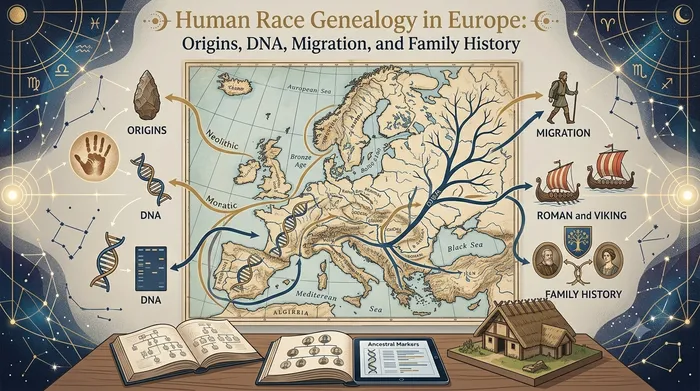
Europe has one of the most extensively studied genealogical histories in the world. From Ice Age hunter-gatherers to modern nations, the continent preserves thousands of years of migration, intermarriage, language change, and cultural exchange. Understanding human race genealogy in Europe is not about dividing people into separate races; it is about tracing how populations moved, mixed, and formed the diverse European communities we know today.
Modern genetics shows that Europeans share deep common ancestry with other human populations. What makes European genealogy especially fascinating is the combination of DNA evidence, archaeological discoveries, historical records, and family documents that can often connect present-day families to ancestors who lived centuries ago.
This guide explores the major ancestral layers of Europe, the role of DNA, historical migrations, surnames, and practical steps for researching your own European roots.
What does “human race genealogy in Europe” mean?
In genealogy, researchers usually focus on ancestry and population history rather than race. The goal is to understand:
- Where ancestors lived.
- How populations migrated.
- Which cultures influenced them.
- How families are connected across generations.
European genealogy combines:
- Church and civil records.
- Census data.
- Military records.
- Immigration documents.
- DNA testing.
- Oral family history.
Together, these sources help reconstruct family lines and broader population history.
The earliest humans in Europe
Modern humans (Homo sapiens) arrived in Europe roughly 45,000 years ago. They encountered other human groups such as Neanderthals, who later disappeared. Genetic studies show that most modern Europeans carry a small percentage of Neanderthal DNA inherited through ancient interbreeding.
Key prehistoric populations
Hunter-gatherers
These were the first widespread modern human populations in Europe after the Ice Age.
Early farmers
Around 7000–5000 BCE, farming communities spread from Anatolia into Europe, bringing agriculture, new technologies, and new ancestry.
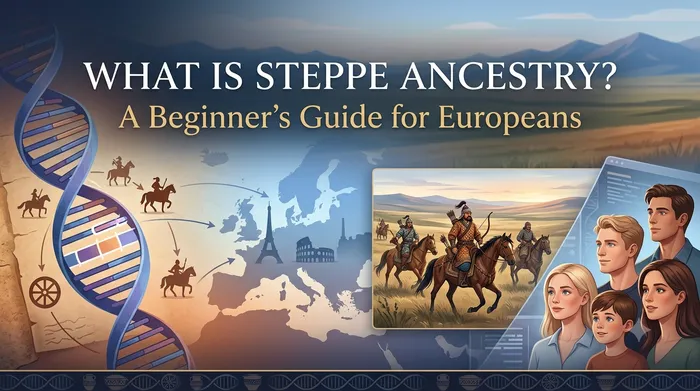
Steppe pastoralists
Around 3000 BCE, populations from the Eurasian Steppe expanded into Europe and contributed significantly to the ancestry of many modern Europeans.
Most present-day Europeans are a mixture of these three major ancestral components.
The great migrations that shaped Europe
European ancestry was never static. Several major migration waves transformed the continent.
Neolithic farming expansion
Farmers moved from the Near East into the Balkans and then across Europe, often mixing with local hunter-gatherers.
Indo-European expansion
Steppe populations spread across large parts of Europe and are associated with the spread of many Indo-European languages.
Classical era movements
Greeks, Romans, Celts, and other peoples created extensive trade networks and settlements that connected distant regions.
Migration Period
Between the 4th and 8th centuries CE, groups such as Goths, Vandals, Franks, Lombards, and Anglo-Saxons moved across Europe.
Viking Age
Scandinavian seafarers settled in the British Isles, Normandy, Iceland, and parts of Eastern Europe.
Medieval and early modern migrations
Trade, warfare, religious change, and colonization continued to reshape European populations.
These movements mean that many Europeans have ancestry from multiple regions even when family traditions emphasize a single origin.
How DNA helps trace European ancestry
DNA testing has become one of the most powerful tools for genealogy.
Autosomal DNA
- Inherited from all recent ancestors.
- Useful for finding relatives within roughly the last 5–7 generations.
- Provides ethnicity estimates based on reference populations.
Y-DNA
- Passed from father to son.
- Helps trace direct paternal lines.
Mitochondrial DNA (mtDNA)
- Passed from mothers to all children.
- Traces direct maternal lines.
DNA cannot usually identify a single ancient tribe with certainty, but it can reveal regional ancestry patterns and connect living relatives.
European genetic regions
Commercial DNA tests often identify ancestry from regions such as:
- British & Irish
- Scandinavian
- Iberian
- Italian
- Balkan
- Eastern European
- Baltic
- Finnish
- Ashkenazi Jewish
- Greek & Cypriot
These categories are statistical estimates, not fixed biological races. Borders changed frequently throughout history, so genetic ancestry often overlaps across neighboring regions.
Surnames and family history
Surnames became hereditary at different times across Europe, often between the 11th and 19th centuries.
Common surname types
- Patronymic: Johnson, Ivanov, Hansen
- Occupational: Smith, Müller, Baker
- Locational: Hill, York, Lombardi
- Descriptive: Short, Brown, Weiss
Studying surname origins can provide clues about geography, language, and social history.
For readers interested in surname research, the My rOoOts blog offers additional genealogy resources and family history guides.
Church records: the backbone of European genealogy
Before modern civil registration, churches recorded baptisms, marriages, and burials.
Important record types
- Parish registers
- Confirmation records
- Marriage banns
- Burial registers
- Communion lists
Countries such as England, France, Germany, Italy, Poland, and the Nordic nations preserve millions of parish records, many of which are now digitized.
Civil registration and census records
Civil registration generally became widespread in the 18th–20th centuries.
These records may include
- Birth certificates
- Marriage certificates
- Death certificates
- Census returns
- Residence registers
- Identity records
They often provide occupations, addresses, parents’ names, and other valuable clues.
Jewish genealogy in Europe
European Jewish communities developed rich genealogical traditions despite persecution, migration, and displacement. Important sources include:
- Synagogue records
- Community registers
- Holocaust archives
- Cemetery inscriptions
- Immigration records
Because many records were lost during the Holocaust, DNA testing and international archival cooperation are especially important in Jewish genealogy.
The challenge of changing borders
One of the biggest difficulties in European genealogy is that ancestors may have lived in places that changed country multiple times.
Examples
- Poland was partitioned and later restored.
- Alsace shifted between France and Germany.
- Galicia belonged to Austria-Hungary.
- The Balkans experienced repeated border changes.
Always search records using the historical place name that existed when the ancestor lived there.
Building a European family tree
A practical research workflow is:
Start with yourself
Record names, dates, places, and family stories.
Interview relatives
Ask about migrations, occupations, military service, and hometowns.
Gather documents
Collect birth, marriage, death, and immigration records.
Search online archives
Use national archives, church databases, and local record collections.
Add DNA evidence
Compare matches with documentary research.
Organize findings visually
Use a family tree chart to track relationships across generations.
You can create and maintain a digital tree with the Family Tree Generator from My rOoOts.
Mapping migrations across generations
Visual timelines help reveal patterns such as:
- Village to city migration.
- Rural to industrial movement.
- European emigration to the Americas, Australia, or South Africa.
- Return migration after wars.
The Ancestor Timeline Generator can help organize ancestral events chronologically.
Understanding relationships in large European families
Historical European families often included many cousins, in-laws, and extended kin living close together. Correctly identifying relationships is essential when records contain repeated names.
If you are unsure how two relatives are connected, the Relationship Calculator can help determine the exact family relationship.
Common myths about European ancestry
“My DNA result proves I belong to a pure race.”
Modern genetics shows that European populations are the result of extensive mixing over thousands of years.
“A surname guarantees noble ancestry.”
Most surnames were adopted by ordinary families; sharing a surname does not prove descent from a famous lineage.
“DNA can identify my exact ancient tribe.”
Current DNA tests usually provide regional ancestry estimates rather than precise tribal identification.
“Family stories are always accurate.”
Oral history is valuable, but it should be verified with records whenever possible.
Why European genealogy matters today
Researching European ancestry can help people:
- Preserve family memories.
- Understand cultural traditions.
- Reconnect with relatives abroad.
- Study migration history.
- Teach children about their heritage.
- Create a lasting family archive.
Genealogy often strengthens a sense of identity while also revealing how interconnected human populations have always been.
The bigger picture: one human family
The most important lesson from modern genealogy is that all humans share common ancestry. European populations differ in language, culture, and historical experience, but genetically they are closely related to one another and to people across the world.
Studying human race genealogy in Europe therefore highlights both diversity and shared human origins. Every family tree eventually connects to broader patterns of migration, adaptation, and cultural exchange that shaped the history of humanity.
Conclusion
European genealogy is a journey through prehistoric migrations, medieval villages, changing borders, and modern DNA discoveries. By combining historical records with genetic evidence, individuals can uncover remarkable details about their ancestors and preserve that knowledge for future generations.
Whether your roots are British, Irish, German, Italian, Polish, Scandinavian, Balkan, Jewish, or mixed across many regions, documenting your family history is a meaningful way to connect personal stories with the larger history of Europe.
To begin your own research, explore the genealogy tools available at My rOoOts, build a digital family tree, and start recording the stories that make your family unique.
Create Your Family Tree for Free
Start building your family history in minutes with the My rOoOts Free Family Tree Creator. Add parents, grandparents, children, and relatives, organize generations visually, and create a beautiful family tree that you can save and share.
👉 Create your free family tree: Free Family Tree Creator
No design skills required. Simply enter your family details and generate a clear, easy-to-read family tree online for free.
Check Zodiac Compatibility for Any Two People
Curious about how well two people match based on their date of birth? Try the My rOoOts Zodiac Compatibility Tool to compare zodiac signs, explore relationship compatibility, and get a quick compatibility score for couples, friends, or family members.
👉 Check compatibility now: Zodiac Compatibility Calculator
You can enter two dates of birth and even mention the relationship type to get a more personalized compatibility result.
Download a Free Family Tree Template
Want to draw your family tree yourself? The My rOoOts Family Tree Template provides a free printable blank pedigree chart for documenting your family history across multiple generations.
👉 Download a free family tree template: Family Tree Template
Choose a 3-generation, 4-generation, or 5-generation family tree template and save it as a PDF for printing, writing, and documenting your ancestors.
Discover the Meaning and Origin of Your Surname
Ever wondered where your family name came from? Use the My rOoOts Surname Meaning Lookup to explore surname meanings, origins, history, and etymology from different regions and cultures around the world.
👉 Discover your surname meaning: Surname Meaning Lookup
Learn more about your last name and explore the possible linguistic, geographic, cultural, and historical roots behind your family surname.
Start your family tree free
No account needed to begin. Build it in minutes, then save it whenever you're ready.
Build your family tree