How Yamnaya Ancestry Appears in Modern European DNA Tests
If you have taken a consumer DNA test and seen labels such as “Northwestern European,” “Eastern European,” or “British & Irish,” a large share of that signal may ultimately trace back to a group of Bronze Age pastoralists known as the Yamnaya. Understanding how Yamnaya ancestry appears in modern European DNA tests helps turn abstract percentages into a clearer picture of deep family history.
Who Were the Yamnaya?
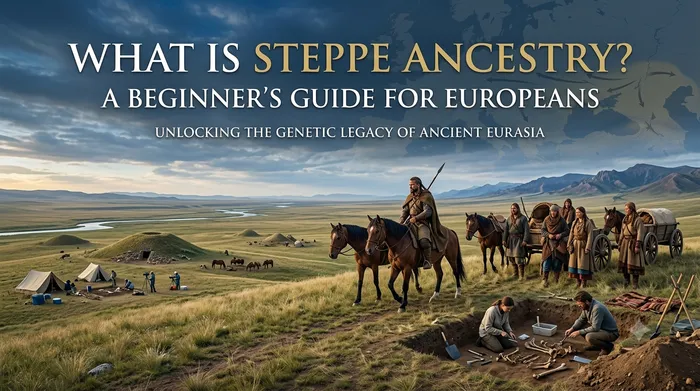
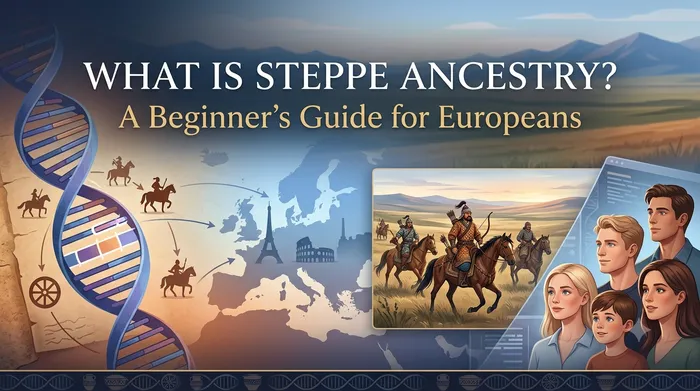
The Yamnaya (also called Western Steppe Herders) lived on the Pontic-Caspian steppe, roughly in present-day Ukraine and southern Russia, between about 3300 and 2600 BCE. They were mobile herders who used wagons, domesticated horses, and practiced kurgan burial traditions. Genetically they formed from a mix of Eastern Hunter-Gatherer and Caucasus Hunter-Gatherer ancestry.
Around 3000–2500 BCE their descendants expanded rapidly into Europe. This movement is strongly associated with the spread of Indo-European languages and left a lasting genetic imprint. Ancient DNA studies show that Corded Ware groups in Central and Northern Europe often carried roughly 70–75 percent Yamnaya-related ancestry. Later Bell Beaker and Bronze Age populations carried varying amounts of the same signal as it mixed with earlier European farmer and hunter-gatherer populations.
How Modern DNA Tests Detect Yamnaya Ancestry
Consumer tests from companies such as AncestryDNA, 23andMe, and MyHeritage do not usually display a category simply labeled “Yamnaya.” Instead they report ancestry relative to present-day reference populations. The Yamnaya contribution is embedded inside broader European categories.
The underlying science relies on ancient DNA reference panels. Researchers compare your genome to genomes from Yamnaya and related steppe individuals. Statistical models then estimate how much of your DNA matches that ancient source after accounting for later mixing. The result is folded into modern labels because those labels best match the genetic clusters of living people.
Key points about the detection process:
- Steppe (Yamnaya-related) ancestry is highest in Northern and Northwestern Europe and declines toward the Mediterranean.
- Typical ranges for people with deep European roots often fall between 30 and 50 percent steppe-related ancestry, with higher figures in Scandinavia, the Baltic region, Ireland, and parts of Britain, and lower figures in Southern Europe.
- Y-chromosome haplogroups common among Yamnaya males (especially branches of R1b) remain frequent in Western Europe today, while R1a is more common farther east.
- Mitochondrial DNA shows less dramatic replacement, consistent with a male-biased migration pattern in many regions.
Because reference panels and algorithms differ between companies, the exact percentage you see can vary even for the same person. Updates to a company’s model can also shift results over time as more ancient samples are added.
Regional Patterns Across Europe
Modern Europeans are generally modeled as a three-way mixture of Western Hunter-Gatherers, Early European Farmers (mainly Anatolian-related), and Yamnaya-related steppe ancestry. The proportions shift by region:
- Northern and Northwestern Europe (Scandinavia, Britain, Ireland, Netherlands): often the highest steppe percentages.
- Central and Eastern Europe: substantial steppe ancestry, frequently combined with elevated hunter-gatherer components in the Baltic and Slavic-speaking areas.
- Southern Europe (Iberia, Italy, Greece): lower average steppe ancestry and higher Early Farmer ancestry.
- Outliers such as Sardinia retain very little steppe signal.
These patterns reflect the intensity and timing of the Bronze Age migrations and subsequent population movements. In some areas the genetic turnover was dramatic; in Britain, for example, studies indicate a large replacement of earlier Neolithic ancestry within a few centuries.
What the Results Mean for Your Family Story
Seeing Yamnaya-related ancestry on a DNA test does not mean your recent ancestors came from the Russian steppe. It means that thousands of years ago people carrying that genetic signature became part of the populations from which your more recent ancestors descended. The signal has been diluted and reshuffled through countless generations of local marriage and migration.
DNA percentages therefore work best when paired with traditional genealogy. A test can point you toward broad ancestral components; documentary research, oral history, and a carefully built family tree can place those components into specific family lines, places, and centuries.
Tools that help visualize deep time and family connections become especially useful at this stage. An ancestor timeline generator can turn birth years and generational estimates into a clear visual span that reaches back toward the Bronze Age. A family tree generator or full interactive tree lets you attach the DNA insights to named individuals, photos, and stories so the abstract percentages become personal.
Practical Tips When Interpreting Your Results
- Compare results across companies if possible; differences often reflect modeling choices rather than errors.
- Look at confidence ranges or chromosome painting views when available; they show how the ancestry is distributed across your genome.
- Remember that autosomal DNA is only half the story. Y-DNA and mtDNA can reveal specific paternal or maternal lines that may or may not carry elevated steppe markers.
- Avoid over-interpreting small percentage differences. Focus on the overall pattern and how it aligns with your known paper trail.
- Use DNA matches and shared segments to identify which branches of your tree are most likely contributing the steppe signal.
Once the genetic picture is clearer, preserving the living family context becomes the natural next step. Building a private, shareable family tree on a platform designed for multi-generational records allows relatives to add names, places, photographs, and stories. You can begin for free with no sign-up required at the My rOoOts create-tree page and later invite family members to contribute while keeping full control over privacy.
Connecting Ancient Ancestry to Everyday Family History
Yamnaya ancestry is one chapter in a much longer story that includes Ice Age hunter-gatherers, Neolithic farmers, and countless later movements. Modern DNA tests make that chapter visible for the first time to ordinary families. The real value appears when the genetic data is joined to the names, relationships, and memories that only living relatives can supply.
A clear family tree turns percentages into people. An interactive tree that supports large families, rich profiles, and easy sharing helps ensure that both the deep genetic heritage and the recent family narrative are preserved together. Whether you are just starting with a few names or already managing hundreds of relatives, the combination of DNA insight and a living digital archive creates a more complete picture of where your family comes from.
Conclusion
Yamnaya ancestry appears in modern European DNA tests not as a separate labeled category in most reports, but as a substantial component inside the broader European ethnicity estimates. It reflects a major Bronze Age migration that reshaped the genetic landscape of the continent and still accounts for a significant fraction of the DNA of people with Northern, Central, and Eastern European roots.
Understanding the science behind the numbers adds depth to any DNA result. Pairing those results with careful genealogical research and a well-maintained family tree transforms distant genetic signals into a tangible family legacy that can be shared across generations. Exploring both the ancient and the recent layers of your story is one of the most rewarding ways to connect with the people who came before you.
Create Your Family Tree for Free
Start building your family history in minutes with the My rOoOts Free Family Tree Creator. Add parents, grandparents, children, and relatives, organize generations visually, and create a beautiful family tree that you can save and share.
👉 Create your free family tree: Free Family Tree Creator
No design skills required. Simply enter your family details and generate a clear, easy-to-read family tree online for free.
Check Zodiac Compatibility for Any Two People
Curious about how well two people match based on their date of birth? Try the My rOoOts Zodiac Compatibility Tool to compare zodiac signs, explore relationship compatibility, and get a quick compatibility score for couples, friends, or family members.
👉 Check compatibility now: Zodiac Compatibility Calculator
You can enter two dates of birth and even mention the relationship type to get a more personalized compatibility result.
Download a Free Family Tree Template
Want to draw your family tree yourself? The My rOoOts Family Tree Template provides a free printable blank pedigree chart for documenting your family history across multiple generations.
👉 Download a free family tree template: Family Tree Template
Choose a 3-generation, 4-generation, or 5-generation family tree template and save it as a PDF for printing, writing, and documenting your ancestors.
Discover the Meaning and Origin of Your Surname
Ever wondered where your family name came from? Use the My rOoOts Surname Meaning Lookup to explore surname meanings, origins, history, and etymology from different regions and cultures around the world.
👉 Discover your surname meaning: Surname Meaning Lookup
Learn more about your last name and explore the possible linguistic, geographic, cultural, and historical roots behind your family surname.
Start your family tree free
No account needed to begin. Build it in minutes, then save it whenever you're ready.
Build your family tree