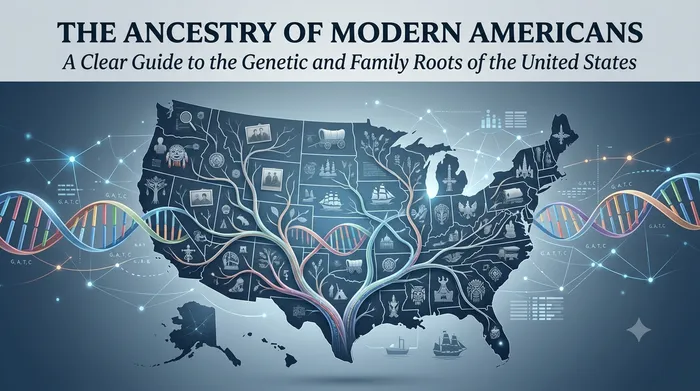
The Ancestry of Modern Americans: A Clear Guide to the Genetic and Family Roots of the United States
Modern Americans carry one of the most diverse sets of ancestral histories on the planet. Waves of migration, forced displacement, voluntary immigration, and centuries of mixing have created a population whose roots stretch across every inhabited continent. Understanding the ancestry of modern Americans means looking at both broad population patterns and the highly personal family stories that DNA tests and genealogical research can reveal.
The Major Ancestral Components
Genetic studies and census data show that the ancestry of people living in the United States today typically draws from several large sources:
- Indigenous American (Native American) ancestry from the original peoples of the Americas
- European ancestry, which itself includes multiple layers such as British and Irish, German, Scandinavian, Italian, Eastern European, and deeper Steppe-related components
- African ancestry, primarily from West and West-Central Africa, brought through the transatlantic slave trade
- East Asian, South Asian, and Southeast Asian ancestry from more recent immigration
- Additional contributions from the Middle East, North Africa, and Oceania
Most Americans of mixed background carry combinations of these components in varying proportions. Even people who identify with a single ethnic group often show smaller percentages from other sources when they take a DNA test.
Native American Ancestry
The first peoples of the Americas arrived tens of thousands of years ago via Beringia and subsequent coastal and inland routes. Their descendants formed hundreds of distinct nations and language groups. Today, many Americans, particularly those with family history in the Southwest, Oklahoma, the Plains, or Alaska, carry detectable Native American ancestry. Percentages range from trace amounts to substantial shares among enrolled tribal members and people with documented Indigenous roots.
DNA tests can detect this component, but they cannot assign it to a specific tribe. Tribal enrollment and cultural identity rest on genealogical records, community recognition, and oral history rather than genetic percentages alone.
European Ancestry in America
European ancestry is the largest single component for the majority of the U.S. population. It arrived in successive waves:
- Early colonial settlement from the British Isles, the Netherlands, France, and Spain
- Large 19th-century immigration from Germany, Ireland, and Scandinavia
- Early 20th-century arrivals from Italy, Eastern Europe, and the Russian Empire
- Continued immigration from across Europe in later decades
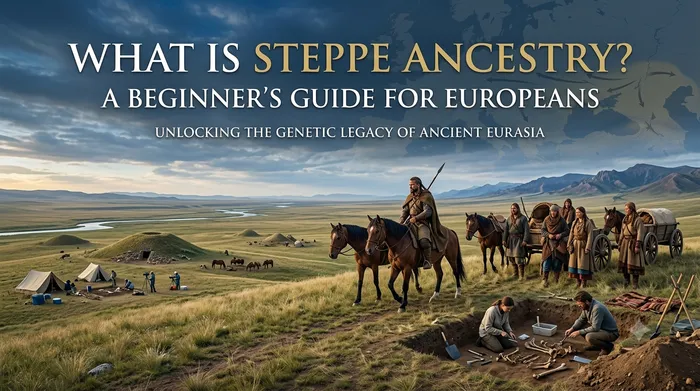
Within this European layer sits the deeper Steppe (Yamnaya-related) ancestry that entered Europe during the Bronze Age. Many Americans with British, Irish, German, Scandinavian, or Eastern European roots therefore carry significant Steppe-related DNA, even if their family trees only reach back a few centuries on American soil.
African Ancestry and the Legacy of Slavery
African ancestry in the United States is overwhelmingly linked to the forced migration of millions of people from West and West-Central Africa between the 16th and 19th centuries. Genetic studies show strong connections to populations in present-day Nigeria, Ghana, Senegal, Angola, and surrounding regions. Because of the nature of the slave trade and subsequent mixing, many African Americans also carry European ancestry, and a smaller percentage carry Native American ancestry.
DNA testing has become an important tool for African American families seeking to recover information that paper records often erased. Matches, ethnicity estimates, and chromosome browsers can point toward specific regions and living relatives.
Asian, Hispanic, and More Recent Immigrant Ancestries
Hispanic and Latino Americans typically show a three-way mix of Indigenous American, European (mainly Iberian), and varying amounts of African ancestry, reflecting the colonial history of Latin America. East Asian, South Asian, Filipino, Vietnamese, Korean, Chinese, and other Asian ancestries have grown rapidly through immigration since the mid-20th century. Middle Eastern and North African communities add further diversity.
These more recent layers mean that the genetic profile of the United States continues to change with every generation.
What DNA Tests Reveal About American Ancestry
Consumer DNA tests report ancestry as percentages linked to modern reference populations. For many Americans the results look something like a mosaic: a large European component, smaller African or Native American shares, and sometimes unexpected traces from other regions. Results differ between testing companies because each uses its own reference panels and algorithms.
Important limitations exist. DNA tests cannot tell you the names of specific ancestors or the exact century a particular component entered your family. They also struggle with fine-scale distinctions inside broad categories. That is why the most powerful approach combines DNA results with traditional genealogy.
Turning Ancestry Percentages into Family Stories
The real value of knowing the ancestry of modern Americans appears when the broad genetic picture is connected to individual family lines. A DNA percentage becomes meaningful when you can place it on a specific branch of your tree, attach names, places, and photographs, and share the record with relatives who may hold missing pieces of the story.
Building a clear, multi-generational family tree is especially useful for American families because so many lines involve migration, name changes, and incomplete records. An interactive digital tree allows you to:
- Organize large numbers of relatives across multiple continents
- Attach DNA notes and ethnicity estimates to specific people
- Preserve photos, documents, and oral histories in one private place
- Invite cousins and older relatives to contribute while controlling who can view or edit
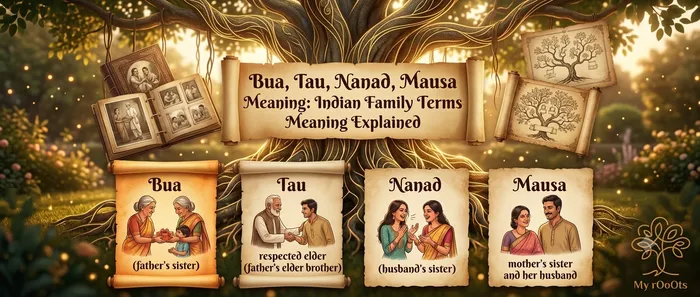
You can begin creating such a record for free, with no sign-up required, at the My rOoOts create-tree page. The family tree generator offers a quick way to start with a few known names, while the ancestor timeline generator helps visualize how far back different branches reach. A relationship calculator can clarify kinship terms when relatives from different cultural backgrounds join the same tree.
Why a Living Family Archive Matters
American family histories are often fragmented by distance, language shifts, and the passage of time. A private, shareable digital tree helps counteract that fragmentation. It turns abstract ancestry percentages into a concrete record that children and grandchildren can explore. It also creates a place where DNA insights, documentary research, and living memory can sit side by side.
Whether your background is primarily European, African American, Hispanic, Asian American, Native American, or a blend of several traditions, the process of mapping your family’s story remains the same: gather what you know, invite relatives to fill gaps, and preserve the result in a form that future generations can understand and expand.
Conclusion
The ancestry of modern Americans is the product of Indigenous foundations, European colonization and immigration, the African diaspora, and successive waves of arrivals from Asia and beyond. DNA tests make the broad genetic layers visible, but only careful genealogical work and a well-maintained family tree can turn those layers into named people, specific places, and living family narratives.
By combining genetic insights with a clear digital family archive, Americans of every background can create a richer, more accurate, and more shareable record of where they come from. Starting that record is simple, and the reward is a family story that becomes clearer and more complete with every relative who contributes.
Create Your Family Tree for Free
Start building your family history in minutes with the My rOoOts Free Family Tree Creator. Add parents, grandparents, children, and relatives, organize generations visually, and create a beautiful family tree that you can save and share.
👉 Create your free family tree: Free Family Tree Creator
No design skills required. Simply enter your family details and generate a clear, easy-to-read family tree online for free.
Check Zodiac Compatibility for Any Two People
Curious about how well two people match based on their date of birth? Try the My rOoOts Zodiac Compatibility Tool to compare zodiac signs, explore relationship compatibility, and get a quick compatibility score for couples, friends, or family members.
👉 Check compatibility now: Zodiac Compatibility Calculator
You can enter two dates of birth and even mention the relationship type to get a more personalized compatibility result.
Download a Free Family Tree Template
Want to draw your family tree yourself? The My rOoOts Family Tree Template provides a free printable blank pedigree chart for documenting your family history across multiple generations.
👉 Download a free family tree template: Family Tree Template
Choose a 3-generation, 4-generation, or 5-generation family tree template and save it as a PDF for printing, writing, and documenting your ancestors.
Discover the Meaning and Origin of Your Surname
Ever wondered where your family name came from? Use the My rOoOts Surname Meaning Lookup to explore surname meanings, origins, history, and etymology from different regions and cultures around the world.
👉 Discover your surname meaning: Surname Meaning Lookup
Learn more about your last name and explore the possible linguistic, geographic, cultural, and historical roots behind your family surname.
Start your family tree free
No account needed to begin. Build it in minutes, then save it whenever you're ready.
Build your family tree