What Is Steppe Ancestry? A Beginner’s Guide for Europeans
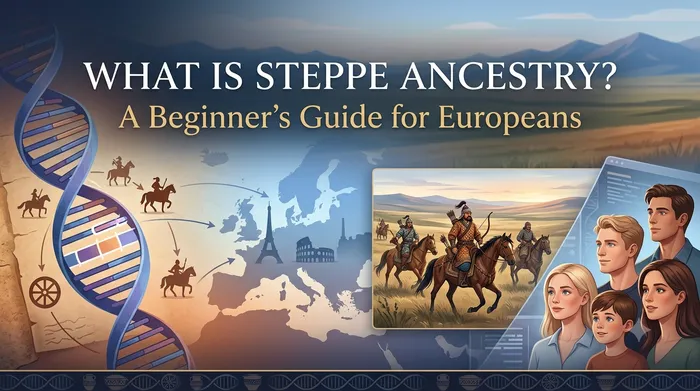
If you have taken a DNA test and seen terms like “Steppe,” “Yamnaya-related,” or simply high percentages of Northern or Eastern European ancestry, you have encountered one of the most important genetic chapters in European history. Steppe ancestry refers to the genetic contribution that arrived in Europe during the Bronze Age from pastoralist populations living on the vast grasslands north of the Black and Caspian Seas. This guide explains the concept in plain language for anyone curious about their European roots.
The Simple Definition
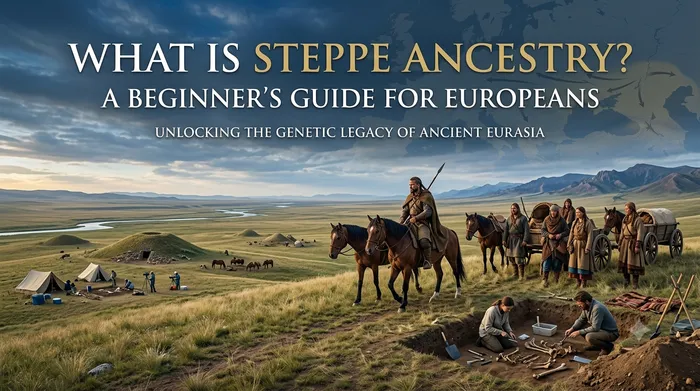
Steppe ancestry (also called Western Steppe Herder or Yamnaya-related ancestry) is the genetic signature left by people who lived on the Pontic-Caspian steppe around 5,000 years ago. These groups mixed earlier hunter-gatherer populations from Eastern Europe with people related to Caucasus hunter-gatherers. When their descendants moved west into Europe, they carried this distinctive genetic profile with them.
Today nearly every European population carries some amount of this ancestry, though the percentage varies widely by region. It is one of the three major ancestral components that make up the genetic makeup of most modern Europeans, alongside Western Hunter-Gatherer and Early European Farmer ancestry.
Who Were the People Behind Steppe Ancestry?
The best-known archaeological culture linked to this genetic profile is the Yamnaya (or Yamna) culture, which flourished roughly between 3300 and 2600 BCE. Yamnaya communities were mobile herders who raised cattle, sheep, and horses. They used wheeled wagons, buried their dead under earthen mounds called kurgans, and left a material culture that spread rapidly across large distances.
Genetically, Yamnaya individuals were not a pure or isolated group. They formed through the mixing of:
- Eastern Hunter-Gatherers (people already living on the steppe and forest-steppe)
- Caucasus Hunter-Gatherers (populations from the region between the Black and Caspian Seas)
Later groups such as the Corded Ware culture in Central and Northern Europe and the Bell Beaker culture farther west carried high levels of this same ancestry after further mixing with local European populations.
How Steppe Ancestry Entered Europe
Around 3000–2500 BCE, people carrying high levels of Steppe ancestry moved into Central and Northern Europe. Ancient DNA studies show that in many regions this was not a small trickle of migrants. In parts of Germany and the Baltic region, early Corded Ware individuals often derived 70 percent or more of their ancestry from Steppe sources. In Britain the genetic turnover associated with the arrival of Beaker-related groups was especially dramatic.
The migration was likely male-biased in many areas. Y-chromosome lineages common among Steppe males (particularly branches of haplogroup R1b in the west and R1a farther east) became widespread, while maternal lineages show more continuity with earlier European populations.
Over subsequent centuries the Steppe signal mixed with the existing farmer and hunter-gatherer populations of Europe. By the later Bronze Age and Iron Age the proportions had stabilized into the regional patterns we still see today.
How Much Steppe Ancestry Do Modern Europeans Carry?
There is no single number that applies to all Europeans. Broad patterns include:
- Highest levels: Ireland, Iceland, Norway, Sweden, and parts of the Baltic region
- High levels: Britain, the Netherlands, Germany, Poland, and much of Eastern Europe
- Moderate levels: France, Central Europe, and parts of the Balkans
- Lower levels: Southern Italy, Iberia, Greece, and especially Sardinia
These differences reflect both the intensity of the original Bronze Age migrations and later population movements. People with deep roots in Northern and Northwestern Europe often carry 40–50 percent or more Steppe-related ancestry, while those from the Mediterranean typically carry less.
What Steppe Ancestry Is Not
It is easy to misunderstand the term. Steppe ancestry does not mean:
- Your recent ancestors came from the Russian steppe
- You belong to a single “race” or pure lineage
- Everyone with the same percentage shares the same family history
Instead it is an average genetic contribution that has been reshuffled through thousands of years of local marriages, migrations, and demographic change. Two people with similar overall Steppe percentages can have completely different family stories in the last 500 years.
How DNA Tests Report Steppe Ancestry
Most consumer DNA tests do not list “Steppe” or “Yamnaya” as a separate ethnicity category. The signal is folded into broader modern labels such as Northwestern European, Eastern European, British & Irish, or Scandinavian. Companies use ancient DNA reference samples behind the scenes to improve their models, but the reports you see are calibrated against living populations.
Some advanced tools and third-party analyzers can estimate Steppe percentages more directly by comparing your data to published ancient genomes. Even without those tools, a high percentage of Northern or Eastern European ancestry is usually a strong indicator that a substantial Steppe component is present.
Why This Matters for Family History
Understanding Steppe ancestry adds depth to the story told by a DNA test. It connects the percentages on a report to real historical processes: the spread of new languages, new burial practices, new technologies, and new social patterns across Europe.
At the same time, DNA alone cannot name the specific ancestors who carried that signal into your family line. That is where traditional genealogy and a carefully built family tree become essential. Mapping names, places, and relationships across generations helps you see which branches of your tree are most likely to have transmitted particular genetic components.
Visual tools make the connection clearer. An ancestor timeline generator can place estimated generational spans against the broad timeline of Steppe migrations. A full family tree lets you attach DNA insights, photos, and family stories to actual people so the ancient genetic signal sits alongside the recent family narrative.
Building Context Around Your Results
Once you understand the broad meaning of Steppe ancestry, the next step is usually practical:
- Review your DNA matches and see whether certain family branches share more of the relevant segments
- Record the paper trail for those branches as completely as possible
- Preserve oral histories and photographs that may otherwise be lost
- Share a private tree with relatives so they can add missing names and details
Platforms designed for multi-generational families make this process easier. My rOoOts offers an intuitive way to create a beautiful, interactive family tree that supports large numbers of relatives, rich member profiles, and controlled sharing. You can start building for free with no account required at the family tree generator or the main create-tree page.
A relationship calculator can also help clarify kinship terms across different European and South Asian traditions, which is useful when relatives from different cultural backgrounds contribute to the same tree.
Conclusion
Steppe ancestry is the genetic legacy of Bronze Age pastoralists from the Pontic-Caspian grasslands who moved into Europe roughly 5,000 years ago. It forms one of the three main pillars of modern European genetic makeup and appears today as elevated Northern and Eastern European components in most DNA tests.
For beginners, the key takeaway is simple: the percentages on a DNA report reflect deep historical migrations, not recent family origins. Combining that genetic insight with careful genealogical research and a living digital family tree turns abstract ancestry into a concrete, shareable family story. Whether you are just starting to explore your European roots or already managing a large multi-generational record, understanding Steppe ancestry adds a richer layer of meaning to the people and places that make up your family’s past.
Create Your Family Tree for Free
Start building your family history in minutes with the My rOoOts Free Family Tree Creator. Add parents, grandparents, children, and relatives, organize generations visually, and create a beautiful family tree that you can save and share.
👉 Create your free family tree: Free Family Tree Creator
No design skills required. Simply enter your family details and generate a clear, easy-to-read family tree online for free.
Check Zodiac Compatibility for Any Two People
Curious about how well two people match based on their date of birth? Try the My rOoOts Zodiac Compatibility Tool to compare zodiac signs, explore relationship compatibility, and get a quick compatibility score for couples, friends, or family members.
👉 Check compatibility now: Zodiac Compatibility Calculator
You can enter two dates of birth and even mention the relationship type to get a more personalized compatibility result.
Download a Free Family Tree Template
Want to draw your family tree yourself? The My rOoOts Family Tree Template provides a free printable blank pedigree chart for documenting your family history across multiple generations.
👉 Download a free family tree template: Family Tree Template
Choose a 3-generation, 4-generation, or 5-generation family tree template and save it as a PDF for printing, writing, and documenting your ancestors.
Discover the Meaning and Origin of Your Surname
Ever wondered where your family name came from? Use the My rOoOts Surname Meaning Lookup to explore surname meanings, origins, history, and etymology from different regions and cultures around the world.
👉 Discover your surname meaning: Surname Meaning Lookup
Learn more about your last name and explore the possible linguistic, geographic, cultural, and historical roots behind your family surname.
Start your family tree free
No account needed to begin. Build it in minutes, then save it whenever you're ready.
Build your family tree